
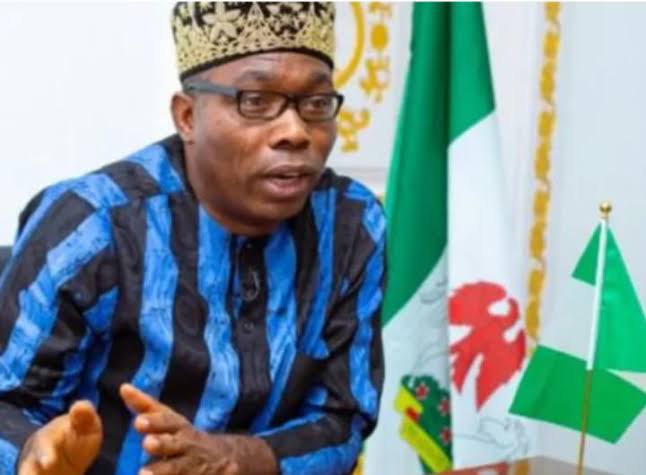
The Social Democratic Party presidential candidate, Prince Adewole Adebayo, has dismissed the Federal Government’s 30-day petrol discount as a chaotic and legally hollow intervention, comparing the announcement to the 1990s television comedy series Fuji House of Commotion and questioning whether it amounts to any coherent policy at all.
Speaking on Channels Television’s Politics Today on Thursday, hours after the Finance Minister and Coordinating Minister of the Economy, Taiwo Oyedele, unveiled the measure in Abuja, Adebayo said he could not determine whether the discount was a formal policy or a political gesture because no implementing framework had been disclosed. “I saw the visual and heard of the policy or statement; I don’t know. There is no plan behind it, so I cannot know whether it is a policy or a gesture, but it immediately reminds me of a series on television in the 90s called Fuji House of Commotion,” he said. “One thing they are presenting is Tinubu’s house of commotion. It does not make any sense in any way.”
Adebayo raised three specific objections. First, he noted that no representative of the Nigerian National Petroleum Company Limited was present at the announcement, despite the company being the designated implementing agency. Second, he said no dedicated account exists at the Ministry of Finance to handle petroleum discount subsidies, raising questions about how the intervention would be funded and accounted for. Third, he argued that the government had cited no law authorising the arrangement, pointing out that the Petroleum Industry Act 2021 expressly provides for market-determined pricing. “One month is not short term; it is not medium term; it is not long term; it is a flash in the moment,” he said. “So, long and short, it looks to me like the government is genuinely now and sincerely confused because they have created problems for themselves.”
The Trade Union Congress President, Festus Osifo, who appeared on the same programme, framed the intervention differently. He argued that any cap on petrol pricing, regardless of terminology, constitutes a subsidy. “Whenever you cap the price of any product, whether that cap will be high or that cap will be low, it is a subsidy in one form or the other,” Osifo said.
The Federal Government’s position, articulated by Oyedele, is that the arrangement is not a subsidy but a temporary forgoing of NNPCL’s retail profit margin. Under the plan, NNPCL retail outlets will sell petrol at landing cost for 30 days, with priority given to public transport operators nationwide. Oyedele also disclosed that the government is negotiating a ₦1,350 per litre ceiling on the ex-gantry or landing cost of petrol to reduce volatility. “Pump prices should not have to follow every swing in global crude or the exchange rate,” he said. The Presidency subsequently issued a statement confirming that President Bola Tinubu had approved the measure.
The discount follows a series of price reductions in late September and early October 2026. The Dangote Petroleum Refinery reduced its gantry price by ₦25 to ₦1,325 per litre, prompting NNPCL to lower its pump price from ₦1,395 to ₦1,370 per litre in Abuja and its environs. MRS filling stations had earlier adjusted to ₦1,370 per litre. The latest reported NNPCL prices put petrol at ₦1,355 per litre in Lagos and Rivers State, and ₦1,370 in Abuja.
Data from the National Bureau of Statistics shows that the removal of the petrol subsidy on May 29, 2023 triggered a sustained increase in transport costs. Intra-city bus fares rose by 38.63 per cent year-on-year to ₦1,431.25 in May 2026, up from ₦1,032.46 in May 2025. Intercity bus fares increased by 17.95 per cent to ₦9,564.12 in March 2026. Between 2023 and 2024, the NBS recorded a 77 per cent increase in fares, a trend that SBM Intelligence has attributed directly to the subsidy removal.
The fiscal picture is equally complex. NNPCL’s 2025 financial statements show ₦11.2 trillion in receivables from the Federation for costs and advances incurred on behalf of the government, a 27 per cent increase from ₦8.84 trillion a year earlier. This figure is more than double the ₦5.4 trillion projected for petrol subsidy payments in 2024. NNPC reported a profit after tax of ₦7.2 trillion for 2025 and declared a ₦5.8 trillion dividend, underscoring the competing commercial and policy demands placed on the company.
The broader political context is the 2027 general election. The discount has drawn criticism from multiple opposition figures, including former Vice President Atiku Abubakar, who described it as a “panic-driven publicity stunt,” and the Makinde/Daura Presidential Campaign Organisation, which called the reported ₦60 reduction insufficient. Adebayo’s intervention adds a distinct legal and structural critique to that chorus. Whether the 30-day discount will be extended, and whether it will translate into lower transport fares for commuters, remains unconfirmed.