
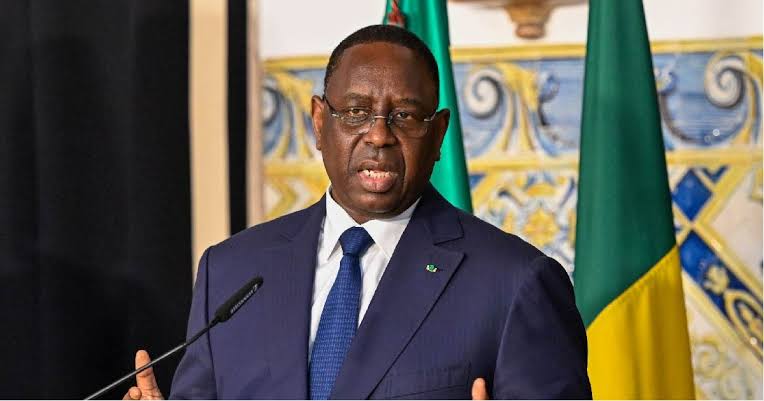
Former Senegalese President Macky Sall has pulled out of the race to become the next United Nations Secretary General, a day after an informal Security Council poll left every remaining candidate facing opposition from at least one veto-holding power. Sall announced his decision on Saturday, October 17, in a statement issued from Marrakech, Morocco, and shared on his social media pages. His exit cuts the field to six and leaves Uganda’s Olara Otunnu as the only African still in contention.
Sall said he took the decision after the straw poll of October 16 and following consultations with Burundian President Evariste Ndayishimiye, who chairs the African Union, and Senegalese President Bassirou Diomaye Faye, the current ECOWAS chairman. He said he hoped his withdrawal would help a consensus candidate emerge within the Security Council. According to the former president, the results of the test votes since the start of the process have pointed to a preference for a candidate from Latin America and the Caribbean, possibly a woman.
The October 16 vote was the sixth informal poll since the Council began the selection in July. Members of the 15-nation body mark each candidate “encourage”, “discourage” or “no opinion” in secret. A UN diplomat said on Friday that all seven hopefuls received at least one “discourage” vote from a permanent member, which is effectively a veto. Costa Rica’s Rebeca Grynspan drew the most “encourage” votes, but she also received five “discourage” votes, two of them from permanent members.
Sall’s campaign had struggled from the first round. In the July poll, he secured six “encourage” votes against seven “discourage” and two “no opinion”. His bid was also clouded at home from the outset. Burundi, holding the rotating AU chairmanship, nominated him on March 2, 2026, but the Senegalese government said at the time that Dakar was not involved in the process.
The tension was rooted in Senegalese politics. The administration of Faye and Prime Minister Ousmane Sonko has accused Sall’s government of concealing the true scale of the country’s public debt, and an International Monetary Fund review later confirmed inaccuracies in reported deficit and debt figures over several years. Sall, who governed Senegal from 2012 to 2024, has denied wrongdoing. Faye reversed course in July and endorsed the bid, directing his government to mobilise support for what he described as Senegal’s candidacy in the service of Africa.
Sall is the second former head of state to quit the contest in a month. Chile’s Michelle Bachelet withdrew on September 20, a day after the third straw poll, in which she recorded one “encourage”, 11 “discourage” and three “no opinion” votes. Her campaign had weakened after Chile’s new government under President José Antonio Kast withdrew its backing in March.
The six candidates left are Grynspan, who heads the UN Conference on Trade and Development; Guyana’s former foreign minister Carolyn Rodrigues-Birkett; Argentina’s Rafael Grossi, Director General of the International Atomic Energy Agency; Ecuador’s Ivonne A-Baki and María Fernanda Espinosa; and Otunnu. Four of the six are from Latin America and the Caribbean. Diplomats have also named Nickolay Mladenov, the UAE’s Minister of State Lana Nusseibeh and OSCE Secretary General Feridun Hadi Sinirlioglu as possible late entrants, though none has formally declared.
Otunnu has a curious link to the process now deciding his fate. The straw poll system was introduced in 1981 by Otunnu himself while he served as Uganda’s Permanent Representative to the UN. Since then, every Secretary General has emerged through these closed-door rounds.
To win, a candidate needs at least nine of the 15 Council votes and no veto from China, France, Russia, the United Kingdom or the United States. The Council then recommends one name to the 193-member General Assembly, whose approval has traditionally been a formality. The new Secretary General will begin a five-year term on January 1, 2027, after António Guterres of Portugal completes his second term on December 31.
History explains the regional argument Sall referred to. Of the nine men who have led the UN in its 80 years, only one, Peru’s Javier Pérez de Cuéllar, came from Latin America, serving from 1982 to 1991. Africa has produced two, Egypt’s Boutros Boutros-Ghali and Ghana’s Kofi Annan, and no woman has ever held the post. A “discourage” vote early in the process has not always proved fatal, however, as Annan overcame initial French opposition before his selection in 1996.
For Nigeria, the outcome also carries a direct interest. Nigerian Amina Mohammed has served as Deputy Secretary General under Guterres since 2017, and the incoming chief will choose a new leadership team. With six names still standing and no candidate yet free of a veto threat, further rounds of polling are expected before the Council settles on a nominee.