
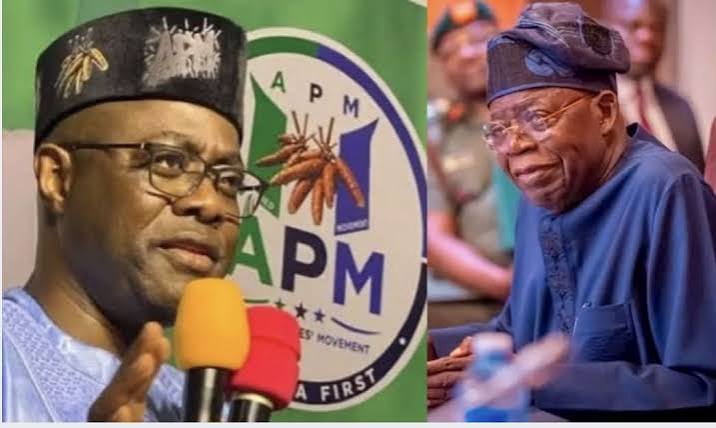
The Allied Peoples’ Movement has accused President Bola Tinubu of trading insults instead of confronting Nigeria’s economic pain, after he mocked the party during an All Progressives Congress rally at Mapo Hall in Ibadan at the weekend. The party, whose presidential candidate is Oyo State Governor Seyi Makinde, said what Nigerians wanted was relief from hardship, not political grandstanding.
The quarrel began on Saturday when Tinubu, addressing supporters in Ibadan, deployed the Yoruba expression “Egbé Palemo” in a swipe at the opposition platform. In a statement by its director of communication and campaign council spokesperson, Yinka Oladoyinbo, the APM read the phrase as the language of a government quietly preparing to pack up and leave, and said such vocabulary came a little too readily to the President.
Oladoyinbo argued that voters were far more troubled by the cost of living, shrinking incomes, insecurity and unemployment than by taunts from a campaign podium. He said a president seeking a fresh mandate should be explaining what he did with his first term rather than exchanging jibes with opponents, and he called for an apology over the hardship households have endured since 2023.
The exchange lands as the race tightens. The Independent National Electoral Commission has fixed the presidential and National Assembly elections for 16 January 2027, brought forward from an earlier 20 February date after complaints that it clashed with Ramadan, under the new Electoral Act 2026. Governorship and state assembly polls follow on 6 February. The earlier timetable leaves the parties a shorter runway and has sharpened campaigning across the South West, a zone that voted heavily for Tinubu in 2023.
Makinde, elected governor on the Peoples Democratic Party ticket in 2019 and again in 2023, emerged as the APM candidate in May 2026 and has built his campaign around security, fuel prices and food under a “Reset Nigeria” message. His bid rests on a PDP and APM alliance, with Bauchi Governor Bala Mohammed among the party’s senatorial candidates, positioning the platform within a broader opposition effort to deny Tinubu a second term.
Much of the APM’s statement took aim at the appearance of traditional rulers at partisan events. The party warned that the presence of monarchs such as the Olubadan of Ibadanland, Oba Rashidi Ladoja, and the Soun of Ogbomoso, Oba Ghandi Olaoye, should not be read as political endorsements. Royal courtesies, it said, cannot stand in for public approval, insisting that a royal handshake does not constitute a ballot.
The APC in Oyo has projected confidence, casting Ibadan as its stronghold and recalling the state’s strong turnout for Tinubu in the last election. A number of Southwest monarchs and party figures have also publicly backed the President’s re-election and his economic reforms, including the removal of fuel subsidy, which the government insists was painful but necessary to stabilise the economy.
For now, the contest in Oyo is as much about tone as policy. The APM says voters will deliver their verdict on living standards at the polls, while the APC is betting that its organisation and its grip on the South West will carry the President through. With less than two months to the vote, both camps are framing the same question in sharply different terms: whether Nigerians feel better off than they did in 2023.