
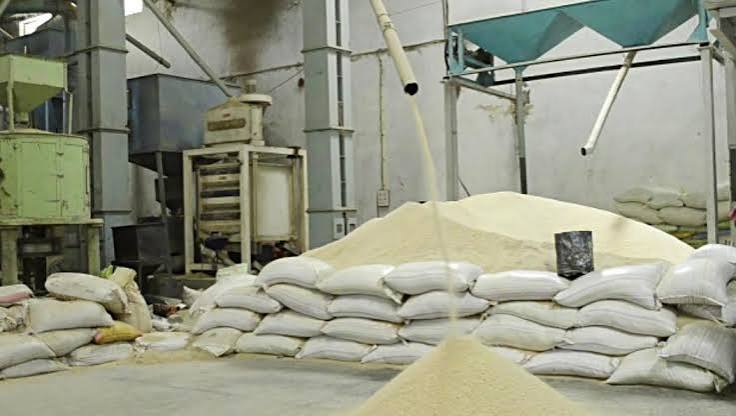
Nigeria’s decade-long push for rice self-sufficiency is unravelling. More than 90 of the country’s estimated 260 integrated rice mills have shut down completely, according to industry operators, who blame a severe shortage of locally grown paddy, rising production costs and a flood of cheaper imported rice.
The collapse comes just as the National Rice Development Strategy II, adopted in 2021 to accelerate investment and self-sufficiency, winds down, closing a chapter that was meant to end decades of dependence on food imports and conserve scarce foreign exchange.
The scale of the reversal sits in the numbers. Paddy output climbed to about 8.5 million tonnes in 2021 but has since fallen to roughly 4.8 million tonnes, with many plants running below 30 per cent of capacity, operators say. Even large mills such as Umza in Kano and Stallion in Lagos are working at less than half their installed capacity.
That is a sharp turn from February 2023, when the government announced 75 per cent self-sufficiency and projected that Nigeria would become a net exporter by 2026. The ambition was dramatised when the authorities unveiled rice pyramids of one million bags of paddy in Abuja, presented as proof of a maturing local industry. The country’s rice import bill, put at about $1 billion in 2015, was said to have dropped to roughly $18.5 million by 2021.
A senior official of the Federal Ministry of Agriculture, who asked not to be named, put current self-sufficiency at 69 per cent and pointed to policy inconsistency as the central problem. He said a growing population, rural to urban migration and changing diets had pushed demand beyond what local output could meet, leaving Nigeria both the continent’s largest producer and its largest importer of rice.
At the heart of the crisis, operators argue, is the end of the Anchor Borrowers’ Programme. Launched by the Central Bank in 2015, the scheme gave smallholders seeds, fertiliser and herbicides on credit at about nine per cent interest, well below commercial rates near 28 per cent, with repayment made in paddy after harvest. Between 2015 and 2021 it helped lift paddy output and cut official imports sharply.
The programme was dogged by allegations of politicisation and weak loan recovery. More than N1.1 trillion was reportedly disbursed, yet repayment is said to have fallen below 30 per cent. A new Central Bank leadership scrapped it in 2023 without a ready replacement, leaving a financing gap that the Bank of Agriculture and the ministry’s dry-season schemes have not filled. Peter Dama, who chairs the Rice Millers Association of Nigeria, estimates that over 40 per cent of farmers who took part have since switched to crops such as sesame and sorghum.
Costs have made local rice uncompetitive. A tonne of paddy that sold for about N180,000 in 2021 now goes for between N600,000 and N650,000, while fertiliser has jumped from roughly N8,000 to N45,000 a bag and petrol from N250 to about N1,400 a litre, operators say. The ministry official tied the fertiliser spike to the end of the Presidential Fertiliser Initiative and to higher global prices worsened by tension in the Middle East.
Dama says locally milled rice now costs more than imported grain cleared through Lagos ports, a gap he insists cannot be closed by import bans alone. He alleges that more than 2.5 million tonnes of foreign rice entered through Benin Republic’s Cotonou port and porous land borders in 2026, with a 50kg bag of imported rice selling for N52,000 to N60,000 against N75,000 to N80,000 for local rice. He also claims some lower-grade imports are repackaged and sold as Nigerian rice in Lagos, Abuja, Kano and Ibadan, an allegation that, if proven, would point to a serious enforcement failure.
He attributes much of the smuggling to a wide tariff gap with Benin and urged enforcement of the ECOWAS Rice Roadmap 2025 to 2035, which sets a common external tariff of 35 per cent for paddy and 50 per cent for milled rice across member states.
The strain reaches well beyond mill owners. In Kebbi, Hadiza Kola, who heads the state’s female farmers’ association, said the loss of affordable credit had hit women hardest, deepening social barriers that already limit their access to land. In the South East, state-backed mills in Ebonyi once branded EbonyRice have fallen silent, with a former worker saying they could never source enough paddy to run.
Dama maintains the answer is not to revive the old scheme wholesale, but to fix its flaws and build a credible financing and input-support system before more capacity is lost.