
By N’Mazi Obiomah O. Igbokwe
Charles Dickens, in his celebrated novel A Tale of Two Cities, opened with one of the most memorable paradoxes in English Literature: “It was the best of times, it was the worst of times.” In that extraordinary description of a society torn between prosperity and deprivation, hope and despair, privilege and suffering, Dickens captured the contradictions of an age where human existence could only be understood through the superlative degree of comparison.
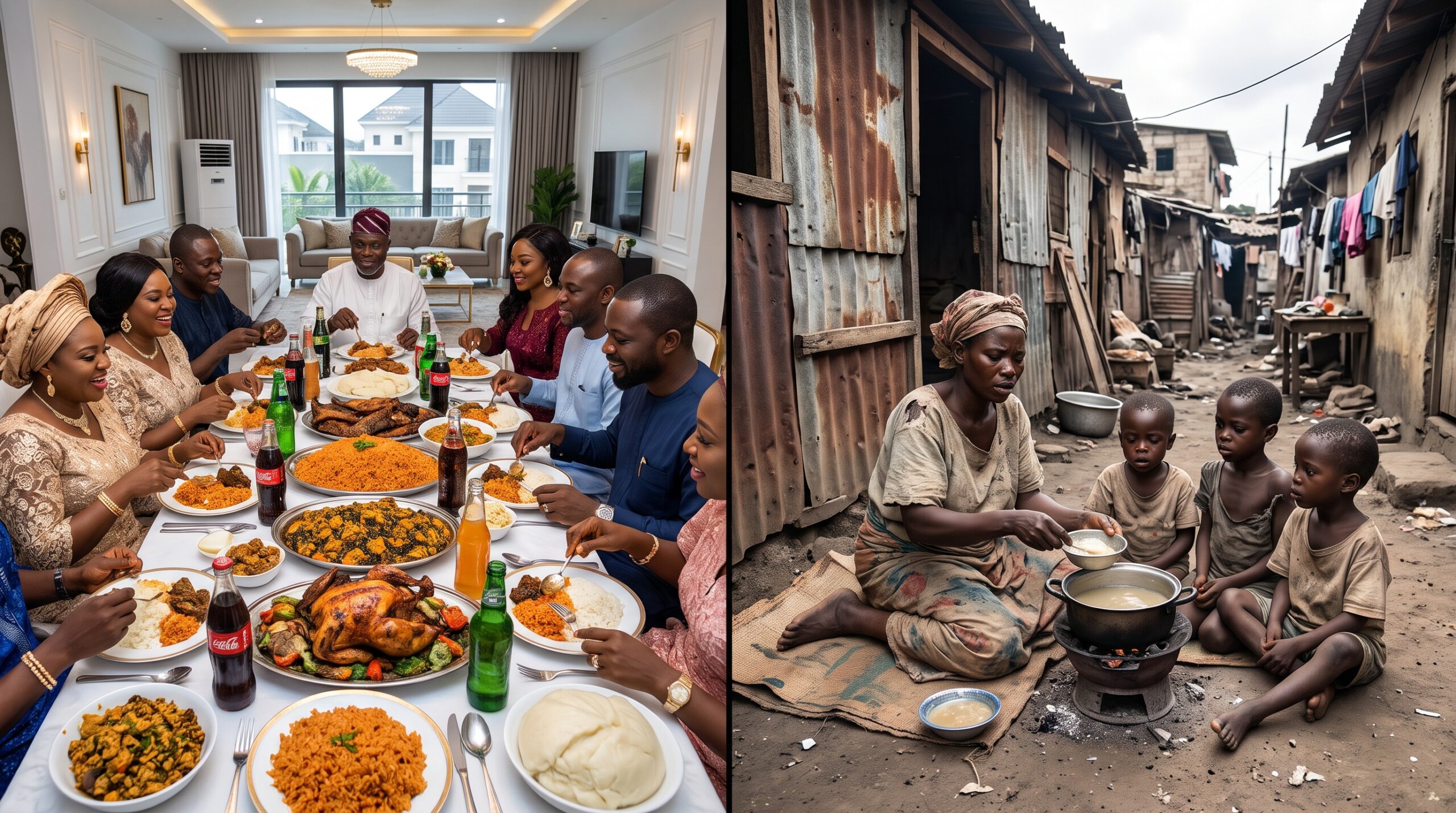
More than a century and a half later, Nigeria presents a similarly troubling picture. It is a country of immense natural wealth and extraordinary human potential, yet millions of its citizens struggle to secure the most fundamental requirement of life: adequate and nutritious food. Here, one Nigeria eats to excess while another goes to bed hungry. One Nigeria debates investment opportunities, luxury lifestyles and the accumulation of wealth, while another wonders where the next meal will come from.
Indeed, if Dickens were alive today, he might find in Nigeria a compelling sequel to his famous novel: A Tale of Two Nigerias.
One Nigeria is populated by the privileged, whose tables are laden with food and whose economic circumstances overshadow rising prices. The other Nigeria exists in overcrowded urban settlements, rural communities, internally displaced persons’ camps and households where parents routinely sacrifice their own meals so that their children might eat. In this second Nigeria, hunger is not a literary metaphor. It is a daily reality, and malnutrition is its cruellest expression.
The tragedy beyond an empty stomach
Malnutrition is often misunderstood as the absence of food. In reality, it is a more complex and devastating condition involving deficiencies, excesses or imbalances in energy and essential nutrients. A child may eat every day and still be malnourished if the diet lacks the proteins, vitamins and minerals for healthy growth and development.
This distinction is important in understanding Nigeria’s nutritional crisis. The challenge is not merely whether food is available, but whether families can afford sufficient quantities of safe, diverse and nutritious food.
Children who suffer from chronic malnutrition may experience stunted growth, weakened immunity, impaired cognitive development and diminished educational prospects. Severe acute malnutrition can become life-threatening without timely treatment. Pregnant women facing nutritional deficiencies risk complications that can affect both mother and child. The consequences extend beyond individual households into the national economy, weakening productivity and perpetuating poverty across generations.
A hungry child cannot concentrate effectively in the classroom. A malnourished adolescent may struggle to achieve their full potential. A workforce weakened by inadequate nutrition cannot contribute optimally to national development. Thus, malnutrition is not simply a humanitarian emergency; it is an assault on Nigeria’s future.
A country that produces hunger
Nigeria’s predicament is particularly painful because the country possesses considerable agricultural potential. From the fertile lands of the Middle Belt to the agricultural communities of the South East and South South, from the rice fields of the North to the fisheries and livestock resources distributed across the federation, the foundations for greater food security exist.
Yet agricultural potential does not automatically translate into affordable food on the family table.
Insecurity has disrupted farming and displaced farming communities in several parts of the country. Farmers face rising production costs, expensive fertilisers, inadequate storage facilities, poor rural roads and limited access to affordable credit. Post-harvest losses further reduce the food that reaches consumers. Transportation costs, inflation and exchange rate pressures have also contributed to the unaffordability of many essential food items.
The result is a cruel contradiction; food may exist in the marketplace, yet remain beyond the reach of those who need it most.
For households whose incomes have failed to keep pace with the rising cost of living, nutritious meals are increasingly replaced by cheaper, less diverse diets. Some families reduce portion sizes; others skip meals altogether. The poor are forced to make impossible choices between food, school fees, healthcare, rent and transportation.
When survival becomes the only objective, nutrition is often the first casualty.
The failure of priorities
The question Nigeria must confront is whether its development priorities reflect the urgency of this crisis.
Government interventions aimed at agricultural production, food distribution and social protection deserve attention, and their success must be measured by tangible improvements in the lives of Nigerians. Announcements, budgetary allocations and policy documents cannot fill an empty stomach unless they translate into affordable food, reliable incomes and accessible nutrition services.
Federal, state, and local governments must therefore treat malnutrition as a national emergency requiring coordinated and measurable action.
First, agricultural investment must go beyond distribution of seedlings and fertilisers. It must include rural infrastructure, irrigation, storage, processing, extension services and access to affordable financing. Farmers must be protected from violence and enabled to cultivate their land safely.
Second, nutrition programmes should prioritise pregnant women, nursing mothers and children during the critical first 1,000 days from conception to a child’s second birthday. Community health centres need the personnel, equipment and supplies to identify and treat malnutrition early. School feeding programmes should provide nutritious meals and be transparently managed.
Third, social protection must reach vulnerable households through properly targeted cash transfers and other support mechanisms. Food assistance should be strengthened in communities affected by conflict, displacement and extreme poverty.
Finally, public accountability is essential. Government must publish credible nutrition indicators, monitor programme outcomes and ensure that funds allocated to food security reach their intended beneficiaries.
The private sector, religious organisations, civil society and community leaders also have important roles. Food manufacturers can support responsible fortification and affordable nutritious products, while businesses and farmers can collaborate to reduce waste and improve local food supply chains.
Charity alone, however, cannot substitute for sound public policy.
The moral question before Nigeria
Ultimately, the tragedy of malnutrition forces us to confront a question more profound than agricultural productivity or economic growth; what is the value of national prosperity when millions cannot afford to eat adequately?
A nation cannot credibly celebrate economic progress while its children suffer preventable nutritional deficiencies. Gross domestic product figures, investment announcements and expanding fortunes tell only part of the story. The true measure of development must include whether ordinary citizens can live with dignity, whether mothers can nourish their children and whether a child’s future is determined by opportunity rather than the accident of birth.
Dickens wrote of a society approaching a moment of profound transformation. His world was divided by inequalities that could no longer be concealed beneath the language of civilisation and progress. Nigeria, too, stands at a crossroads where economic hardship and social inequality demand more than political rhetoric.
There must not be two standards of citizenship: one for those who can afford three nutritious meals a day and another for those who survive on whatever they can find. There must not be one future for children born into privilege and another for children whose development is compromised by hunger before they can even speak.
The tragedy of Nigeria is not simply that some citizens have too little while others possess so much. It is that a country blessed with human talent, agricultural resources and enormous economic possibilities struggles to guarantee adequate nutrition for its most vulnerable people.
the final analysis, the tale of two Nigerias is a test of leadership, compassion and national conscience. Government is not merely how much wealth it generates, but how effectively that wealth transforms human wellbeing.
Until hunger stops determining the destiny of millions of Nigerian children, the promise of national development will remain incomplete.
Until every Nigerian child has a fair chance to grow, learn and thrive, we shall continue to live in Dickensian times: the best of times for a fortunate few, the worst of times for far too many.