
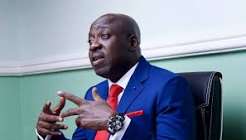
The African Democratic Congress has spent more of its first two years fighting court cases than campaigning or building its structures, the party’s National Publicity Secretary, Bolaji Abdullahi, has admitted, in a candid assessment of the legal turbulence that has trailed Nigeria’s main opposition coalition since 2025.
Speaking on Arise Television on Thursday, Abdullahi said the ADC had been buried under what he called an avalanche of litigation, to the point where the courtroom, rather than the campaign ground, had become the party’s main battlefield. He insisted the coalition had still grown into a formidable opposition platform, arguing that the very fact its name now dominates political conversation was itself a measure of how far it had come.
His remarks land barely a week after the heaviest legal blow the coalition has absorbed. On 5 November, the Federal High Court in Abuja, presided over by Justice Peter Lifu, declared the David Mark-led caretaker leadership of the ADC illegal and nullified the decisions taken under it, including the process that produced former Vice President Atiku Abubakar as the party’s candidate for the 16 January 2027 presidential election. The nomination of his running mate, former Transportation Minister Rotimi Amaechi, and that of former Osun State Governor Rauf Aregbesola as National Secretary, were caught in the same judgment.
The court acted on a suit filed by Nafiu Bala Gombe, a former National Deputy Chairman of the party, who argued that Mark and his colleagues never emerged through a proper national convention and therefore held office unlawfully. Gombe had gone to court in September 2025, months after the resignation of the party’s former National Chairman, Ralph Nwosu, opened the way for the Mark-led caretaker committee. Justice Lifu also threw out 27 preliminary motions filed by Mark, Aregbesola and the party, describing them as frivolous.
The ADC has rejected the ruling and is heading to the Court of Appeal. Its position rests on an earlier judgment delivered on 2 July by another Federal High Court judge, Justice Musa Liman, which affirmed the Mark leadership. The party’s lawyers contend that one High Court cannot sit in appeal over a subsisting decision of a court of equal standing, a principle they say renders the latest verdict an academic exercise. A member of its legal team, Kalu Kalu, went further, arguing that the judgment did not in express terms cancel Atiku’s nomination, and that commentators were reading into it conclusions its orders do not contain.
Atiku himself has cast the decision in starkly political terms, describing it as a calculated effort to erode his support in the North and frustrate his ambition, and accusing the ruling All Progressives Congress of moving to destabilise the opposition. Abdullahi struck the same note, suggesting the run of cases was designed to clear the field so that President Bola Tinubu would face no serious challenger in 2027, and questioning why some judges were, in his words, making themselves available for such purposes. The APC and the presidency have consistently denied any role in the party’s legal troubles.
Whatever its origin, the litigation has been relentless. Before the November judgment, Justice Lifu had in a separate suit ordered the Independent National Electoral Commission to begin deregistering the ADC and four other parties, a ruling the Court of Appeal later set aside. The commission had earlier stripped Mark and Aregbesola from its portal in April, while rival camps led by Gombe and by businessman Dumebi Kachikwu have each laid claim to the party’s structures, leaving the coalition without a leadership universally recognised by the electoral umpire. A further suit by Atiku and the ADC challenging Tinubu’s eligibility to contest, over an alleged discrepancy in his National Youth Service Corps records, is itself due for a ruling on an amendment application on 20 November.
The timing could hardly be sharper. The presidential election is set for 16 January 2027, little more than ten weeks away, and INEC was expected to weigh the implications of the November ruling at its own meeting this month. For a coalition assembled with real fanfare in 2025, uniting figures who between them have contested or shaped every recent presidential race, the threat is no longer obscurity but exhaustion. Abdullahi’s own words capture the bind: a party that set out to offer Nigerians an alternative has found much of its energy consumed not by voters, but by judges.