
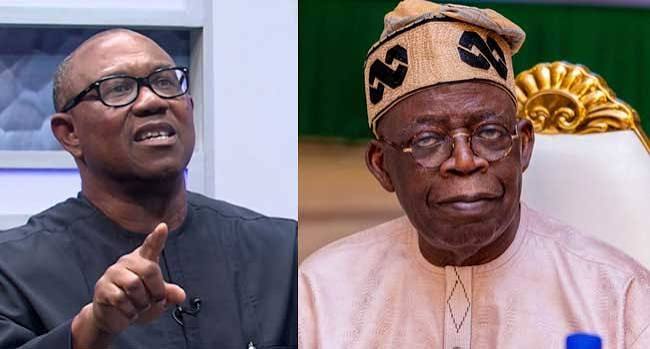
A fresh demand for President Bola Ahmed Tinubu to step down has emerged from the opposition, with Nigeria Democratic Congress presidential candidate Peter Obi pointing to the resignation of British Prime Minister Keir Starmer as a model of political accountability the Nigerian leader should follow.
Obi made the call in a statement on his official X account on Monday, June 22, 2026, hours after Starmer announced his own departure. Starmer said he would stand down as prime minister after days of intense pressure from his own Labour Party, with a new leader expected to be in place by the time parliament returns in September. His resignation paves the way for the country’s seventh leader in a decade, with former Greater Manchester mayor Andy Burnham widely seen as the frontrunner.
“As a keen observer of global politics, my primary interest lies in examining what successful nations do right and the structural factors that cause others to lag or struggle with governance and development,” Obi said. According to him, Starmer’s decision followed public dissatisfaction over economic challenges, rising living costs and unmet campaign promises.
Drawing a direct parallel, Obi recalled that before the 2015 general election, Tinubu had repeatedly called on then-President Goodluck Jonathan to resign over insecurity and economic hardship. “During the Chibok school kidnapping incident, he demanded the immediate resignation of President Jonathan, arguing that the government had failed in its most fundamental duty of protecting lives,” he stated.
He further referenced Tinubu’s 2023 campaign commitments. “President Bola Ahmed Tinubu made several promises, including improved electricity supply. He also challenged the electorate not to vote for him for a second term if he failed to deliver on those commitments,” Obi said, adding that conditions had since worsened. “Electricity supply remains unreliable, insecurity has intensified in many areas, including kidnappings, and economic hardship has deepened rather than eased.”
The power sector record lends weight to part of his claim. Shortly after assuming office, Tinubu had told Nigerians not to re-elect him if he failed to provide steady electricity, but almost three years later the situation has not improved. The national grid first collapsed in 2026 on January 23, when generation fell from nearly 3,997 megawatts around noon to about 20 megawatts by 1pm, followed by a second collapse just four days later on January 27. The grid has an installed capacity of about 12,000MW but generation companies typically deliver only 4,000MW to 5,000MW, against expert estimates that the country needs at least 30,000MW for a population exceeding 200 million.
Obi said other sectors, including infrastructure, transportation and anti-corruption efforts, had also recorded setbacks, declaring, “We are in the worst possible condition.” He then urged the President to step down. “I, therefore, join Nigerians of goodwill in calling for the resignation of the President over monumental failure in governance,” he said, arguing that such a step would foster “a political culture rooted in accountability and responsibility” and signal that “public office is a sacred trust, not an entitlement.”
There has been no official response from the Presidency to Obi’s statement as of press time. Tinubu, who completes his first term in May 2027, has not indicated any intention to leave office, and resignation by a sitting Nigerian president has no precedent in the country’s Fourth Republic. The comparison Obi draws is also imperfect: under Britain’s parliamentary system, a prime minister can be removed by party lawmakers mid-term, whereas Nigeria’s presidential system fixes the President’s tenure barring impeachment or election defeat.