
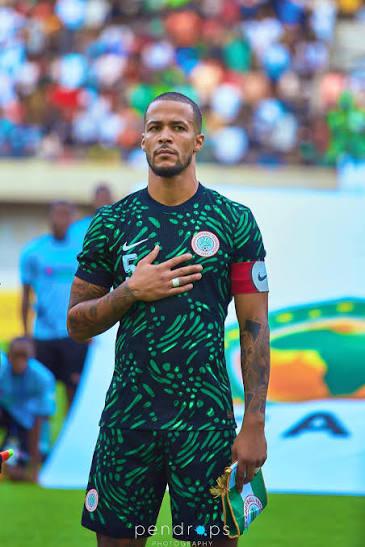
William Troost-Ekong has signalled that his next contribution to Nigerian football will come from the committee room rather than the dugout, arguing that the Super Eagles will not climb back to their former heights until more former internationals are handed genuine authority over how the game is run.
The former captain, who ended a decade in the green and white in December 2025, made clear that a coaching career holds little appeal for him. “I have had so many people ask me about coaching the team, I am not sure that is something that I really want to do,” he told Brila FM. “I think there also need to be players that think about going one level above that, whether it is going to be in the boardroom, whether it is going to be working with federations, with FIFA, with CAF, whether the NFF. I think that is probably where you can make the biggest change.”
By his account, the groundwork for that pivot is already under way. Ekong said he had begun taking educational programmes run by the English Football Association, positioning himself for governance and policy roles rather than the touchline. He framed the ambition as a matter of lived expertise being wasted. “It is a difficult landscape because in African football there is also a lot of politics involved. We have so many ex-players who have a great understanding of the game. I do not think we have seen enough ex-players getting involved from the top. For me in Nigerian football, it is about finding ways that we can collaborate and enhance the federation because we have been there, we have seen it,” he said.
The timing of his remarks is not incidental. They land in the wake of one of the darkest chapters in the modern history of the Super Eagles, a team that failed to reach the 2026 FIFA World Cup co-hosted by the United States, Mexico and Canada. Nigeria finished second in a qualifying group that also contained South Africa, Rwanda, Benin, Zimbabwe and Lesotho, then lost the Confederation of African Football playoff final to DR Congo on the night of November 16, 2025, in Rabat. The match ended 1-1 after extra time, with Frank Onyeka striking early and Meschack Elia levelling in the 32nd minute, before DR Congo prevailed 4-3 on penalties. Calvin Bassey, Moses Simon and Semi Ajayi all failed from the spot. It was Ekong’s final appearance for his country.
The defeat carried a weight beyond one bad evening. It was the second consecutive World Cup Nigeria had missed, following the away-goals elimination by Ghana that denied them a place at Qatar 2022, and it marked the first time since their 1994 debut that the Super Eagles had failed to qualify for two tournaments in a row. Nigeria have reached the finals six times, in 1994, 1998, 2002, 2010, 2014 and 2018. The financial cost of missing out is steep in an expanded competition where the 48 finalists in North America will share a record 652 million dollars in prize money, and where Africa was granted an unprecedented nine automatic slots. The Nigeria Football Federation issued a public apology addressed to President Bola Tinubu, and its subsequent legal petition to overturn the result was dismissed.
Ekong speaks from a position of unusual authority on the field. He retired with 83 caps, placing him among Nigeria’s most capped players of all time, and three international goals in the shirt after making his debut in an AFCON qualifier against Chad in June 2015, handed to him by the late Stephen Keshi. Born and raised in the Netherlands, where he represented the country at youth level, he switched allegiance to Nigeria and went on to feature at the 2016 Olympic Games in Rio, where the team won bronze and he scored the winning goal in the quarter-final against Denmark, and at the 2018 World Cup in Russia. His defining campaign came at the delayed 2023 Africa Cup of Nations in Côte d’Ivoire, where he captained the side to the final, scored in the decider against the host nation and was named Player of the Tournament, finishing his AFCON career as the highest scoring defender in the competition’s history.
His intervention feeds a wider and increasingly public argument over who should steer the Nigerian game. Former Nigeria striker Peter Ijeh has pinned the national team’s decline on administrators, citing a lack of structure and accountability. Former captain John Obi Mikel used an appearance on a podcast hosted by former England striker Peter Crouch to criticise the football system, saying he had declined invitations to get involved because of disagreements with those already in charge. That position drew a rebuttal from former international Oladimeji Lawal, who urged Mikel to convert his experience into practical solutions rather than public commentary, and observed that Mikel had not, to his knowledge, invested in a football academy or facility in Nigeria since retiring.
Ekong pointed to a template already established elsewhere. He referenced Andriy Shevchenko and Samuel Eto’o, both former forwards who rose to lead their national federations in Ukraine and Cameroon respectively, and Brazil great Zico, who served as his country’s sports minister. “What I would love to do now, and the way I am preparing this part of my career, is to try and find ways where I can be part of the solution to see Nigeria reach bigger heights than we did when I was a player,” he said.
The federation he speaks of remains under the leadership of Ibrahim Musa Gusau, whose tenure has been dominated by the fallout from the World Cup miss. The Super Eagles did recover a measure of pride at the 2025 Africa Cup of Nations staged in Morocco from December 2025 to January 2026, reaching the semi-final unbeaten before falling to the host nation on penalties, a run overshadowed at one point by a players’ dispute over unpaid bonuses ahead of the quarter-final against Algeria. Senegal ultimately lifted the trophy, beating Morocco in the final. Nigeria’s long wait for a fourth continental title, last won in 2013, therefore continues.
Whether Ekong’s stated intentions translate into an actual role within the game’s power structures remains to be seen. Administrative appointments in Nigerian football are shaped as much by congress politics and factional alignment as by playing pedigree, and the boardroom he describes has historically been resistant to precisely the kind of insider reform he is proposing. For now, the former skipper has set out an ambition rather than a plan. What is clear is that a generation of retiring internationals, from Mikel to Ekong, is being drawn into a debate about accountability that the country’s repeated World Cup failures have made impossible to ignore.