
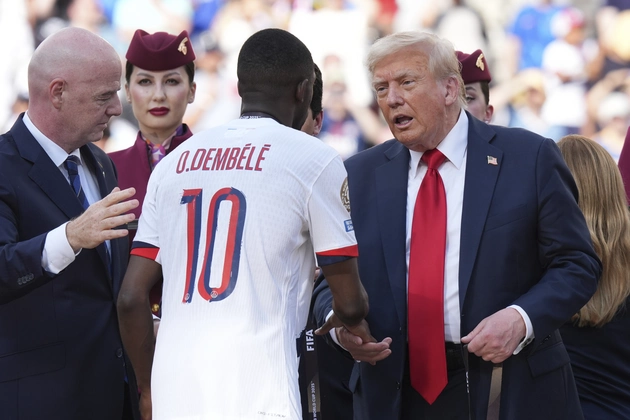
Folarin Balogun will lead the line for the United States against Belgium in Seattle on Monday night, days after a red card had seemed certain to keep him out, following an intervention that has drawn FIFA into an unusual and contested episode at the 2026 World Cup. The forward’s reinstatement, confirmed by FIFA on Sunday and welcomed by U.S. Soccer, came after multiple reports that President Donald Trump personally telephoned FIFA President Gianni Infantino to ask that the sanction be reviewed.
The dismissal itself dates to Wednesday, July 1, when Balogun was sent off in the 64th minute of the United States’ round of 32 knockout tie against Bosnia and Herzegovina at Levi’s Stadium in Santa Clara, California. The 25 year old caught the foot of Bosnian defender Tarik Muharemovic, and the referee issued a red card after consulting a slow motion replay. The United States went on to win the match 2 nil, but the sending off carried an automatic one match ban that would ordinarily have ruled Balogun out of the round of 16.
FIFA did not cancel the red card. In its statement on Sunday, the governing body said the automatic suspension had been set aside on procedural grounds. “The implementation of the automatic match suspension for USA player Folarin Balogun is suspended for a probationary period of one (1) year,” the statement read. FIFA anchored the ruling in Article 27 of its Disciplinary Code, which provides that “the judicial body may decide to fully or partially suspend the implementation of a disciplinary measure.” In effect, the card stands on Balogun’s record, but the ban attached to it will not be served unless he offends again within the probation window.
What has made the decision extraordinary is not the legal mechanism, which exists in the code, but the reported political weight behind the review. Sports broadcaster Ben Jacobs first reported that the White House had contacted Infantino. The New York Times subsequently reported that Trump spoke to the FIFA president by phone and asked him to look again at the suspension, citing people familiar with the conversation. According to accounts carried by American outlets, Infantino told the president that FIFA’s Disciplinary Committee would examine the matter. Andrew Giuliani, executive director of the White House’s World Cup task force, was also said to have spoken to Infantino, while Secretary of Commerce Howard Lutnick was reported to be in communication with FIFA.
One U.S. official, quoted anonymously, said the government had supplied “additional evidence” that the Disciplinary Committee then weighed, with attention drawn to the referees’ review of the slow motion replay before the card was shown. “Ultimately the correct and proper outcome was achieved,” the official said.
Trump left no doubt about his view once the reversal was announced. Writing on his Truth Social platform, the president declared: “Thank you to FIFA for doing what was right, and reversing a great injustice!” U.S. Soccer, for its part, said it was “pleased” that Balogun would be available for the tie at Lumen Field, the winner of which advances to the quarter finals.
The version of events is not settled. FIFA sources, according to reporting by Sports Illustrated, insisted that the White House played no part in the outcome and that the reversal was solely a matter for the disciplinary panel acting under Article 27. Those competing accounts, one stressing political contact and the other institutional independence, have not been reconciled in public, and neither the White House nor FIFA has offered a detailed narrative of the review process.
Beyond the United States camp, the ruling has stirred unease. The Royal Belgian Football Association said it was “astonished” by the decision, arguing that it ran contrary to FIFA’s own written rules. “The RBFA is investigating all potential options,” the association said. European football’s governing body, UEFA, was also expected to weigh in. Belgium, the opponent who stands to be most directly affected, has framed the matter as one of consistency and fair application of the laws.
There is precedent that FIFA can point to. Cristiano Ronaldo received a red card against the Republic of Ireland during qualifying that threatened to keep him out of Portugal’s opening World Cup fixture, and a comparable decision spared him the full force of the ban. Supporters of Sunday’s ruling have cited that case as evidence that discretion under Article 27 is neither new nor reserved for any single nation. Critics counter that the manner of this particular intervention, with a head of state reportedly on the line, sets it apart.
The episode also sits within a wider relationship between Trump and Infantino that has grown notably close as the United States co hosts the tournament alongside Mexico and Canada. In December 2025, at the World Cup draw in Washington, Infantino presented Trump with the inaugural FIFA Peace Prize, telling the president he had earned it “in an incredible way” and pledging the support of the global football community. That proximity has informed how observers have read the past week’s events.
Balogun’s own profile adds another layer of context. Born in the United States and raised in the United Kingdom, he committed his international future to the American side and has been among the standout performers of the tournament, scoring three goals in three appearances. His eligibility by birth carries a certain resonance at a moment when questions of American citizenship have been prominent, coming shortly after the Supreme Court declined to uphold the administration’s attempt to restrict birthright citizenship, ruling that those born on U.S. soil are citizens.
For now, the sporting consequence is straightforward. Balogun, who continued to train with the squad through the uncertainty, is cleared to face Belgium, and his teammates have spoken of relief. What lingers is the governance question that the reversal has reopened, over how far outside influence should reach into the enforcement of football’s own rules, and whether Sunday’s decision will invite challenges from other quarters before the World Cup is done.