
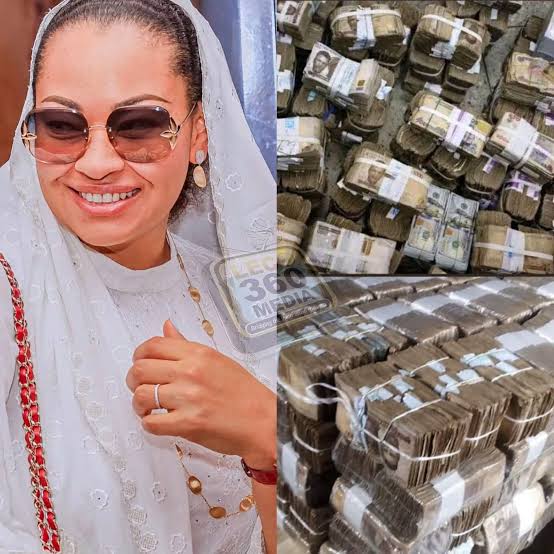
The dispute between the Obi-Kwankwaso Movement and Senator Natasha Akpoti-Uduaghan over her distribution of cash to constituents has flared up again, with the group pressing for an investigation and the senator insisting she acted within the law. The renewed exchange has pulled a familiar question back into public view: when does a lawmaker’s empowerment programme cross the line into vote buying.
At the centre of the row is a programme the senator, who represents Kogi Central, held to mark her third anniversary in the 10th National Assembly. Photographs and videos showing bundles of naira stacked on a table spread widely in early November, with reported grants running into millions of naira. The senator’s camp has put the number of beneficiaries at about 600.
The movement, through its director-general, John Ughulu, has asked the Economic and Financial Crimes Commission to examine the exercise. He argued that the public display of money raised questions about the use of public office and the integrity of the electoral process, and said that if the cash was meant to sway voters it could amount to what he described as advance vote buying. He also asked whether similar handouts featured in the campaign that first brought the senator to the Senate.
Akpoti-Uduaghan has rejected the accusation outright. She maintained that the money came from a Federal Government budgetary allocation, that it was handed over in the open, and that she would honour any invitation from the commission to explain the process. “There was no money abuse,” she said, adding that she presented the funds to beneficiaries herself. Through her media aide, she explained that cash was chosen over equipment because earlier recipients had said direct funds better suited their immediate business needs.
The quarrel plays out against the senator’s turbulent recent history. She was suspended by the Senate for six months in March 2025 after a confrontation with Senate President Godswill Akpabio over a seating arrangement, a clash that unfolded alongside her allegation of sexual harassment against him, which he denied. A Federal High Court later described the suspension as excessive, and she returned to her seat in October 2025 after serving the full term.
The group pressing the complaint is itself a product of the coming election. Known as the OK Movement, it mobilises support for the Nigeria Democratic Congress presidential ticket of Peter Obi and Rabiu Kwankwaso, drawing its members from the Obidient bloc, the Kwankwasiyya structure and the New Nigeria Peoples Party. Ughulu has said the demand for scrutiny would apply to any politician who distributes money to influence voters, including candidates of the NDC itself.
Akpoti-Uduaghan has turned that argument back on her critics, suggesting the movement push its own allied senators to match her interventions rather than single her out. Her defenders in Kogi Central have called the petition politically motivated and premature in the absence of evidence, while a civic technology group questioned the wisdom of using stacks of cash as a measure of representation. The disagreement feeds into a wider enforcement drive, with the anti-graft agency saying it has made repeated arrests over electoral inducement, including 20 people detained and about 17.2 million naira seized during the recent Federal Capital Territory council polls.
Whether the gifts breach any law is not a straightforward matter. Nigerian electoral law generally treats vote buying as an offence that must be proved through an unlawful inducement tied to how people vote, and there is so far no confirmation that the commission has opened an inquiry or that any authority has established wrongdoing. What is clear is that constituency handouts, long accepted as routine, are drawing sharper scrutiny as parties position themselves for 2027, and the distinction between genuine empowerment and electoral inducement is likely to be tested again and again before the polls.