
Sudan Resumes Full IGAD Membership Amid Ongoing Civil War
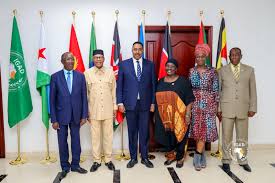
Sudan’s government has resumed full participation in the Intergovernmental Authority on Development, ending a two-year suspension that stemmed from regional tensions over the country’s devastating internal conflict. The move, announced by the foreign ministry in Khartoum, comes as the nearly three-year war between the Sudanese Armed Forces and the paramilitary Rapid Support Forces continues to ravage the nation, displacing millions and exacerbating one of the world’s most severe humanitarian crises.
The foreign ministry’s statement on Monday detailed the decision, declaring that “the government of the Republic of Sudan will resume its full activity in the membership” of the Djibouti-based bloc. This reversal follows Sudan’s freeze on its IGAD involvement in January 2024, triggered by the organization’s invitation to Mohamed Hamdan Daglo, the head of the Rapid Support Forces, to attend a summit in Uganda aimed at addressing the conflict.
Read Also: Sudan And Its Many Coups
That war erupted on April 15, 2023, pitting the Sudanese Armed Forces, led by General Abdel Fattah al-Burhan, against the Rapid Support Forces under Daglo, commonly known as Hemedti. What began as a power struggle over the integration of the paramilitaries into the regular army has escalated into a brutal nationwide clash, claiming an estimated 150,000 lives or more, according to reports from organizations like the Council on Foreign Relations and various United Nations assessments. The conflict has forcibly displaced over 12 million people, including 9.3 million internally displaced persons and more than 4 million refugees who have fled to neighboring countries such as Chad, Ethiopia, and South Sudan, marking the largest displacement crisis globally, as documented by the UN High Commissioner for Refugees.
Humanitarian conditions have deteriorated sharply, with 33.7 million people—roughly two-thirds of Sudan’s population—now requiring aid, per UN estimates from early 2026. Disease outbreaks, including cholera, dengue, malaria, and measles, have spread across all 18 states, compounded by the destruction of health facilities; the World Health Organization has verified 201 attacks on healthcare since the war’s onset, resulting in 1,858 deaths and 490 injuries. Famine risks loom large, with over 25 million facing acute food insecurity, as noted by the World Food Programme.
Sudan’s history of strife provides deep context for the current turmoil. Since gaining independence from Anglo-Egyptian condominium rule in 1956, the country has endured prolonged civil wars driven by ethnic, religious, and resource-based divisions. The First Sudanese Civil War, from 1955 to 1972, centered on southern demands for autonomy, ending with the Addis Ababa Agreement that granted limited self-rule. However, grievances persisted, leading to the Second Sudanese Civil War in 1983, which lasted until 2005 and claimed over 2 million lives through fighting, starvation, and disease. That conflict culminated in the Comprehensive Peace Agreement, brokered with significant involvement from regional actors, paving the way for South Sudan’s independence in 2011 following a referendum.
The Darfur region in western Sudan became a flashpoint in 2003, when rebel groups rose against perceived marginalization by the central government under then-President Omar al-Bashir. In response, Bashir armed Arab nomadic militias known as the Janjaweed to suppress the uprising, leading to accusations of genocide by the International Criminal Court. The Janjaweed’s atrocities, including mass killings, rapes, and village burnings, resulted in over 300,000 deaths and displaced millions, as reported by the United Nations. In 2013, Bashir restructured these militias into the Rapid Support Forces, placing them under Daglo’s command and integrating them into national security operations, including border patrols and counterinsurgency efforts in Darfur, South Kordofan, and Blue Nile states.
Bashir’s three-decade rule, marked by strict Sharia enforcement and suppression of dissent, ended in April 2019 amid massive pro-democracy protests. The Rapid Support Forces and Sudanese Armed Forces jointly orchestrated a coup to oust him, establishing a transitional sovereignty council with Burhan as chair and Daglo as deputy. Civilian economist Abdalla Hamdok was appointed prime minister to steer toward elections, but tensions simmered. In October 2021, Burhan and Daglo staged another coup, suspending the constitution and derailing the democratic transition, which prompted international aid suspensions and renewed protests.
Read Also: 4.5 Million Girls at Risk of FGM in 2026, Africa Bears Largest Burden — UNFPA
The 2023 war has effectively partitioned Sudan, with the army controlling northern, eastern, and central regions, while the Rapid Support Forces hold sway over western areas and portions of the south. The paramilitaries have established a parallel administration in Nyala, the capital of South Darfur state, though it lacks any international recognition, according to public records from regional bodies.
Sudan’s return to IGAD was prompted by recent diplomatic engagements. In January, IGAD’s executive secretary, Workneh Gebeyehu, met with Sudan’s Prime Minister Kamil Idris. Following the discussions, IGAD issued a statement condemning “all forms of violations committed by the Rapid Support Forces” and reaffirming “its full support for the unity and sovereignty of the Republic of the Sudan, as well as its existing national institutions.” The foreign ministry referenced an IGAD communique that emphasized “its full recognition of Sudan’s sovereignty and the unity of its lands and people” and committed to “non-interference in member states’ internal affairs.”
IGAD itself traces its roots to 1986, when it was founded as the Intergovernmental Authority on Drought and Development to combat famines in the Horn of Africa. Revitalized in 1996 as the Intergovernmental Authority on Development, the bloc now comprises eight member states: Djibouti, Eritrea, Ethiopia, Kenya, Somalia, South Sudan, Sudan, and Uganda. It has played pivotal roles in regional peace processes, including mediating the Comprehensive Peace Agreement for Sudan in 2005 and facilitating South Sudan’s independence. IGAD’s involvement in Sudan’s current crisis has included mediation attempts, though progress remains stalled amid accusations of bias from both sides.
On Monday, IGAD welcomed Sudan’s reinstatement, calling it “a reaffirmation of regional solidarity and collective commitment to peace, stability, and cooperation across the region.” While this step may open avenues for renewed dialogue, the ongoing fighting now approaching its 1,000th day as of January 2026—continues to inflict widespread suffering, with no immediate resolution in sight. Contested reports of ethnic violence in Darfur and Kordofan underscore the fragility, as highlighted in UN briefings, urging sustained international attention to avert further catastrophe.