
Tinubu calls for immediate release of South Sudan’s vice president
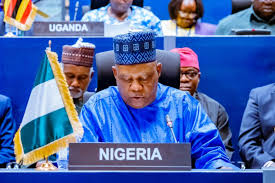
President Bola Ahmed Tinubu has reaffirmed Nigeria’s dedication to the prompt implementation of the revitalised peace agreement in South Sudan, while calling for the immediate and unconditional release of the country’s First Vice President, Riek Machar, and other detained opposition leaders.
The commitment was conveyed in a statement issued on Monday by Stanley Nkwocha, Senior Special Assistant to the President on Media and Communications in the Office of the Vice President.
According to the statement, Tinubu, represented by Vice President Kashim Shettima, made the declaration during the African Union High-Level Ad Hoc Committee for South Sudan, also known as the C-5 Plus Summit, held in Addis Ababa, Ethiopia, on the sidelines of the 39th AU Assembly of Heads of State and Government. South African President Cyril Ramaphosa chaired the summit.
“We wish to specifically call on the government to consider the immediate and unconditional release from detention of the Vice President and other key opposition figures,” Tinubu stated.
The Nigerian leader further emphasised the need for comprehensive national dialogue to address the ongoing crisis in South Sudan.
“It is also imperative to convene an all-inclusive South Sudan national dialogue and reconciliation forum. We call on all parties to engage constructively with authorities in the mediation process without preconditions,” he said.
Tinubu expressed Nigeria’s alignment with other African nations in recognising the South Sudanese people’s aspiration for peace, sustainable development, and rapid conflict resolution.
“We support the lofty ambition of all parties and wish to reiterate our doctrinal commitment to accompany the South Sudanese Transitional Government of Unity as well as the good people of the country to actualise their aspiration for lasting peace and development,” he added.
The President underscored that national unity and consensus among political elites remain essential for advancing the country’s transition, urging African leaders to prioritise inclusive, peaceful, and transparent elections as the foundation for rebuilding trust and confidence in South Sudan’s political future and leadership.
Tinubu also drew attention to Nigeria’s involvement in the recently established Regional Partnership for Democracy and highlighted how insecurity and political instability have hindered South Sudan’s transitional processes, including security sector reforms and constitutional drafting.
South Sudan has been embroiled in conflict since gaining independence from Sudan in 2011. Civil war erupted in December 2013 following a power struggle between President Salva Kiir and his former deputy, Riek Machar, resulting in widespread violence, displacement, and humanitarian crisis. The conflict has displaced millions and claimed hundreds of thousands of lives.
In September 2018, the Revitalised Agreement on the Resolution of the Conflict in South Sudan was signed in Addis Ababa, establishing a framework for a unity government and outlining steps toward peace, including security arrangements, power-sharing, and the holding of elections. However, implementation has been repeatedly delayed, with key provisions remaining unfulfilled nearly eight years later.
President Ramaphosa acknowledged the efforts of African leaders in seeking a resolution to the crisis and noted the prolonged delay in implementing the revitalised agreement since its endorsement.
He described the C-5 Plus Summit as “a demonstration of the commitment of leaders to finding a lasting solution in the interest of the people of South Sudan.”
The Intergovernmental Authority on Development, a regional bloc comprising East African nations, has played a central role in mediating the South Sudan peace process. IGAD’s involvement has included facilitating negotiations, monitoring ceasefires, and supporting the implementation of peace agreements.
During the summit, the President of Djibouti and IGAD Chairman, Ismail Omar Guelleh, reaffirmed the organisation’s commitment to restoring peace in South Sudan. He proposed the appointment of a lead mediator tasked with overseeing the implementation of the agreement and addressing emerging obstacles to the peace process.
Other prominent attendees at the summit included the Chairperson of the AU Commission, Mahmoud Ali Youssouf; Ethiopian Prime Minister Abiy Ahmed Ali; Algerian President Abdelmadjid Tebboune; and representatives from Chad, Rwanda, and other African nations.
The African Union High-Level Ad Hoc Committee for South Sudan was established to support peace efforts and coordinate regional responses to the crisis. The committee includes heads of state and government from member countries who engage directly with South Sudanese leaders to facilitate dialogue and implementation of peace commitments.
In a separate development, Nigeria announced its intention to provide full infrastructural and operational support for the Combined Maritime Task Force operating in the Gulf of Guinea.
Tinubu pledged that Nigeria would supply “office buildings, ships, helicopters, and temporary personnel to ensure the Force remains effective in combating transnational organised crimes and enhancing maritime security across the region.”
The Gulf of Guinea has experienced persistent maritime security challenges, including piracy, armed robbery at sea, illegal fishing, and trafficking. The region accounts for a significant portion of global piracy incidents, prompting regional and international efforts to strengthen maritime governance and security cooperation.
Nigeria, as the largest economy and most populous nation in West Africa, has increasingly positioned itself as a leader in regional security initiatives. The country’s involvement in maritime security operations reflects broader efforts to protect trade routes, secure energy infrastructure, and curb criminal activities that threaten economic stability in the Gulf of Guinea.
The Combined Maritime Task Force represents a collaborative security mechanism aimed at coordinating naval and law enforcement activities among Gulf of Guinea nations to address shared maritime threats.