

Tinubu Rallies Global Partners to Fix Nigeria’s Mismatched Job Market
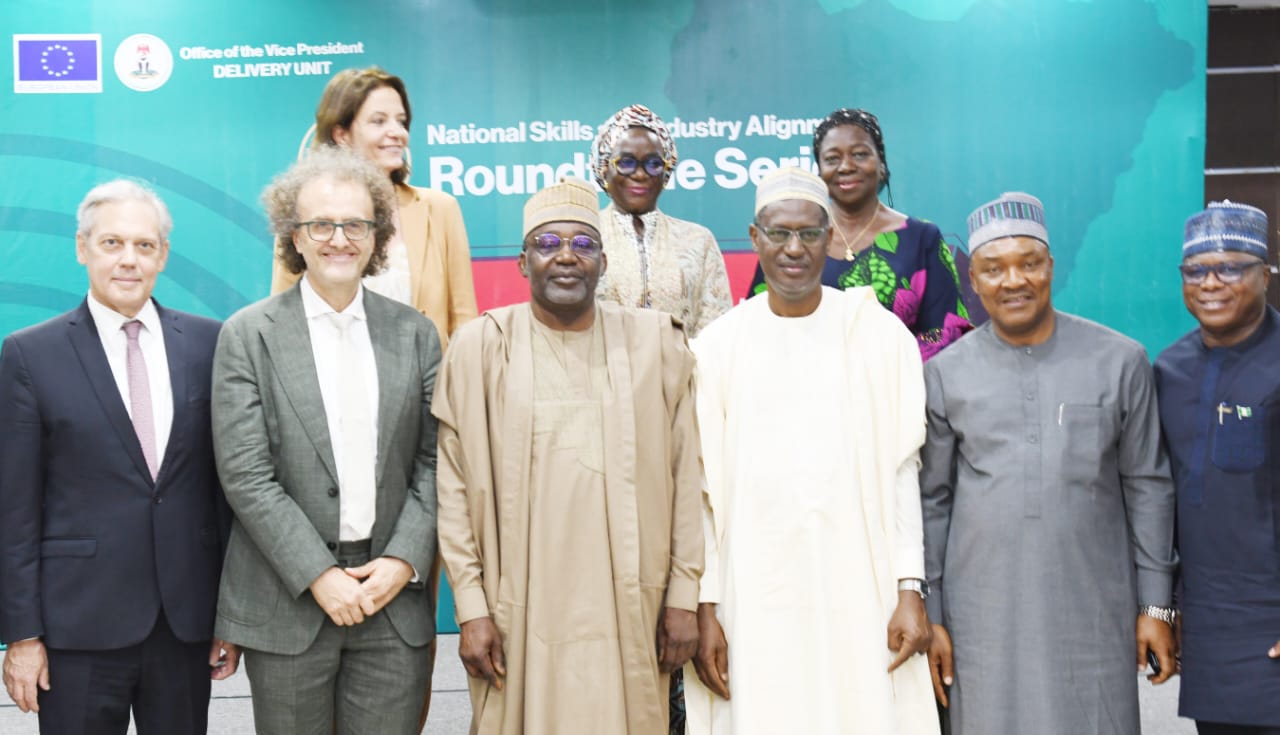
The Federal Government has moved to consolidate Nigeria’s fragmented youth empowerment schemes into a single, industry-led national system. At a high-level roundtable in Abuja on Tuesday, Vice President Kashim Shettima called for an end to “isolated interventions” that fail to translate into stable employment. Represented by Senator Ibrahim Hassan Hadejia, the Vice President argued that Nigeria suffers not from a talent shortage, but from a profound misalignment between classroom output and boardroom needs. The initiative, supported by the European Union (EU), marks a shift toward a “coordinated ecosystem” where the private sector dictates the curriculum.
Nigeria’s demographic pressure remains the primary driver behind this policy pivot. With one of the world’s largest youth populations entering the labour market annually, the administration is wary of the social risks posed by an expanding, under-skilled informal sector. The government’s new strategy seeks to move beyond “job creation” as a mere political slogan toward “skills alignment.” This involves a rigorous mapping of the national job ecosystem to ensure that technical training programmes, such as the 3MTT fellowship, are directly linked to high-growth industries like construction and technology.
The private sector is being asked to transition from passive employers to active “co-creators” of the workforce. Minister of Housing and Urban Development, Ahmed Musa Dangiwa, noted that critical sectors like housing face a paradox of high unemployment alongside a scarcity of skilled artisans. From architects to bricklayers, the housing value chain is currently hampered by a lack of certified proficiency. The government’s goal is to bridge this gap by involving industry leaders in the design of vocational training modules, ensuring graduates are “job-ready” upon completion.
International partners are already aligning their capital with this new directive. Massimo De Luca, the EU Head of Cooperation for Nigeria and ECOWAS, confirmed that European support is now focused on “organic engagement” within Nigeria’s production systems. Rather than funding generic workshops, the EU is backing initiatives that grow skills “where they are required and defined.” This involves collaboration with domestic heavyweights like the Tony Elumelu Foundation and the Aliko Dangote Foundation to scale up programmes that have already demonstrated measurable success.
The administrative architecture for this drive is being managed by the Office of the Vice President and the Senior Special Assistant on Delivery and Coordination. By establishing the National Skills and Industry Alignment Roundtable Series, the government aims to create a permanent feedback loop between policymakers and the organised private sector. The focus for Q1 2026 is clear: moving from policy dialogue to deliberate action. This includes streamlining the multiple, often overlapping, youth agencies to reduce bureaucratic waste and improve the “hit rate” of employment interventions.
Ultimately, the Tinubu administration is betting that coordination, rather than just funding, will unlock the potential of Nigeria’s youth. The Vice President’s message to stakeholders was blunt: the time for fragmented action is over. As the digital and construction sectors continue to evolve, the government’s ability to synchronise its training pipes with market demand will determine the success of its broader $1 trillion economy ambition. For millions of young Nigerians, the promise of this roundtable is a shift from “learning” to “earning.”