
Wike Blames Makinde for PDP’s Crisis, Denies Pledge to ‘Hold Down’ Party for Tinubu
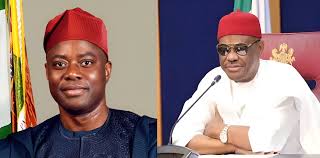
The internal crisis consuming Nigeria’s main opposition party, the Peoples Democratic Party (PDP), intensified further on Monday as Federal Capital Territory Minister Nyesom Wike turned the tables on Oyo State Governor Seyi Makinde, accusing him of masterminding the deteriorating political landscape within the party. Speaking during an end-of-year media chat at his residence in Port Harcourt, Wike categorically dismissed allegations that he pledged to undermine the PDP to support President Bola Tinubu’s re-election bid, dismissing the claims as frustration-driven and politically motivated.
The escalating war of words between two former allies reflects the deepening rupture within a party that has been struggling for relevance since its 2023 election defeat. With 2027 general elections looming, the PDP appears increasingly fragmented, with dueling factions, conflicting court judgments, and rival leadership claiming legitimacy. Political analysts warn that the party may be unable to mount an effective challenge to the ruling All Progressives Congress without resolving its internal disputes.
The crisis entered a new phase on 23 December when Makinde publicly alleged that Wike had offered to “hold down” the PDP for President Tinubu ahead of the 2027 presidential election. According to Makinde, the pledge occurred during a private meeting in Abuja that included the president, Wike, and several other officials, including the president’s Chief of Staff.
Makinde described the declaration as unsolicited and not agreed upon by other party stakeholders. Speaking during a media briefing at the Government House in Ibadan, the Oyo State capital, the governor disclosed that President Tinubu had once asked him to assist in organising the All Progressives Congress (APC) in the state, a request he said he turned down because of his membership of the PDP.
The allegation struck at the heart of party loyalty and democratic principles. Makinde portrayed Wike’s reported statement as a betrayal of the opposition party and a threat to Nigeria’s multiparty democracy. He further claimed that efforts to convince Wike to reconsider the pledge had failed, cementing the divide between the two leaders.
Wike’s response was swift and forceful. During his media chat on Monday, the FCT minister rejected Makinde’s account entirely, questioning both the veracity of the allegations and the timing of their public disclosure.
“First of all, you ask yourself, what was that meeting? What was the purpose of that meeting? That would have led me to say, Mr President, I will hold PDP for you,” Wike said, pointing out the implausibility of Makinde’s narrative. He questioned why, if such a statement had genuinely been made, Makinde waited months before raising the issue publicly within the party.
“Why did Seyi Makinde not come up all this while to tell the party, see what Wike is doing? I was in a meeting. I saw what Wike said. It’s not correct,” Wike added.
Setting the record straight, Wike provided his own version of events. According to him, the meeting in question involved multiple PDP leaders, not a private bilateral arrangement. “There was no such meeting. Rather, my humble self, the former governor of Benue State, Samuel Ortom; the former governor of Abia State, Okezie Ikpeazu; the former governor of Enugu State, Ifeanyi Ugwuanyi; and Seyi Makinde, we went to see the president,” he said.
Wike explained that the gathering occurred after the 2023 general elections and focused on post-election political discussions rather than any predetermined arrangement. According to Wike, the meeting took place after the elections and focused on general political discussions. “Yes, we went to see the president to discuss. Of course, elections were over. To discuss certain things,” he explained, adding that the president’s chief of staff was present as expected.
Rather than mounting a purely defensive posture, Wike launched a direct counteroffensive, placing responsibility for the PDP’s deterioration squarely on Makinde’s shoulders. According to Wike, Makinde’s personal ambitions and actions have systematically weakened the party, leaving it unable to function effectively.
Wike accused the Oyo governor of masterminding the removal of Senator Samuel Anyanwu as PDP National Secretary in a bid to control the party structure. He further alleged that Makinde orchestrated a disputed national convention in Ibadan in November 2025, which was not recognised by the Independent National Electoral Commission (INEC) and contradicted earlier Federal High Court judgments.
According to Wike, the Independent National Electoral Commission (INEC) later challenged the matter in court and was struck out of the case. This, Wike argued, demonstrated the illegitimacy of Makinde’s actions and the convention he promoted.
Wike characterised Makinde’s approach to party politics as fundamentally at odds with established norms. “Politics is not like being a contractor with Shell. Politics is not like being a contractor. It has different rules,” Wike said, suggesting that Makinde was treating political office as if it were a commercial transaction rather than a responsibility governed by institutional rules and procedures.
The depth of the party’s crisis is evident in its deteriorating political position. He noted that if council elections were held in the FCT today, the PDP would struggle to win, arguing that ongoing development projects in Abuja would favour President Tinubu. The party has lost candidates and support across multiple states, further weakening its prospects for 2027.
Wike warned that if the party does not resolve its lingering crisis, the PDP’s chances of bouncing back to power in the next electoral cycle would be jeopardised. He appealed to party leadership to prioritise unity and coherent strategy over factional interests.
“We have a leadership that is not focused, we have a leadership that does not know what to do or take any suggestions. If the leadership is committed and comes back to say we have made a mistake, why is it that things are happening this way, and what do we do to make corrections?” Wike asked.
The current explosion of hostility between Wike and Makinde is particularly notable given their previous close alliance. Both were members of the “Group of Five” (G5) governors who dramatically departed from the PDP during the 2023 presidential election, ultimately backing President Tinubu. Makinde is also Wike’s in-law, with Makinde’s wife hailing from Rivers State, adding a personal dimension to their rupture.
However, as political analysts note, personal relationships often yield to political interests in Nigeria’s dynamic political landscape. According to Ojo, while the party’s troubles are long-standing, the immediate trigger of the current crisis is the open fallout between Makinde and Wike, which has brought underlying tensions to the surface.
Wike’s central narrative places Makinde’s actions within a framework of personal frustration and thwarted ambition. While Makinde has not explicitly declared a 2027 presidential bid, Wike suggested that the governor’s behind-the-scenes manoeuvres indicate undisclosed presidential aspirations, which party members rejected or sought to constrain.
“I have told everybody, frustration if you can see it, if you watch Seyi Makinde, you can see frustration. And this young man, we have advised severely,” Wike said, suggesting that Makinde’s public allegations stem from disappointment over his inability to consolidate party control.
Wike further suggested that Makinde’s inexperience in higher-level politics may explain his approach. “When did Seyi Makinde come into politics? There is nothing wrong with having ambition, but the ambition must be pursued according to the rules. He has not even had the guts to tell us that he wants to run for president,” Wike added.
The PDP’s institutional framework remains in flux, with two factions claiming legitimacy. The meeting brought together the faction chaired by Tanimu Turaki—backed by Makinde—and a rival group led by Abdulrahman Mohammed, aligned with Wike. Recent attempts by INEC to broker resolution between these competing entities have proven unsuccessful.
According to Ememobong, the immediate outcome of the meeting was an agreement that all parties would await the decision of the Court of Appeal, where conflicting judgments from the Federal High Courts are being challenged. The appellate process will likely take months, leaving the party in institutional limbo during a critical period before 2027.
Makinde has maintained his stance that the interests of the PDP and Nigeria’s multiparty democracy supersede personal or factional considerations. “The real issue is that Wike would like to support the President for 2027 — that is fine; it is within his right to do that. But some of us want to ensure that democracy survives and we don’t drift into a one-party state. We also want to ensure that the PDP survives, and he should allow us to do our own thing,” Makinde said.
Makinde has drawn a firm line on his own 2027 positioning, explicitly rejecting any support for President Tinubu’s re-election bid, contrasting his position with what he portrays as Wike’s willingness to subordinate the opposition to the ruling government
The Wike-Makinde rift exposes deep structural vulnerabilities within the PDP, a party already weakened by its 2023 election loss and the subsequent exodus of prominent figures to the ruling APC. With critical elections approaching in 2026 and 2027, the party’s inability to resolve internal disputes raises serious questions about its capacity to mount an effective political challenge.