


Clintons to Testify in House Epstein Probe, Averting Contempt Vote
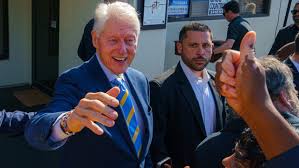
The shadow cast by Jeffrey Epstein’s crimes continues to reshape Washington’s political landscape, now pulling former President Bill Clinton and former Secretary of State Hillary Clinton into a contentious House investigation that has exposed deep partisan fault lines over how the deceased financier’s sprawling network should be scrutinised.
After initially refusing to appear before lawmakers, the Clintons have reversed course, committing to testify in person before a House committee examining how federal authorities handled their earlier investigations into Epstein, the disgraced financier whose connections spanned the world’s most exclusive circles of business, politics, academia, and entertainment.
Read Also: Thousands Protest In Greenland And Denmark Over Trump’s Greenland Takeover Plan
The decision, announced by Clinton spokesman Angel Urena on X, comes as the House Rules Committee had advanced resolutions to hold the couple in contempt for defying subpoenas demanding their personal appearance. The resolution accused them of refusing to explain their links to Epstein, who died in federal custody in 2019 under circumstances that remain the subject of ongoing public scrutiny and conspiracy theories.
“The former President and former Secretary of State will be there. They look forward to setting a precedent that applies to everyone,” Urena said, framing the couple’s decision as a principled stance on accountability.
The Rules Committee suspended its vote on the contempt proceedings Monday evening, effectively pausing what could have been an embarrassing moment for the Democratic Party, which has long positioned itself as the champion of accountability and oversight. That the chamber would have moved to hold two of the party’s most prominent figures in contempt would have exposed fractures within Democratic ranks that party leaders had sought to contain.
In their initial refusal to testify, the Clintons’ legal representatives had challenged the validity of the subpoenas themselves, arguing that the House committee had failed to establish a clear legislative purpose for demanding their in-person appearance. This legalistic objection—the sort that might typically be raised by political figures seeking to avoid uncomfortable questioning—marked the couple’s first formal resistance to the investigation.
The Clintons instead offered what they characterised as a comprehensive alternative: sworn written statements describing their knowledge of Epstein and his key associate, Ghislaine Maxwell, the French-born socialite now serving a 20-year prison sentence for her role in sex trafficking operations that victimised dozens of women and girls.
Bill Clinton’s written account acknowledged that he had flown on Epstein’s private plane during the early 2000s, stating that these flights were undertaken for Clinton Foundation-related humanitarian work. However, he categorically denied ever visiting Epstein’s private island in the Caribbean, a location that has featured prominently in accounts of the financier’s activities and where many alleged crimes occurred.
Hillary Clinton’s sworn statement was even more categorical. She asserted that she had engaged in no meaningful interactions with Epstein, had never flown on his aircraft, and had never set foot on his private island. Her statement effectively drew a sharp line between her husband’s documented business relationship with the financier and her own involvement—or lack thereof.
These written submissions might ordinarily have satisfied legislative inquiries, but Republicans on the House committee pressed for in-person testimony under oath, arguing that the Clintons’ historical links to Epstein—particularly Bill Clinton’s documented use of the businessman’s jet—warranted face-to-face questioning that would allow for immediate follow-up and the assessment of credibility that only live testimony permits.
The Epstein scandal has proven remarkably durable in its capacity to generate controversy and reshape political narratives more than five years after the financier’s death. His operation—a network built on wealth, access, and the cultivation of powerful connections across business, politics, entertainment, and academia—represented one of the most extensive documented cases of systematic sexual abuse in recent American history.
For decades, Epstein had operated with apparent impunity, his activities known to law enforcement authorities, financial institutions, and social circles, yet unimpeded. His 2008 conviction in Florida on charges related to soliciting prostitution from minors—a plea deal that many legal observers and victims’ advocates have criticised as extraordinarily lenient—did little to interrupt his activities or substantially diminish his influence and access to prominent figures.
The reopening of investigations into Epstein’s networks following his death in 2019 has cast an uncomfortable spotlight on the many prominent individuals who maintained relationships with him over the years. These figures span the political spectrum and include some of the most recognisable names in American public life. President Donald Trump himself maintained a documented social relationship with Epstein for years, and the two men were photographed together at social events in the 1990s. However, Trump has not been called to testify before the House committee investigating the matter.
The House investigation into how authorities handled Epstein cases has become entangled in broader partisan conflicts that have increasingly characterised Washington, and this reality has created genuine discomfort within Democratic ranks.
Republicans have seized upon the Clintons’ connections to Epstein as evidence of the necessity for rigorous scrutiny, framing the investigation as a legitimate oversight exercise aimed at ensuring that no one—regardless of political affiliation or prominence—remains beyond accountability for connections to serious crimes. They have pointed specifically to Bill Clinton’s use of Epstein’s private jet and the frequency of his flights as justifying in-person testimony.
Democrats, by contrast, have argued forcefully that the investigation represents weaponisation of legitimate oversight mechanisms for partisan advantage. They contend that singling out the Clintons for aggressive pursuit while declining to summon Trump—who, according to public accounts and his own past statements, was closer socially to Epstein than the Clintons ever were—exposes the investigation as a selective tool designed to damage political opponents rather than genuinely illuminate how federal authorities mishandled the Epstein matter.
Read Also: Nigeria Becomes Second Largest Bitcoin Market After USA
This Democratic critique has raised genuine internal tensions. Some Democrats have privately acknowledged that their party has consistently argued that no individual, regardless of rank or prominence, should be exempt from scrutiny when investigating serious crimes. To advance contempt resolutions against the Clintons while Trump remains untouched threatens to undermine that stated principle and to hand Republicans a powerful rhetorical weapon.
Simultaneously, other Democrats have feared that allowing contempt proceedings against the Clintons to advance would represent a capitulation that further normalises weaponisation of investigative mechanisms, setting a precedent that could backfire against Democrats when they lack power.
The Justice Department released what it characterised as the final batch of files related to the Epstein investigation during the preceding week, bringing what officials described as closure to a prolonged documentary disclosure process that has stretched across years since the financier’s death.
These releases have added further texture to public understanding of Epstein’s networks and activities, though they have also continued to fuel speculation about the full extent of his operations and the identities of all individuals involved. The compartmentalised nature of Epstein’s activities—conducted across multiple jurisdictions and involving numerous intermediaries—has meant that no single batch of documents has provided a comprehensive account of his entire operation.
Trump had spent considerable effort in preceding months attempting to block the disclosure of investigative files linked to Epstein, claiming executive privilege and national security justifications for withholding materials. These efforts faced legal challenges and public criticism before the Justice Department’s recent release.
The Clintons’ agreement to testify in person has provided the House Rules Committee with a graceful exit from a vote that threatened to deepen divisions within the Democratic caucus while potentially exposing the investigation to intensified accusations of partisan selectivity.
By agreeing to appear and submit to questioning, the Clintons have effectively called the investigation’s bluff—accepting the challenge to answer questions while simultaneously removing the contempt issue from the table. Whether this appearance will satisfy Republican demands for accountability or whether it will instead generate new controversies remains to be determined.