
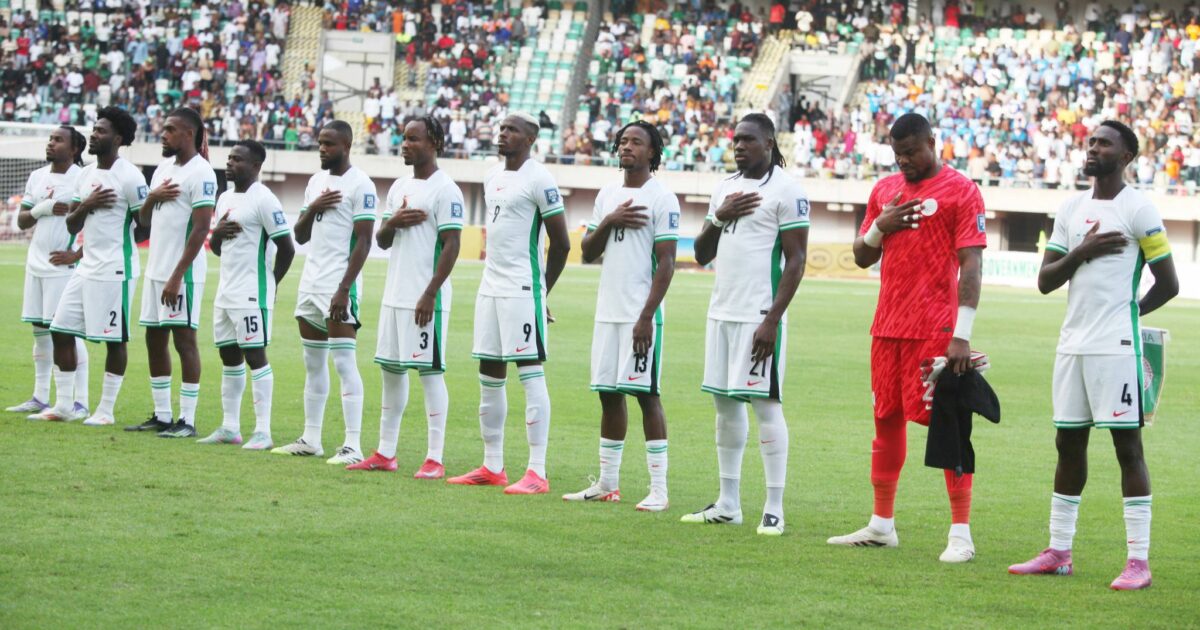
Nigeria’s senior national football team, the Super Eagles, will confront Jordan in an international friendly match scheduled for Amman during the March 23–31 FIFA international window.
The Nigerian Television Authority reported on Monday that the encounter will represent the first senior-level meeting between the two nations and serves as part of Jordan’s preparatory programme ahead of their maiden FIFA World Cup appearance.
Jordan, known as “The Chivalrous Ones,” secured qualification to the 2026 FIFA World Cup and have been placed in a formidable group containing defending world champions Argentina, Algeria, and Austria.
Reports further suggest that Iran is exploring the possibility of arranging a March fixture against the three-time African champions, while a potential June meeting with Portugal is also under discussion.
Nigeria’s participation in the Jordan friendly, however, remains contingent on an imminent FIFA ruling concerning the country’s eligibility protest lodged against the Democratic Republic of Congo.
According to PUNCH Online, FIFA was scheduled to review Nigeria’s formal petition on Monday, which alleges that DR Congo fielded six ineligible players during the 2026 World Cup African qualifying play-offs held last year.
The Super Eagles were eliminated from World Cup contention following a penalty shootout defeat to DR Congo in Morocco, marking the second consecutive edition of the tournament that Nigeria will miss after failing to qualify for the 2022 World Cup in Qatar.
Nigeria last participated in the FIFA World Cup during the 2018 edition hosted by Russia, where the team exited at the group stage. The country has featured in six World Cup tournaments since making its debut at the 1994 edition in the United States, with a Round of 16 finish in 1994, 1998, and 2014 representing the nation’s best performances.
The outcome of Monday’s FIFA deliberation carries significant implications, as a favourable ruling could potentially reinstate Nigeria into the intercontinental play-offs scheduled for Mexico later this month. The play-offs will determine one of the final berths available for the expanded 48-team World Cup co-hosted by the United States, Canada, and Mexico.
Both Nigeria and DR Congo are reportedly prepared to escalate the matter to the Court of Arbitration for Sport should either party find FIFA’s decision unsatisfactory. Sources indicate that world football’s governing body is handling the case with heightened sensitivity to minimise potential reputational risk.
Eligibility disputes have previously shaped major tournament qualification processes across global football, with FIFA’s Disciplinary Committee empowered to investigate allegations of player ineligibility and impose sanctions ranging from match forfeits to points deductions when violations are confirmed.
The controversy surrounding DR Congo’s alleged use of ineligible players has intensified scrutiny on FIFA’s player eligibility verification mechanisms, particularly in African qualifiers where documentation standards and administrative processes have occasionally faced challenges.
Nigeria’s football authorities have maintained that substantial evidence exists to support the protest, though specific details regarding the six players in question and the nature of their alleged ineligibility have not been publicly disclosed by the Nigeria Football Federation.
DR Congo’s football federation has not issued official public statements directly addressing the specific allegations contained in Nigeria’s petition.
The intercontinental play-offs represent a critical pathway for nations that narrowly missed direct qualification from their respective continental zones. The format typically involves knockout fixtures between teams from different confederations competing for remaining World Cup slots.
Should Nigeria’s protest succeed and the team gains entry into the play-offs, the Super Eagles would face a high-pressure scenario with minimal preparation time before potentially decisive fixtures in Mexico.
Jordan’s World Cup qualification marked a historic achievement for the Middle Eastern nation, whose football programme has grown considerably over recent decades. The country’s inclusion in a group featuring Argentina, the reigning world champions who triumphed at the 2022 World Cup in Qatar, presents both a formidable challenge and a significant opportunity for global exposure.
International friendlies during FIFA windows serve essential purposes for national teams, providing opportunities to assess squad depth, test tactical approaches, and maintain competitive rhythm outside official qualifying campaigns.
Nigeria’s football calendar has been relatively sparse in recent months following the World Cup qualification disappointment, making the proposed fixtures against Jordan, and potentially Iran and Portugal, valuable for squad cohesion and player evaluation ahead of upcoming Africa Cup of Nations qualifiers.
The Jordan match, if it proceeds, will offer head coach an opportunity to integrate new players, assess form, and refine strategies in a competitive environment without the pressure of points or tournament progression.
Nigeria’s national team has historically utilised international friendlies to blood younger talents and provide exposure to fringe players competing for places in the starting lineup.
The scheduling of international friendlies also carries financial implications, with FIFA providing compensation to clubs that release players for national duty, while host nations typically benefit from gate receipts and commercial partnerships associated with high-profile fixtures.