
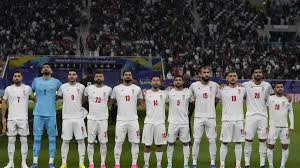
Iran’s football federation has entered negotiations with FIFA to relocate the national team’s group stage matches at the 2026 World Cup from the United States to co-host Mexico, citing security concerns following statements by American President Donald Trump and the ongoing military conflict that has claimed the life of Iran’s Supreme Leader and triggered waves of retaliatory strikes across the Middle East.
Mehdi Taj, president of the Football Federation of the Islamic Republic of Iran, announced the diplomatic push in a statement posted on the Iranian embassy in Mexico’s official social media account on Monday, framing the move as a response to Trump’s inability to guarantee the safety of Iranian players and officials on American soil.
“When Trump has explicitly stated that he cannot ensure the security of the Iranian national team, we will certainly not travel to America,” Taj stated. “We are currently negotiating with FIFA to hold Iran’s matches in the World Cup in Mexico.”
Iran’s participation at this summer’s finals has been cast into serious doubt since the United States and Israel launched a massive military offensive against the Islamic Republic on February 28, 2026, killing Supreme Leader Ayatollah Ali Khamenei and triggering a regional conflagration that has left more than 1,200 dead in Iran and sparked retaliatory missile and drone strikes against Israeli territory and American military installations across the Gulf.
The World Cup tournament, scheduled to run from June 11 to July 19 across 16 cities in the United States, Canada, and Mexico, represents the first time the competition will be hosted by three nations simultaneously and the first expansion to a 48-team format in the tournament’s history. Iran qualified for the expanded competition on March 25, 2025, becoming the first Asian nation to secure a berth after topping their qualification group with a 2-2 draw against Uzbekistan at Tehran’s Azadi Stadium.
Under the current schedule, Iran is slated to face New Zealand and Belgium at SoFi Stadium in Inglewood, California, with a final group stage match against Egypt set for Lumen Field in Seattle. The team’s base camp for the tournament is currently designated to be in Tucson, Arizona, placing all of Iran’s World Cup operations entirely within American territory.
Iran’s ambassador to Mexico, Abolfazl Pasandideh, issued a separate statement on Monday denouncing what he described as systematic American obstruction of Iranian participation, citing visa processing delays and insufficient logistical support for the delegation’s travel arrangements.
“The US government’s lack of cooperation regarding visa issuance and the provision of logistical support” has created insurmountable barriers to participation, Pasandideh stated, adding that he had independently “suggested to FIFA that Iran’s matches be moved from the United States to Mexico.”
The relocation request follows a week of escalating rhetoric between Iranian officials and the Trump administration over Iran’s World Cup participation. On March 12, Trump posted a statement on his Truth Social platform that appeared to simultaneously welcome and discourage Iranian attendance at the tournament.
“The Iran National Soccer Team is welcome to The World Cup, but I really don’t believe it is appropriate that they be there, for their own life and safety,” Trump wrote, without elaborating on specific security threats or whether his administration would actively prevent Iranian participation.
Trump’s statement marked a significant shift from assurances he had provided just days earlier to FIFA President Gianni Infantino, who publicly announced on March 11 that the American president had “reiterated that the Iranian team is, of course, welcome to compete in the tournament in the United States.”
Infantino, who in December 2025 established a FIFA Peace Prize and awarded it to Trump during the World Cup draw ceremony in Washington, had framed the tournament as an opportunity for global unity despite the escalating Middle East conflict.
“We all need an event like the FIFA World Cup to bring people together now more than ever,” Infantino stated following his meeting with Trump, expressing gratitude for what he described as American support for Iranian participation.
The Iranian national team responded defiantly to Trump’s warnings, issuing a statement asserting that no individual nation could unilaterally exclude a qualified team from FIFA competition and questioning America’s capacity to provide adequate security for all participating nations.
“The World Cup is a historic and international event and its governing body is FIFA, not any individual country,” the statement read. “Iran’s national team, with strength and a series of decisive victories achieved by the brave sons of Iran, was among the first teams to qualify for this major tournament. Certainly no one can exclude Iran’s national team from the World Cup. The only country that could be excluded is one that merely carries the title of host yet lacks the ability to provide security for the teams participating in this global event.”
Iranian Sports Minister Ahmad Donyamali had earlier ruled out participation entirely, stating on March 11 that “considering that this corrupt regime has assassinated our leader, under no circumstances can we participate in the World Cup,” in reference to the killing of Ayatollah Ali Khamenei during the initial wave of American and Israeli airstrikes.
The 86-year-old Khamenei was killed along with numerous other senior Iranian officials, including military commanders and government ministers, when Israeli jets dropped 30 bombs on his compound in Tehran during a coordinated strike that utilized American intelligence and targeted at least 24 Iranian provinces. Iran responded with waves of ballistic missiles and drone attacks against Israel, American military bases in Bahrain, Jordan, Kuwait, Qatar, Saudi Arabia, Turkey, and the United Arab Emirates, significantly escalating a conflict that had already witnessed previous military exchanges during the 2025 Twelve-Day War.
The current crisis represents an unprecedented challenge for FIFA, which has historically maintained that World Cup participation transcends political conflict and diplomatic tensions. The organization faced similar pressure when Indonesia withdrew as host of the Under-20 World Cup in 2023 after refusing to welcome Israel’s qualified team, prompting FIFA to strip Indonesia of hosting rights and relocate the tournament to Argentina.
FIFA regulations state that “if any Participating Member Association withdraws and/or is excluded from the FIFA World Cup 26, FIFA shall decide on the matter at its sole discretion and take whatever action is deemed necessary,” including the possibility of replacing Iran with another qualified team from the Asian Football Confederation.
However, implementing such a replacement at this stage presents significant logistical challenges. The United Arab Emirates and Iraq, who competed in the final stages of Asian qualification, represent the most likely substitutes, though Iraq’s pathway to qualification involved winning an intercontinental playoff that was only completed in November 2025, leaving limited time for FIFA to restructure Group G.
An alternative scenario would see FIFA reduce Group G to three teams, though this would create competitive imbalances with other groups and potentially affect the calculation of third-place teams advancing to the knockout rounds under the new 48-team format, which allows the top two teams from each of the 12 groups plus the eight best third-place finishers to progress to a newly created round of 32.
Iran’s World Cup history extends across six previous tournaments, including every edition since 1998, though the team has never progressed beyond the group stage despite consistently qualifying ahead of regional rivals. The 2026 tournament was widely viewed within Iranian football circles as the nation’s best opportunity to break this pattern, with the expanded format creating additional advancement opportunities and a talented squad featuring European-based players such as Mehdi Taremi, who led the qualification campaign with crucial goals.
Windsor John, general secretary of the Asian Football Confederation, stated on March 16 that Iran remains officially listed as a participating team in the World Cup despite the mounting diplomatic and security challenges surrounding their attendance.
The Trump administration has maintained a travel ban on Iranian nationals entering the United States, though exceptions are written into the policy for athletes, coaches, support staff, and immediate family members traveling specifically for major sporting events including the World Cup and Olympic Games. However, logistical complications regarding visa processing and the broader security environment have created uncertainty about whether these exemptions can be implemented effectively in the current crisis.
The request to relocate matches to Mexico, if approved by FIFA, would represent a highly unusual accommodation that could set precedent for future tournaments facing geopolitical complications. Mexico is hosting 13 matches across three venues in Mexico City, Guadalajara, and Monterrey, and possessing the infrastructure to accommodate additional group stage fixtures, though reassigning matches at this stage would require complex renegotiation of broadcasting schedules, ticketing arrangements, and team travel logistics.
Political analysts have noted that Iran’s potential withdrawal or relocation would mark the first time since France and India pulled out of the 1950 World Cup in Brazil that a qualified nation has failed to participate in the tournament due to circumstances beyond sporting performance. Such a withdrawal could also trigger financial penalties under FIFA regulations, though the governing body has historically shown flexibility in cases involving genuine security concerns or force majeure circumstances.
The broader implications for the 2026 World Cup extend beyond Iran’s individual situation. The conflict has disrupted air travel across the Middle East, forced cancellation of the Finalissima match between Argentina and Spain that was scheduled for Qatar, and raised questions about the participation of other regional teams including Iraq, whose qualification playoff matches have been affected by airspace restrictions.
FIFA has not issued an official statement responding to Iran’s relocation request, and attempts to obtain comment from the organization’s media office were unsuccessful as of the time of publication. The governing body faces a delicate balancing act between maintaining the integrity of its competition regulations, addressing legitimate security concerns, and navigating the political pressures emanating from the tournament’s primary host nation.
The 2026 World Cup represents one of the most commercially significant sporting events in history, with ticket sales reportedly exceeding projections and broadcast rights generating unprecedented revenue across global markets. The United States is hosting 78 of the 104 total matches, including all fixtures from the quarterfinal stage onwards and the final at MetLife Stadium in East Rutherford, New Jersey, on July 19.
Iran’s situation has also drawn attention to FIFA’s awarding of the inaugural FIFA Peace Prize to Trump in December 2025, a decision that human rights organizations criticized as politically compromising the organization’s stated commitment to neutrality. Less than four months after receiving the peace award, Trump authorized the military operation that killed Khamenei and triggered the current regional conflict, creating what critics describe as an inherent contradiction in FIFA’s messaging about football’s role in promoting global harmony.
As the June 11 tournament kickoff approaches, the uncertainty surrounding Iran’s participation represents one of several complications facing organizers, including earlier concerns about security funding that were resolved when the Department of Homeland Security confirmed the release of $625 million in World Cup-related appropriations following delays caused by partial government shutdowns.
For Iranian football supporters, the potential inability to participate in the tournament represents a devastating blow to a program that has invested decades in developing competitive infrastructure and producing players capable of competing at the highest international level. The national team’s qualification as the first Asian nation to secure a berth had been celebrated across Iran as a moment of sporting achievement transcending the country’s political and economic challenges.
Whether FIFA approves Iran’s relocation request, identifies a replacement nation, or maintains the current schedule while pressing both Iran and the United States to resolve the participation dispute remains to be seen as the tournament’s opening matches draw closer and the window for logistical adjustments narrows.