
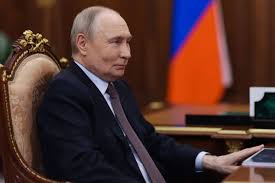
Russian President Vladimir Putin used the occasion of Nowruz, the Persian New Year, on Saturday to publicly reaffirm Moscow’s solidarity with Tehran, describing Russia as a “loyal friend and reliable partner” of Iran at one of the most consequential moments in that country’s modern history. The message, directed at Iran’s new Supreme Leader, Ayatollah Seyyed Mojtaba Hosseini Khamenei, and President Masoud Pezeshkian, arrived on the same day Iranians marked the start of their new year under the shadow of an active war, with missile strikes, displacement, and mounting losses shaping the daily reality of life across the country.
“Nowruz greetings were sent to the Iranian leaders: Supreme Leader of the Islamic Republic Ayatollah Seyyed Mojtaba Hosseini Khamenei and President Masoud Pezeshkian,” the Kremlin said in a statement. “Vladimir Putin wished the Iranian people strength in overcoming these severe trials and emphasised that during this difficult time, Moscow remained a loyal friend and reliable partner of Tehran.”
The message was more than a seasonal courtesy. It landed at a moment when the nature and extent of Russia’s actual support for Iran is under intense scrutiny, disputed even among Iran’s own leadership, and when Washington and Moscow are exchanging accusations over Moscow’s reported intelligence activities in the conflict zone.
The 2026 Iran war began on 28 February 2026, when the United States and Israel launched surprise airstrikes on multiple sites and cities across Iran, killing Supreme Leader Ali Khamenei and numerous other Iranian officials. Iran responded with missile and drone strikes against Israel, US bases, and US-allied countries in the region.
At the State of the Union Address in late February 2026, President Trump stated that Iran had restarted its nuclear programme and was developing missiles capable of striking the United States. The military campaign, which the Trump administration has referred to publicly as “Operation Epic Fury,” was framed by Washington as a preemptive measure against what it described as an imminent threat from the Iranian regime.
The death toll has risen to more than 1,300 people in Iran, more than 1,000 people in Lebanon, 15 in Israel and 13 US military members in the region. Millions of people in Lebanon and Iran have been displaced. The conflict has triggered one of the most severe disruptions to global energy markets in recent memory, with oil prices surging sharply and shipping through the strategically vital Strait of Hormuz severely affected.
On 5 March 2026, a military source told Fars News Agency that Iran had fired over 500 ballistic and naval missiles and almost 2,000 drones since 28 February. The report claimed that almost 40 percent of the launches were aimed towards Israel, and almost 60 percent were fired towards US targets in the region.
Among the most consequential recent developments in the war was the killing of Ali Larijani, Iran’s Secretary of the Supreme National Security Council, in an Israeli airstrike on the outskirts of Tehran on 17 March 2026. Larijani was a former Revolutionary Guards officer who went on to run state broadcasting, serve as Iran’s chief nuclear negotiator and serve as the speaker of parliament for more than a decade. In the months leading up to the war, Larijani had become even more important, at times effectively running the country’s day-to-day strategy as pressure mounted.
His son Morteza and the head of his office Alireza Bayat were also killed in the strike. The commander of Iran’s internal Basij militia, Gholamreza Soleimani, was also killed in a separate Israeli airstrike on the same night.
Moscow condemned both deaths. Kremlin spokesman Dmitry Peskov told reporters, “We firmly condemn actions aimed at harming the health and, even more, the killing of the leadership of sovereign and independent Iran.” Iranian state media later reported that Putin sent a personal letter to Supreme Leader Mojtaba Khamenei offering his condolences.
According to analysts, while the assassination of Larijani weakened the Islamic Republic, it would significantly hinder efforts to bring the Iran war to a negotiated end. Often described as a pragmatist, Larijani was a diplomatic figure central to shaping Iran’s strategic decisions.
Putin’s Nowruz message has done little to settle the central question hanging over Moscow’s posture in this conflict: what exactly is Russia doing beyond issuing sympathetic statements?
The extent of Moscow’s support for Iran is in dispute. Some Iranian sources have said that they have had little real help from Moscow in the biggest crisis for Iran since the US-backed Shah was toppled in the 1979 revolution.
Russia’s role in the war has focused on intelligence sharing and logistical aid, avoiding direct combat to prevent straining its resources amid the Ukraine conflict. US officials reported that Moscow supplied Iran with real-time data on American warships and aircraft, enabling more precise retaliatory strikes. This assistance included satellite feeds from Russian assets, which helped Iran monitor US military positions.
Russia is reportedly providing Iran with intelligence and advice on drone tactics as it continues to launch attacks in retaliation for US-Israeli strikes. The Kremlin has denied those reports. White House officials separately said that Moscow had assured Washington it was not providing targeting information to the Iranian military, a claim that sits uneasily alongside persistent reporting from US media outlets suggesting otherwise.
Politico reported that Moscow proposed a quid pro quo to Washington: the Kremlin would stop sharing intelligence with Iran if Washington ceased supplying Ukraine with intelligence about Russia, but the United States rejected the idea. The Kremlin has dismissed the report as fake.
When asked about the reports by CBS News, Defense Secretary Pete Hegseth said: “No one’s putting us in danger. We mitigate it as we need to. Our commanders factor all of this.”
Historian Sergey Radchenko noted that while Russia and Iran have a treaty of comprehensive strategic partnership signed in 2025, “they’re not military allies, so Russia is not bound to help Iran.” He added that any intelligence support being provided is “probably on a limited scale” and that “Russia is not in a great hurry to help.”
To understand the current dynamic, it is necessary to look beyond the immediate conflict to the longer history of the Russia-Iran relationship. After the collapse of the Soviet Union, Moscow and Tehran saw mutual advantage in developing a partnership. In 2015, the civil war in Syria brought Russia and Iran into a tactical alliance to prop up the Assad regime. Moscow provided air support, and Tehran reinforced the pro-regime forces’ land component by sending military advisers and encouraging Hezbollah to join the fight on Assad’s behalf.
But it wasn’t until Putin’s full-scale invasion of Ukraine that the relationship between Moscow and Tehran evolved into a much closer, more balanced partnership. After February 2022, Iran checked all three key boxes Russia needed from external partners: willingness to support its military campaign against Kyiv, help in evading sanctions, and the ability to use instruments of pressure against the Western coalition supporting Ukraine.
Iran’s most consequential early contribution was the Shahed series of loitering munitions, which Russian forces began deploying in the autumn of 2022. In return, according to media reports, Russia provided Iran with new military hardware, including several Yak-130 trainer jets and Mi-28 attack helicopters, dozens of Spartak armoured vehicles, and small arms.
Last year, Putin and Pezeshkian signed a Comprehensive Strategic Partnership Treaty, committing their countries to oppose interference by third parties in each other’s internal and external affairs. Moscow and Tehran celebrated the agreement as the culmination of decades of growing ties.
Yet the limits of that partnership have been exposed by the current war. Analysts say Russia specifically avoided language in agreements with Iran that would legally obligate it to fight on Tehran’s behalf if attacked. The ambiguity was a deliberate move by Putin to keep his options open with Israel and the Gulf states.
Brian Whitmore, a senior fellow at the Atlantic Council’s Eurasia Center, said the US and Israeli strikes on Iran have exposed that Russia is an unreliable ally: “For all its talk of establishing a multipolar world, for all of its bluster about leading an anti-Western bloc of states, Moscow lacks the will and the capacity to come to the aid of its alleged partners.”
Despite the optics of watching an ally bear the brunt of a US-Israeli military campaign, Russia’s position may not be as unfavourable as it appears at first glance. Russia, despite denying providing the alleged assistance, clearly benefits from the conflict’s continuation, particularly the rise in oil prices.
Russia’s war economy remains heavily dependent on hydrocarbon revenues. The Kremlin’s 2026 budget reportedly assumes an average Urals oil price of roughly $59 per barrel to balance the books; in late 2025, Urals prices were often well below that level, squeezing Russia’s ability to finance its operations. The surge in global oil prices triggered by the Iran war has therefore come as a significant fiscal relief to Moscow.
Antonio Costa, president of the European Council, stated bluntly: “So far, there is only one winner in this war — Russia. It steadily undermines Ukraine’s position by flouting international law. It gains new resources to finance its war against Ukraine as energy prices rise. It profits from the diversion of military capabilities that could otherwise have been sent to support Ukraine.”
The war in Iran is yet another distraction for the United States, diverting precious resources and bandwidth that Washington might otherwise have allocated to its European partners and Ukraine. Russia may be unable to protect its partners, but it is still skillful in adapting to strategic failures and reaping important tactical gains from them.
The war itself has continued to expand in scope and geography. Iran’s semi-official Mehr news agency reported on Saturday that Iran fired two ballistic missiles at the US-UK military base on Diego Garcia in the Indian Ocean. The reported attacks on the remote Indian Ocean archipelago, some 4,000 kilometres from Iranian territory, marked a significant escalation in Iran’s stated determination to carry the fight beyond the immediate region.
The United Arab Emirates’ Defence Ministry said Saturday that it had responded to three ballistic missiles and eight drones. Iran has attacked US and Israeli bases and other targets around the Gulf in response to the strikes on its territory, with the UAE, Bahrain, Kuwait and Saudi Arabia all coming under fire in recent weeks.
Iran’s official news agency Mizan said Saturday’s airstrike on the country’s Natanz nuclear facility did not result in any radiation leakage. The United Nations’ nuclear watchdog said that “no radiological consequence” was expected.
Within the US-Israeli camp, signals have been mixed. Israeli Defence Minister Israel Katz said attacks against Iran will “increase significantly” in the coming week. US President Donald Trump, however, said on Saturday that he was considering “winding down” military operations in the Middle East, even as the United States simultaneously announced it was sending more warships and Marines to the region.
The mixed US messages came after another climb in oil prices plunged the US stock market, and was followed by a Trump administration announcement that it would lift sanctions on Iranian oil loaded on ships, a move aimed at reining in soaring fuel prices.
Back in Tehran, Iranians marked the arrival of Nowruz under extraordinary circumstances. Iran’s Supreme Leader Mojtaba Khamenei issued a statement marking Nowruz, praising the public for standing firm amid repeated attacks from Israel and the United States, saying the population had “continued your struggle, expanded the defensive front across the country to many fields, neighbourhoods and mosques, and dealt a confusing blow to the enemy.”
Putin’s Nowruz message, for all the warmth of its language, has done little to resolve the central ambiguity of Russia’s role in the worst crisis to hit Iran since the 1979 revolution. What is clear is that Moscow intends to maintain its posture of visible political solidarity while keeping the precise contours of any practical assistance firmly opaque, a calibrated position that protects its economic gains, preserves diplomatic flexibility with Washington, and keeps open whatever leverage Tehran’s dependence on Moscow may yet yield.