
The Funding Mystery Inside Trump’s Gaza Reconstruction Board
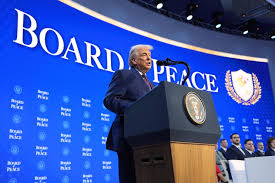
US President Donald Trump’s Board of Peace, the high profile body assembled to oversee the reconstruction of war torn Gaza, currently holds zero dollars in its official fund despite member nations publicly pledging billions, according to a Financial Times investigation published Wednesday.
The disclosure casts fresh scrutiny on an initiative that has already drawn criticism over its membership composition, governance structure, and the unusually central role assigned to the US president himself.
Trump originally conceived the Board of Peace as the principal vehicle for rebuilding the Gaza Strip following the US brokered ceasefire reached in October between Israel and Hamas, an agreement intended to bring an end to nearly two years of devastating warfare. The board was formally established in January.
However, since its inception, the fund administered by the World Bank and endorsed by the United Nations has received no deposits from donor nations, the Financial Times reported, citing four sources familiar with the matter. “Zero dollars have been deposited,” one source told the newspaper.
Instead, contributions have reportedly flowed into a JPMorgan account managed directly by the board, according to the board’s spokesperson cited in the report. The Financial Times noted that the JPMorgan account operates without “independent transparency requirements,” raising questions among observers about oversight and accountability for sums of such magnitude.
The board’s pledged commitments are substantial on paper. Trump previously announced that the United States would contribute $10 billion. Qatar, Saudi Arabia, and the United Arab Emirates each pledged at least $1 billion. Under the board’s charter, member states are required to pay $1 billion to secure a permanent seat.
The governance arrangement has also drawn attention. The body is led not merely by the United States as a state actor but personally by Trump, who retains final decision making authority and, according to the charter, may continue in that role beyond the end of his presidency.
The board’s invitations have proven equally controversial. Trump extended membership offers broadly, including to Russian President Vladimir Putin and to several countries with limited historical involvement in Middle East diplomacy. Major European powers have declined to participate, with France and Britain both refusing to join. The current membership leans heavily on traditional US allies in the Middle East, ideological partners of Trump, and smaller states seeking closer ties with Washington.
The scale of Gaza’s reconstruction needs makes the funding gap particularly significant. A joint European Union and United Nations assessment published in April estimated that more than $71 billion will be required over the next decade to rebuild the territory.
On the ground, conditions remain volatile. Despite the October ceasefire, Gaza continues to experience daily violence, with Israeli strikes ongoing and both the Israeli military and Hamas trading accusations of truce violations.
Neither the White House nor the board’s administrators have publicly responded to the Financial Times findings as of the time of this report.
AFP