
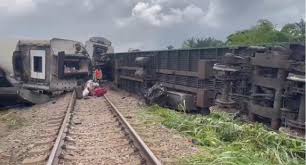
Survivors of the June 8 derailment on the Warri-Itakpe rail corridor have nearly all left hospital, the Nigerian Railway Corporation says, even as a federal safety bureau presses on with its inquiry into yet another accident on a line battered by repeated failures.
Managing Director of the NRC, Kayode Opeifa, said in a statement issued on Tuesday in Lagos that every injured passenger had been treated and discharged, with one corporation staff member who suffered severe injuries still under specialist care. All equipment involved in the accident has also been fully recovered.
The accident happened at about 4:17 p.m. on June 8 near the Goodluck Jonathan Railway Station in Agbor, Delta State, when four coaches capsized and one derailed. The train had departed Itakpe at noon for Ujevwu, carrying 442 passengers and 40 crew, security, medical and support personnel, a total of 482 people on board.
The corporation has confirmed five fatalities. Early statements through the Federal Ministry of Transportation, signed by Permanent Secretary Funsho Adebiyi, had put the toll at four, comprising two adult females, one adult male, and one infant, with 24 others seriously injured. Among those on board were Senator Ede Dafinone, who represents Delta Central, and former Delta State Secretary to the Government, Patrick Ukah.
Opeifa said the NRC had accounted for all passengers and personnel, commending medical teams at General Hospital Owa Oyibu, Owa Alero Hospital and Central Hospital, Agbor, for their response. He said a medical and victim support committee had visited injured passengers and bereaved families in Agbor, Asaba and Ugbolu, with visits to Warri to follow. The NRC boss disclosed that engineers had begun restoration works on the damaged track.
The crash has reopened hard questions about a corridor that has buckled repeatedly. Commissioned for commercial operations in 2020, the Itakpe-Warri line is one of Nigeria’s major standard-gauge projects, linking the North Central and South-South regions and serving thousands of commuters and traders daily. Yet its recent record is troubling. The NRC resumed the service on October 29, 2025 after an August 2 suspension for technical faults, only for two coaches to derail at Agbor on November 1, an incident the corporation blamed on suspected track vandalism. Service was suspended again in May 2026 for operational and technical assessments before the system failed once more on June 8.
Following the November derailment, the Senate, acting on a motion by Ede Dafinone, warned of grave safety lapses, inadequate technical supervision and a poor maintenance culture. The latest tragedy has drawn fresh scrutiny, with the House of Representatives on June 10 adopting a motion by Delta lawmaker Francis Waive calling for a thorough investigation and adequate compensation for victims.
The Nigerian Safety Investigation Bureau has retrieved critical evidence and concluded on-site work. Its Director-General, Captain Alex Badeh Jr., led investigators to the scene alongside Opeifa and Adebiyi. The bureau stressed that its inquiry is safety-focused and non-punitive, aimed not at apportioning blame but at establishing causal factors and recommending measures to improve rail safety.
Wider context underscores the stakes. Rail has become a preferred option for many Nigerians amid road insecurity and costly air travel, and in March 2022 an Abuja-Kaduna train was attacked by terrorists, causing deaths and abductions and forcing a months-long shutdown. The NSIB’s findings are now expected to shape whether the Warri-Itakpe line can win back public confidence.