
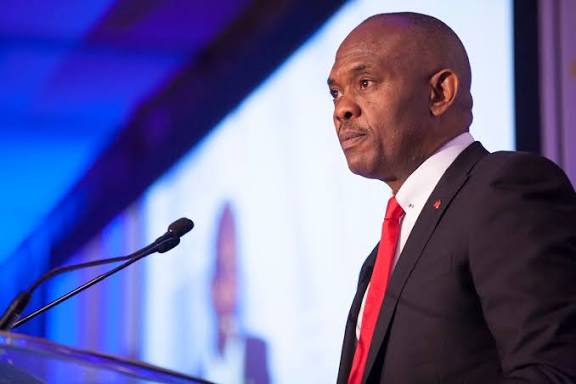
A brief exchange between United Bank for Africa Group Chairman, Tony Elumelu, and a young graduate over how he should be addressed has reopened a familiar argument in Nigerian workplaces about titles, hierarchy and the widening gap between traditional deference and the first name informality favoured by a younger, globalised generation.
The moment, captured in a video widely circulated on social media, occurred during an interactive session at the graduation ceremony of the bank’s Graduate Management Accelerated Programme in Lagos. When the graduate greeted him with “Good morning, Tony,” Elumelu corrected her, making clear his preferred forms of address. “You’ll call me Mr Elumelu or TOE,” he said, adding that he did not subscribe to that style of familiarity. The graduate quickly adjusted and continued with her question.
The clip drew mixed reactions. Some commenters online argued that addressing a senior figure by his first name in a formal setting showed a lapse in social awareness, insisting that even in Western corporate cultures, familiarity is usually earned before first names are used. Others were more sympathetic to the graduate, noting that many modern organisations, particularly in banking and technology, now encourage employees to address colleagues and even senior executives by their first names, and that she may simply have been reading from that script.
That tension is the real story, and it is not new. In much of Nigerian corporate and public life, seniority is signalled through address. Words such as “oga”, “sir”, “ma” and “boss” remain standard, and titles carry social weight far beyond the office. At the same time, multinational firms, fintech startups and remote first employers have imported flatter conventions in which first names are the norm and titles are seen as barriers to collaboration. Younger workers, often described loosely as Gen Z, move between these two worlds and are frequently caught in the mismatch.
The setting sharpened the moment. The programme in question is UBA’s flagship talent pipeline. According to figures shared at the ceremony, 374 young professionals graduated in this cohort, while the initiative has trained more than 5,000 graduates across Africa since inception. Earlier cohorts in 2026 alone accounted for more than 700 graduates in a single combined ceremony, an indication of the scale at which the bank is recruiting and shaping entrants into its workforce.
The programme sits against a difficult labour market backdrop. Youth unemployment and underemployment remain among the country’s most pressing economic challenges, and structured graduate schemes are one of the few reliable routes into stable professional employment. Elumelu himself has repeatedly framed the initiative around Nigeria’s demographic profile, noting that with more than 60 per cent of the population under the age of 30, the country’s prospects depend heavily on how well its young people are trained and absorbed into productive work.
There is a certain irony in the exchange given Elumelu’s own history. He is a self described former copier salesman who rose through the banking sector, led the 2005 merger of Standard Trust Bank and United Bank for Africa in one of the largest banking deals in sub Saharan Africa at the time, and built UBA into a pan African group with operations in about 20 African countries and a presence in France, the United Kingdom and the United States. He was conferred with the national honour of Commander of the Order of the Federal Republic in 2022 and remains one of the continent’s most visible business figures through his investment company and his foundation, which focuses on empowering young African entrepreneurs. For many observers, his insistence on formal address was less about ego than about institutional culture and the standards he expects entrants to internalise.
Neither side of the online debate is objectively wrong, and that is precisely why the clip resonated. Etiquette experts have long noted that the safest default in a formal, hierarchical or unfamiliar setting is to use a title until invited to do otherwise, since the cost of excessive formality is low while the cost of misjudged familiarity can be high. Corporate culture specialists, on the other hand, point out that first name policies are deliberately designed to reduce hierarchy and encourage open communication, and that young professionals trained in such environments are behaving exactly as instructed.
What the exchange ultimately reflects is a workplace culture in transition. As Nigerian firms compete for global talent and adopt international norms, and as a younger workforce brings different expectations, moments like this are likely to recur. The lasting lesson is a practical one that predates the video and will outlast it. When in doubt, read the room, and let the senior person set the terms of address.