
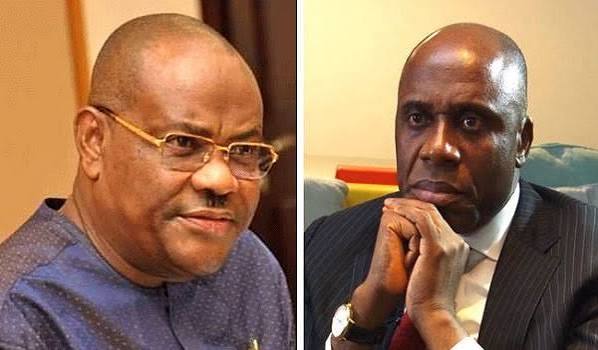
Two men who once shared the same political household, one as governor and the other as his chief of staff, now stand on opposite ends of a fight over who truly owns Rivers State, and the numbers behind that fight tell a more complicated story than either side admits.
Minister of the Federal Capital Territory, Nyesom Wike, on Tuesday used his monthly media chat in Abuja to describe former Minister of Transportation and African Democratic Congress vice presidential candidate, Chibuike Rotimi Amaechi, as a political liability with no electoral value in Rivers State or the wider South South. He also declared that President Bola Tinubu is the only candidate capable of winning Rivers in the 2027 general election.
“If anybody is counting Rivers, go now and cancel it. The only person that can count Rivers is Asiwaju Bola Ahmed Tinubu. I am not talking because I want to talk; I am talking as a political realist, because I know my people,” Wike said.
On Amaechi’s nomination as running mate to former Vice President Atiku Abubakar, the minister said, “I am sure the only factor that has been used to choose Rotimi Amaechi may be financial because the former governor lacks the capacity to deliver votes.”
Wike anchored his argument on three election cycles. “He has never won a presidential election after 2011 when I was the Director of Campaign. Never! He was the Director-General of Buhari in 2015 when he was governor; why did he not get 25%? He was the DG in 2019 when he was a Super Minister; why did he not get 25%? He supported Atiku in 2023; how come he didn’t get 15%?” he queried.
Independent National Electoral Commission records for Rivers support two of those three claims and complicate the third.
In the 2015 presidential poll, conducted while Amaechi was sitting governor and director general of the Buhari campaign, the Peoples Democratic Party’s Goodluck Jonathan polled 1,487,075 votes in Rivers against 69,238 for the All Progressives Congress. Out of 1,565,461 valid votes, that placed the APC at roughly 4.4 per cent, far below the constitutional 25 per cent threshold.
In 2019, with Amaechi serving as Minister of Transportation and again heading the Buhari campaign, the state collation officer declared 473,971 votes for the PDP’s Atiku Abubakar. Figures reported at the time for the APC ranged between 150,710 and 159,710 out of 642,165 valid votes, placing the party between 23 and 25 per cent. Collation that year was disrupted, with results cancelled in Ikwerre, Amaechi’s local government, as well as Ahoada West, Emohua, Okrika, Bonny and Akuku Toru.
The 2023 figure is where the claim strains. INEC declared Tinubu winner in Rivers with 231,591 votes, ahead of Peter Obi of the Labour Party with 175,071 and Atiku with 88,468. Against 523,651 valid votes, the PDP scored about 16.9 per cent, slightly above the 15 per cent benchmark Wike cited. It is also worth noting that Amaechi contested the APC presidential primary in June 2022 and lost to Tinubu, and remained an APC member through the 2023 poll rather than formally campaigning for Atiku. He has since publicly alleged that Obi, not Tinubu, won Rivers that year, a position that remains contested and was not upheld by the courts.
Beneath the exchange of claims sits a sharper trend. Rivers recorded 1,584,768 votes cast in 2015 from 2,324,300 registered voters, a turnout of about 68 per cent. By 2019, turnout fell to 666,585 votes from 3,215,273 registered voters, roughly 21 per cent. In 2023, it dropped further to 553,944 from 3,537,190 registered voters, about 16 per cent.
Put plainly, the winning candidate in Rivers in 2023 secured victory with fewer votes than the losing party polled in 2019, and with barely a seventh of Jonathan’s 2015 haul. Whatever either camp claims about ownership of the state, the pool of voters actually turning out has shrunk dramatically across a decade.
Amaechi served as Speaker of the Rivers State House of Assembly from 1999 to 2007, governor from 2007 to 2015, and Minister of Transportation from 2015 to 2023. He won re election as governor in 2011 with 1,178,529 votes on the PDP platform, with Wike then serving as his chief of staff. Their split, and Amaechi’s defection to the APC, preceded Wike’s own emergence as governor in 2015 with 1,029,102 votes against Dakuku Peterside’s 124,896.
Wike returned to that history on Tuesday, tying it to Jonathan’s defeat. “A South-South person wanted to go for a second term. You were proud you kicked him out. Now, will South-South be happy for you to be Vice President? You think that people have forgotten?” he asked.
He also questioned Amaechi’s consistency over the ADC primary. “This was the same man, just one month ago, who said the ADC primary was manual, irregular, and corrupt. How can we talk about removing a government that we are saying there is no election, and then we are in another election? The same man now is benefiting from the corruption, from irregularities of the same system,” Wike said.
Public records show the ADC declared Atiku winner of its May 2026 presidential primary with 1,846,370 votes, ahead of Amaechi with 504,117 and Mohammed Hayatu-Deen with 177,120. Amaechi publicly rejected the outcome as concocted and alleged voter disenfranchisement, while Hayatu-Deen boycotted the declaration. ADC National Chairman David Mark described the contest as free, fair and credible. On June 15, roughly three weeks after that protest, the party’s National Publicity Secretary, Bolaji Abdullahi, announced Amaechi as Atiku’s running mate, citing his runner up performance and his standing in the South South. Amaechi has not publicly issued a formal acceptance statement, and Abdullahi has insisted there is no crisis over that silence.
Wike said a cross party alliance had taken shape in the state. “Today, we have PDP, APC, Labour Party, AA all together. Whoever emerges should not be seen as APC or PDP; the person should be seen as the coalition’s candidate,” he said, describing the arrangement as “spreading like wildfire.”
The alliance, publicly known as the Rainbow Coalition, gained ground on July 22 when Governor Siminalayi Fubara endorsed Tinubu’s re election, aligned with the coalition and backed Kingsley Chinda as his preferred successor. That reconciliation follows a two year rupture that saw impeachment moves against Fubara, a six month state of emergency declared by President Tinubu in March 2025, Fubara’s later defection to the APC, and his withdrawal from the APC governorship primary in May 2026.
Wike framed the alliance in developmental terms. “If Rivers State is relevant because projects are coming and people are benefiting from government, then I am satisfied. It is not about personal ambition; it is about the interest of the state,” he said, citing the Bonny Road and adding, “Never in the history of Rivers State, from 1999, of those who claimed to be very close to the President, have we had the type of attention that Rivers State has now.”
He also recalled the 2019 governorship exercise, saying, “I saw what federal might means. Military personnel came with battalions as if Rivers State was at war. We survived it by the grace of God and fought back.”
INEC data offers a final marker for what is at stake. Rivers recorded 71,456 registrations across the first two phases of the Continuous Voter Registration exercise and a further 52,710 in the third phase, which closed on July 10, 2026, out of 2,436,275 nationwide as at that date. The commission has proposed converting 2,424 voting points in the state into full polling units, which would raise the state total to 6,866. Claims and objections for the third phase register opened across the 23 local government areas on Tuesday and run till August 10.
Whether the coalition delivers what Wike projects, or whether the ADC ticket makes inroads Amaechi’s critics doubt, will be settled at those units in 2027.