
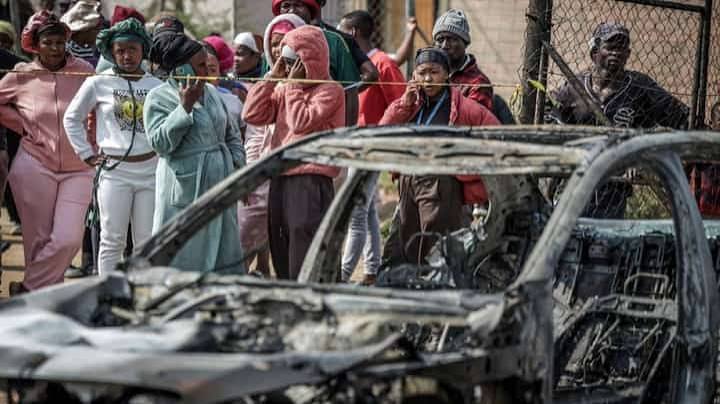
At least 17 people have been shot dead in two unrelated attacks in South Africa, deepening a wave of mass killings that has turned the country’s gun problem into one of its gravest security challenges. Police said nine victims, six men and three women, were found in a shack at an informal settlement outside Pretoria early on Monday, while eight men were discovered with gunshot wounds inside a vehicle in a semi-rural area outside Pietermaritzburg, in KwaZulu-Natal.
The eight victims in KwaZulu-Natal, believed to be aged between 20 and 30, were pronounced dead at the scene. Police have made no arrests and say the two incidents are not connected. Provincial Police Commissioner Tommy Mthombeni said the Pretoria attack might be linked to a shooting at a nearby settlement last year in which 12 people were killed and 13 others wounded, while a police spokesman, Col Robert Netshiunda, cautioned against speculation about the motive until the victims are identified.
Investigators have in the past tied similar killings in the province to stock theft, drug networks and disputes over control of minibus taxi routes. KwaZulu-Natal Premier Thamsanqa Ntuli linked the latest bloodshed to the flood of illegal weapons in circulation, describing their easy availability as a serious threat to public safety.
The attacks fit a pattern that has alarmed officials and researchers alike, and the official numbers place the problem in sharp relief. According to the South African Police Service, the country recorded 5,181 murders between January and March 2026, an average of 58 a day, a decrease of almost 10 per cent compared with the same period a year earlier. That decline continued into the following quarter, with 5,427 murders logged between April and June 2026, down 5.9 per cent on the same three months in 2025.
Measured over a full year, the trend is similar but the scale remains extreme. From April 2025 to March 2026 the murder rate stood at 36.6 per 100,000 people, down from 40.7 in the preceding twelve months, yet still far above the African average of about 12.7 and a global average of roughly 5.6. The Eastern Cape remains the deadliest province, while KwaZulu-Natal recorded a rate of 8.8 murders per 100,000, against a national average of 8.2.
What has shifted most sharply is the frequency of attacks that claim several lives at once. The Institute for Security Studies has identified KwaZulu-Natal as the epicentre of multiple murders, noting that the provinces where such killings weigh heaviest, KwaZulu-Natal, Gauteng and the Western Cape, also record the highest levels of firearm use in violent crime. The institute estimates that about 3.5 million illegal firearms are in circulation, and that guns are used in roughly 60 per cent of murders.
This year has brought a grim run of such incidents. In late September, 27 people were killed in a single weekend of tavern attacks in Carletonville in Gauteng and Lwandle near Cape Town, part of a seven-day stretch in which about 38 people died. Days earlier, 11 people had been shot at a house party in KwaMakhutha, south of Durban. Researchers counted more than 80 mass shooting incidents in 2024, and the police recorded seven in the first quarter of 2025 alone, counting events with five or more victims.
The repeated massacres have forced a harder response. The authorities have leaned on joint operations such as Operation Prosper, which pairs the police with the military to target illegal mining, gangsterism and violent crime in Gauteng. Even so, the gap between falling official totals and daily experience remains wide. A recent Statistics South Africa survey recorded a 21 per cent rise in households reporting that a member had been murdered, a sign of how deeply the violence is felt on the ground.
For now, two more communities are counting their dead, and detectives in both provinces are working without suspects. Whether the killings outside Pretoria and Pietermaritzburg prove to be fresh outbreaks or extensions of older feuds, they sharpen a point officials themselves concede, that lower crime figures are not the same as safety.