
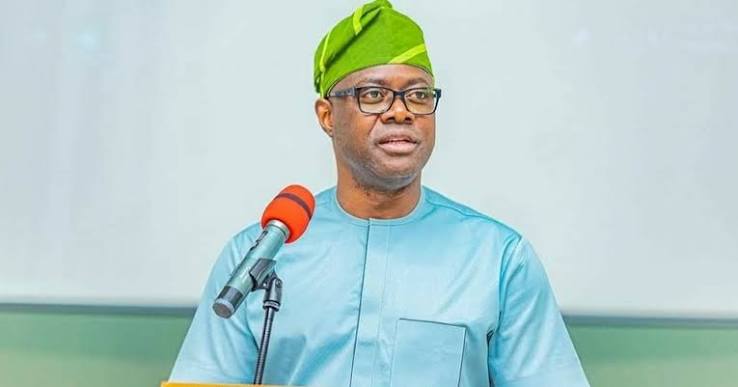
Oyo State Governor Seyi Makinde has built his 2027 presidential campaign around an unusual promise: a single four-year term that, by his own reasoning, would let Southern Nigeria finish the eight-year run in the presidency that political tradition assigns it before power rotates back to the North in 2031.
In a statement from his campaign office, Makinde, who is flying the flag of the Allied Peoples Movement, said he was in the race to win, to reset the country and to serve just one purposeful term. His team said the commitment to a single term was rooted in fairness and in keeping faith with the understandings that hold the federation together, arguing that the South should complete its remaining four years and round off its turn by 2031.
Makinde’s path to the ballot has been anything but conventional. Elected governor on the Peoples Democratic Party platform in 2019 and returned for a second and final term in 2023, he broke with the PDP amid a prolonged leadership crisis and declared his presidential ambition on 14 May 2026 at a joint rally with the APM at Mapo Hall, Ibadan. He formally accepted the APM ticket at the end of that month, later completing it with Lawal Daura, a former Director-General of the Department of State Services, as his running mate, giving the party a South-North pairing.
The eight-year argument he leans on is not his alone, and that is part of what makes it politically charged. Since 1999, the presidency has largely alternated between North and South in eight-year cycles, an unwritten convention rather than a constitutional rule. President Bola Tinubu, a southerner elected in 2023, is seeking a second term on the same logic, and senior figures in his camp, including the Minister of the Federal Capital Territory, Nyesom Wike, have argued that the South must be allowed to complete its eight years through Tinubu. Makinde accepts the rotation but turns it on its head, offering himself as a southern candidate who would serve only four years and hand over in 2031, rather than pursue the full two terms.
At the centre of his pitch is what he calls the Reset Agenda, a manifesto organised around four pillars: the economy, security, education and the socio-political system. The programme proposes lowering the cost of production and living, introducing state policing, transferring more responsibilities from the Federal Government to the states, and lifting learning outcomes, with a target of at least half of Primary Three pupils meeting minimum literacy standards within three years. Makinde has repeatedly insisted the reset can be achieved in one term, describing himself as a “resetter” and promising a transitional government of national unity.
The strategy carries real risks. Makinde is building a national structure outside Nigeria’s dominant parties, and the opposition remains fractured despite an April 2026 summit in Ibadan, which he hosted, where major parties agreed in principle to field a single candidate against Tinubu. That consensus never held. Atiku Abubakar is now the candidate of the African Democratic Congress, Peter Obi retains a large following, and the APC is marshalling the advantages of incumbency. Even within Makinde’s new political home the picture is mixed: six members of the House of Representatives from Oyo followed him into the APM, yet other politicians and supporters in the state have drifted towards the APC, some dismissing the platform as too closely tied to one man.
Whether a one-term offer strengthens or weakens his hand is the open question. For some northern voters wary of an extended southern presidency, a fixed four-year ceiling could be reassuring. For others, a candidate promising to leave after a single term may struggle to convince them he can deliver sweeping reform and still see it through. What is clear is that Makinde has chosen to make rotation, restraint and results the spine of his campaign, and that argument will be tested as the 2027 field takes firmer shape.