
The Catholic Bishops’ Conference of Nigeria has set aside 8 December 2026 as a national day of prayer and fasting for a peaceful and credible 2027 general election, and has directed dioceses and parishes to begin months of civic education and voter mobilisation before the polls.
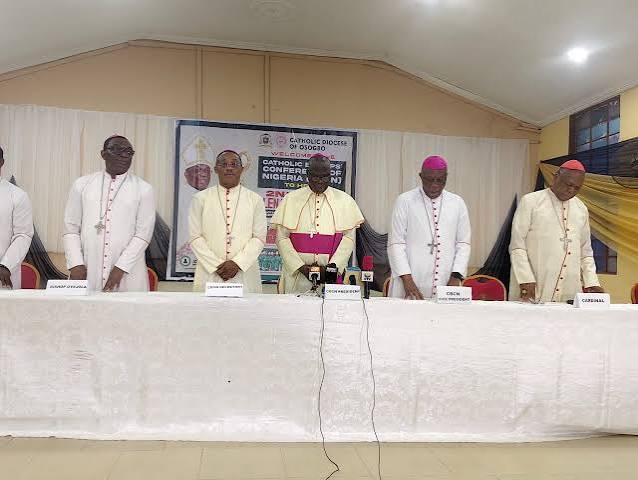
The declaration came in a communiqué issued at the close of the conference’s Second Plenary Meeting for 2026, held from 10 to 18 September at the Our Lady and St Kizito Pastoral Centre, Oke-Gada, Ede, in the Osogbo Diocese of Osun State. The communiqué was signed by the CBCN President, Archbishop Matthew Man-Oso Ndagoso of Kaduna, and the Secretary, Bishop Peter Olukayode Odetoyinbo of Abeokuta, and read in Osogbo by Archbishop Ndagoso.
Beyond the single national day, the bishops asked all dioceses and parishes to hold end of month fasting, prayer and Rosary processions from October to December 2026 in the run up to the election. According to the communiqué, the conference has also issued a separate pastoral letter on the forthcoming polls.
On participation, the bishops urged eligible voters to turn out in large numbers and to vote according to their conscience. They called on all stakeholders to work for elections that are free, fair and credible.
The intervention lands at a defined point in the electoral calendar. The Independent National Electoral Commission has confirmed that the presidential and National Assembly elections will hold in 2027, and the two main figures already in contention, President Bola Tinubu of the All Progressives Congress and Atiku Abubakar of the African Democratic Congress, are locked in a court dispute over eligibility that the Federal High Court in Abuja adjourned to 28 September. The bishops did not name any candidate or party.
Much of the communiqué dwelt on the economy. The conference said poverty was being used as a weapon of control, and stated that the lack of basic needs had left many families struggling to survive.
The bishops called on government at every level to create more jobs, support local businesses and manage economic policy in a way that eases the burden on the poor. They also urged citizens to practise honest labour, back local enterprise and shun crime and corruption.
The concern has a measurable backdrop. The National Bureau of Statistics reported that headline inflation eased to 15.43 per cent in July 2026, its second straight monthly decline, but food inflation moved the other way, rising to 20.31 per cent from 17.52 per cent in June. That gap means the relief in the overall rate has not reached the food basket, where poorer households spend most of their income. Comparisons with rates before 2025 should be treated with care, as the bureau rebased the index that year.
On security, the conference commended government efforts, including the move to decentralise the police, but said the reform should be holistic rather than driven by ethnic sentiment. The bishops said kidnapping, banditry, illegal mining and the theft of natural resources persisted, and demanded that government recover land seized for such activity and put it to productive use.
The communiqué also took a firm position on a pending piece of legislation. The bishops called on the National Assembly to halt the Foreign Aid Bill 2026, warning that granting sweeping discretionary authority to officials over humanitarian resources could stifle faith based organisations, churches, mosques and non governmental groups. They argued that non profit bodies are already regulated under existing law.
That bill, formally the Foreign Aids (Regulation, Transparency and Disclosure) Bill, 2026, marked SB.1034, was sponsored by Senator Ibrahim Hassan Dankwambo of Gombe North. According to National Assembly records, it was first read on 6 May 2026 and passed second reading on 22 July 2026, and is before Senate committees for further work. It seeks to establish a Foreign Aid Regulatory Commission with powers to register, monitor and sanction recipients of foreign funding, including civil society groups, religious bodies and private entities.
The bill has drawn wide opposition beyond the church. Human Rights Watch, the Nigerian Guild of Editors and the Socio-Economic Rights and Accountability Project have all urged the National Assembly to withdraw or reject it, describing several provisions as a threat to civic space and freedom of association. Supporters in the Senate have said the measure is aimed at transparency and national security.
For the church, the timing reflects a long standing practice of political mobilisation through prayer and civic instruction ahead of major elections, a pattern seen in previous cycles. Whether the December exercise translates into higher voter turnout or shapes conduct at the polls will only become clear as 2027 approaches, and the bishops framed their call as a moral appeal rather than a partisan one.