
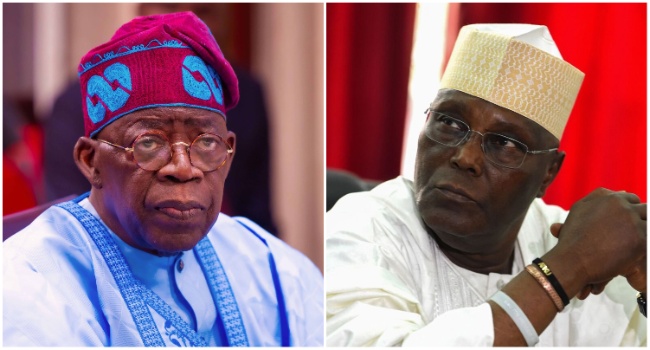
An admission from the International Monetary Fund that Nigeria left public spending worth about two per cent of its Gross Domestic Product out of recent budget records has handed the opposition fresh ammunition, with former Vice President Atiku Abubakar now demanding that President Bola Tinubu’s government account for money he insists “somebody spent” and “somebody benefited from.”
The African Democratic Congress presidential candidate framed the matter in a statement issued on Saturday through his Senior Special Assistant on Public Communication, Phrank Shaibu, describing the omission as evidence of “institutional corruption” at the highest levels of government and warning that it raises “constitutional and accountability concerns” that demand immediate investigation.
At the centre of the row is a disclosure by the IMF’s Resident Representative in Nigeria, Christian Ebeke, who told business executives in Lagos on Wednesday, July 1, that roughly two per cent of GDP in public expenditure was not captured in recent official budgets, creating a mismatch between the country’s reported fiscal deficit and its real financing needs. Ebeke tied the gap largely to major capital projects executed off budget. “So far we think that there are about 2% of GDP of expenditure that were not reported that should be reported and should be recorded, so that this statistical discrepancy will disappear,” he said. He noted that Nigerian authorities had begun revising budget laws to absorb the unrecorded spending, while cautioning that off-budget outlays raise concerns about procurement, oversight and accountability.
Placed against Nigeria’s 2025 nominal GDP of N441.5tn as computed by the National Bureau of Statistics, two per cent works out to roughly N8.83tn, a figure Atiku has seized upon. “If, as the IMF has revealed, expenditure amounting to two per cent of Nigeria’s GDP was omitted from the budget process, then Nigerians are entitled to one simple question: Who stole the missing two per cent of our GDP?” he asked. “This is no longer an accounting discrepancy” but “a constitutional, legal and moral scandal. Money does not simply disappear from a national budget. Somebody authorised it. Somebody approved it. Somebody spent it. Somebody benefited from it. Nigerians deserve to know who those people are.”
The former Vice President wove the IMF disclosure into the wider controversy over the alleged Presidential Foreign Intervention Promotion Council, an entity the Presidency has publicly disowned. In a June 11 disclaimer and a fuller July 1 statement, the State House, through presidential spokesman Bayo Onanuga and Chief of Staff Femi Gbajabiamila, described the self-styled Director General of the body, Prince Adeniyi Adeyemi, as an impostor with a history of fraudulent misrepresentation, and confirmed that the Nigeria Police Force had filed an eight-count charge of conspiracy, forgery and impersonation against him at the Federal High Court in Abuja. Even so, published details of the 2026 Appropriation Act list an entity styled “Presidential Economic Advisory Council/Presidential Foreign Intervention Promotion Council,” with reports by Channels Television and the ICIR putting the allocation at more than N1.3bn.
Atiku drew a sharp contrast between that figure and the health sector. He said it was troubling that the Federal Ministry of Health reportedly received only N36m in releases despite a budgetary allocation of more than N218bn, while the disputed council allegedly had about N1.3bn waiting for it. “Nothing better illustrates the warped priorities of this administration than a government that starves hospitals and healthcare programmes of funds while ghost agencies somehow find billions waiting for them. This is not fiscal management; it is institutionalised corruption,” he said.
He called on the Secretary to the Government of the Federation, George Akume, to explain how the alleged agency gained official recognition. “The Secretary to the Government of the Federation owes Nigerians a duty of candour. He must come clean. The country deserves to know who authorised the recognition of the so-called Presidential Foreign Intervention Promotion Council and under whose directive government institutions accorded it official status,” Atiku said.
He further pointed to Adeyemi’s own allegation that the dispute began after he refused a demand for a 48 per cent kickback from the Office of the Chief of Staff over a proposed N27.3bn take-off grant, an allegation the Presidency has firmly rejected and which remains untested in court. Describing it as too serious to ignore, Atiku called for an independent probe. “If the allegations are false, let the government prove them through an open investigation. If they are true, then every official connected with this scandal, regardless of rank or office, must be removed immediately and handed over to the appropriate security agencies for prosecution,” he said.
The intervention lands at a difficult moment for household finances. Headline inflation rose for a third straight month to 15.93 per cent in May 2026, according to the NBS, even as the naira, electricity tariffs and multiple taxes continue to bite following the removal of the fuel subsidy. Nigeria’s public debt profile remains heavy, with the 2026 budget of N68.32tn carrying a deficit of N31.46tn and debt servicing alone gulping N15.81tn. Against that backdrop, Atiku argued, the off-budget question cuts deep. “It is both ironic and cruel that citizens are being asked to make endless sacrifices while government itself cannot transparently explain where enormous public resources have gone,” he said.
He insisted the issue transcends partisan politics. “The books must be opened. Every naira must be traced. Every expenditure must be justified. Every official found culpable must be held accountable,” he said, adding that until the government offers a satisfactory explanation for the alleged off-budget spending, “every claim of transparency by this administration will ring hollow.”
To that end, the former Vice President urged the National Assembly, the Auditor-General of the Federation, the Public Accounts Committees of both chambers, the Economic and Financial Crimes Commission and the Independent Corrupt Practices and Other Related Offences Commission to investigate the matter.
The IMF, for its part, framed its findings less as an allegation of theft than a call for cleaner reporting. In its latest Article IV consultation, the Fund commended Nigeria’s macroeconomic reforms, including foreign exchange liberalisation and subsidy removal, for strengthening stability and investor confidence, while warning that the gains have yet to reach ordinary citizens and could be undermined by external shocks. Whether the government’s ongoing revision of budget laws will close the transparency gap the Fund identified, or quiet the political storm now building around it, is likely to remain contested in the weeks ahead.