
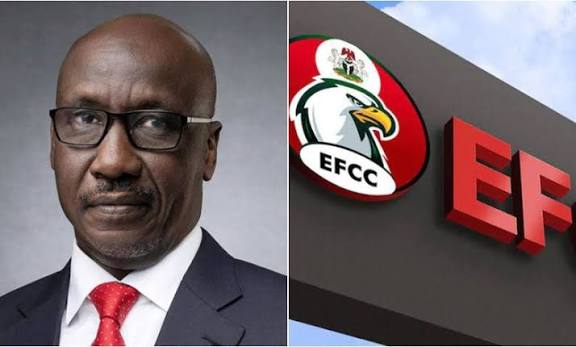
The long-running effort to hold someone accountable for the billions of dollars poured into Nigeria’s dead refineries reached a courtroom on Wednesday, as the Economic and Financial Crimes Commission arraigned the former Managing Director of the Port Harcourt Refining Company Limited, Ahmed Adamu Dikko, before the Federal High Court in Abuja on a 12 count money laundering charge.
Dikko, an engineer who ran the plant from March 2020 for roughly four years, was docked alongside Masterpiece Projects and Investment Limited, listed as the second defendant. Both pleaded not guilty before Justice Inyang Ekwo. The anti graft agency alleged that the defendants laundered about N1.32 billion, put precisely at N1,322,839,112.70, said to be proceeds tied to contractors engaged by the Nigerian National Petroleum Company Limited for the rehabilitation of the refinery. According to the commission, the money moved through cash property purchases, undisclosed bank retentions, concealment of funds through third parties and unauthorised currency conversion, in breach of the Money Laundering (Prevention and Prohibition) Act, 2022.
The specifics laid out in the charge, marked FHC/ABJ/CR/360/2026 and filed on June 22, are granular. One count states that Dikko paid the naira equivalent of N218,375,000 in cash to a person named as Hadeija Bashir for a plot on Abubakar Umar Street, Katampe Extension, Abuja, without routing it through a financial institution. Another alleges that on or about 26 June 2023 he disguised the origin of N328,710,337.50 paid into a GTBank account operated by Masterpiece by OMSA Integrated Services Limited, from transactions involving NNPC Limited’s allocation of Vacuum Gas Oil for export. A further count accuses him of converting an aggregate of 77,080 dollars through one Ibrahim Isa Yaro between October 2022 and May 2025, sums the commission says fell outside his lawful earnings as a public officer.
Prosecution counsel Ekele Iheanacho, SAN, opposed bail, telling the court the commission had filed a counter affidavit on 7 July. Defence counsel Okechukwu Ajunwa, SAN, countered that his client had been reporting to the EFCC under administrative bail and would neither flee nor interfere with the trial. Justice Ekwo, noting that bail is a constitutional right and that substantial reasons must be shown to deny it, admitted Dikko to bail of N150 million with one surety in like sum. The surety must reside within the court’s jurisdiction and own landed property valued at not less than the bail figure. The defendant was ordered to surrender his international passport and remanded in EFCC custody pending perfection of the conditions. Trial was fixed for 12, 13 and 14 October.
The arraignment is one thread in a far larger inquiry. The case sits within what investigators have described as one of the most extensive corruption probes ever mounted in Nigeria’s oil sector, centred on roughly 2.79 billion dollars released between 2021 and 2023 for quick fix repairs, turnaround maintenance and rehabilitation of the Port Harcourt, Warri and Kaduna refineries. Of that sum, about 1.56 billion dollars went to the Port Harcourt plant, 740.7 million dollars to Kaduna and 492.3 million dollars to Warri. Investigators say they found little evidence of any matching improvement in operations, fuelling suspicion that large portions of the money were diverted or misapplied.
Late in June, the EFCC disclosed that it had recovered more than N38.66 billion in cash and assets from the wider investigation, comprising N9.4 billion and 21.2 million dollars, the latter worth about N29.26 billion at the Central Bank’s official rate of N1,380 to the dollar, alongside several landed properties. A further 2.32 million dollars was recovered through the Federal Inland Revenue Service. More than 30 senior NNPCL officials and over 50 representatives of contracting firms have been interrogated, with contractors including Daewoo Engineering Nigeria Limited and Tecnimont SPA named among those under scrutiny. In materials tied to the probe, the commission accused Dikko of approving direct payments to contractors from provisional sum funds in breach of contractual procedure, and said it traced assets worth N983.9 million, 227,030 dollars and three landed properties to him, now under an interim forfeiture order.
The backdrop is a rehabilitation programme that has repeatedly disappointed. Nigeria’s four state owned refineries carry a combined installed capacity of 445,000 barrels per day, yet have run far below that for decades. The Warri refinery reopened in December 2024 only to shut within weeks over safety concerns, while the Port Harcourt refinery was taken offline in May 2025 for scheduled maintenance. In October 2025, the NNPCL announced a technical and commercial review of the three plants, and has since signalled fresh partnerships, including a memorandum of understanding with Chinese firms, to complete and possibly expand the facilities.
The charges against Dikko remain allegations yet to be tested in court, and he has denied all of them. What is not in dispute is that the October hearing will place one of the most closely watched refinery corruption cases squarely before a judge, at a moment when public patience with the state of Nigeria’s refining assets has worn thin.