
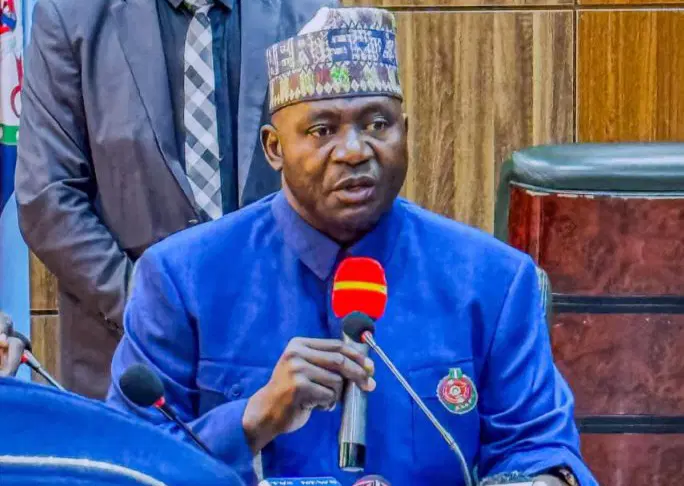
Nigeria’s Minister of Defence, General Christopher Musa (retd.), has drawn a hard line for the country’s security forces, warning that any operative who holds fire while waiting for instructions from above will be treated as a friend of the very criminals he was sent to fight.
The minister issued the directive on Wednesday in Sokoto while commissioning 62 operational vehicles and a range of tactical equipment worth N27.127bn procured by the Sokoto State Government to reinforce operations across the state. His words left little room for interpretation. “Once you are deployed, do not wait for any order from anybody to shoot any bandit or any terrorist,” he said. “Anybody who refuses to shoot or kill any bandit or terrorist in the name of waiting for an order, we will treat you like a bandit. This is a general order.”
The charge speaks directly to one of the most persistent complaints in Nigeria’s counter-insurgency campaign, that troops on the ground often hesitate for fear of sanction, allowing armed men to slip away. Musa framed decisive action as a duty rather than a discretion, while insisting that professionalism must not be sacrificed in the process. “You are not to go there and extort or harass the people. You are there to protect them and work with them to eliminate bandits and terrorists operating within your area,” he added.
The setting was significant. Sokoto sits within Nigeria’s North-West, the epicentre of a banditry crisis that has hollowed out rural communities across Katsina, Zamfara, Kaduna, Kebbi and Sokoto over the past decade. Geopolitical research firm SBM Intelligence recorded 2,938 kidnappings in the region between July 2024 and June 2025, more than 60 per cent of all reported abductions nationwide, with Zamfara alone accounting for 1,203 cases. Displacement has followed the violence. The New Humanitarian reported that by February 2025, over 580,000 people, mostly women, had fled their homes across Katsina, Sokoto and Zamfara.
Musa, who described himself as “a proud son of Sokoto,” credited the state’s relative calm to cooperation between government, security agencies and residents. He said the newly commissioned armoured vehicles and tactical gear would sharpen operational mobility, intelligence gathering and force protection against banditry, terrorism and kidnapping, but cautioned against carelessness with the assets. “This equipment costs billions of naira. We don’t want to hand them over, and then you throw them away or mishandle them. They must serve the purpose for which they were procured,” he said.
Governor Ahmed Aliyu, who was honoured with the naming of a major Sokoto road after the defence minister, said the intervention formed part of a sustained security drive. The package, according to him, includes bulletproof vehicles, Buffalo Armoured Personnel Carriers, 320 motorcycles, 3,200 security gadgets, 2,000 bulletproof helmets and vests, and 200 night-vision goggles, among other items. “These vehicles and security equipment cost the Sokoto State Government N27.127bn,” he said, adding that the state had previously spent more than N36bn on security, including the establishment of the Sokoto State Community Guard Corps.
Aliyu also disclosed that a bill prescribing stiffer penalties for informants who aid bandits was before the state House of Assembly, and that a command and control centre had been approved to strengthen surveillance. “Security is a collective responsibility, and together we shall overcome every security challenge confronting our state,” he said.
The minister’s shoot-on-sight order will likely reignite a familiar debate. Rights groups, including Human Rights Watch, have repeatedly cautioned that Nigerian security operations have at times killed civilians, and that accountability for such incidents remains weak. How the armed forces balance Musa’s call for speed against the imperative to protect the innocent may well determine whether the directive is remembered as a turning point or a source of fresh controversy.