
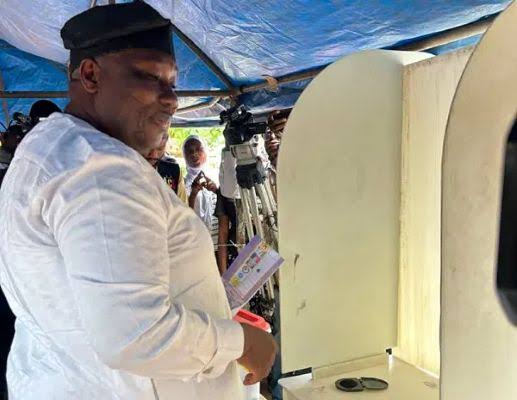
Voting was disrupted at the polling unit of the African Democratic Congress (ADC) governorship candidate, Najeem Salaam, in Ejigbo, Osun State, on Saturday after violence erupted shortly after he and his wife cast their ballots.
The incident occurred at Unit 003, Iroyin Ayo Open Space, Ward 004, Ejigbo, forcing voters, electoral officials, observers and journalists to flee the area as tension escalated. Salaam was subsequently whisked away by his security operatives.
Personnel of the Department of State Services (DSS) and the Nigeria Security and Civil Defence Corps (NSCDC) later arrived at the polling unit in an attempt to restore order, but the situation remained unsettled.
The disruption brought voting to a halt and raised concerns over the safety of voters and electoral officials at a time when the Independent National Electoral Commission (INEC) was conducting the governorship election across the state.
A voter identified as Adewale said he arrived early but could not vote after the crisis forced people away from the polling unit.
“I came here early because I wanted to vote and return home. But after the crisis started, everybody ran away. Now the INEC officials and security men have left. We don’t know what will happen next,” he said.
Another voter, who spoke anonymously, said several residents had been unable to exercise their franchise because of the disruption.
“We have been here since morning. We want to vote, but there is nobody to conduct the election anymore. The security people who came to restore order have also left,” the voter said.
As of the time of the reports, voting at the unit had been cancelled or halted, with some voters remaining in the area while awaiting information on whether the exercise would resume.
Salaam later alleged that the incident was a planned attempt to attack him, although the claim had not been independently established.
The ADC candidate said the violence occurred barely a minute after he cast his ballot and that his security team moved him away from the scene.
“The plan was to even attack me. That alone was to attack me, my personality,” Salaam said, according to Channels Television.
He described the incident as serious and called for an investigation into what happened.
Channels Television reported that Salaam said a suspect had been arrested in connection with the incident and called for the person to be questioned to establish the motive behind the violence.
“I am worried and disturbed about Nigerian democracy. The way we are going, plus the way the security operation works. What is the future?” he said.
The identity of the suspected attacker or what triggered the incident was not immediately established in the reports reviewed.
The incident highlights the potential consequences of violence at individual polling units.
A polling unit may account for only a fraction of the electorate in a local government, but disruption can prevent voters from completing accreditation and voting within the period available for the exercise.
The Electoral Act 2022 provides legal procedures for dealing with situations in which voting or accreditation is disrupted, including circumstances involving the failure of prescribed electoral technology. However, whether a particular polling unit requires any further electoral action depends on the facts established by INEC and the applicable provisions of the law.
The Ejigbo incident also occurred against a broader backdrop of operational challenges reported elsewhere during Saturday’s election.
Reports from Ila, for instance, documented repeated BVAS problems at a polling unit with 342 registered voters. By 12:40pm, only about 75 voters had reportedly been accredited and voted, representing roughly 22 per cent of the registered voters at the unit.
At another polling unit in Ila-Orangun, 1,133 registered voters were reportedly sharing one BVAS machine, resulting in congestion and a slow accreditation process.
The combination of technical difficulties and isolated security incidents means that the final assessment of the Osun election will require more than the overall turnout or eventual result.
INEC, security agencies, political parties and election observers will need to establish how many polling units experienced disruptions, how long voting was affected and whether voters who were unable to cast their ballots were eventually allowed to do so.