
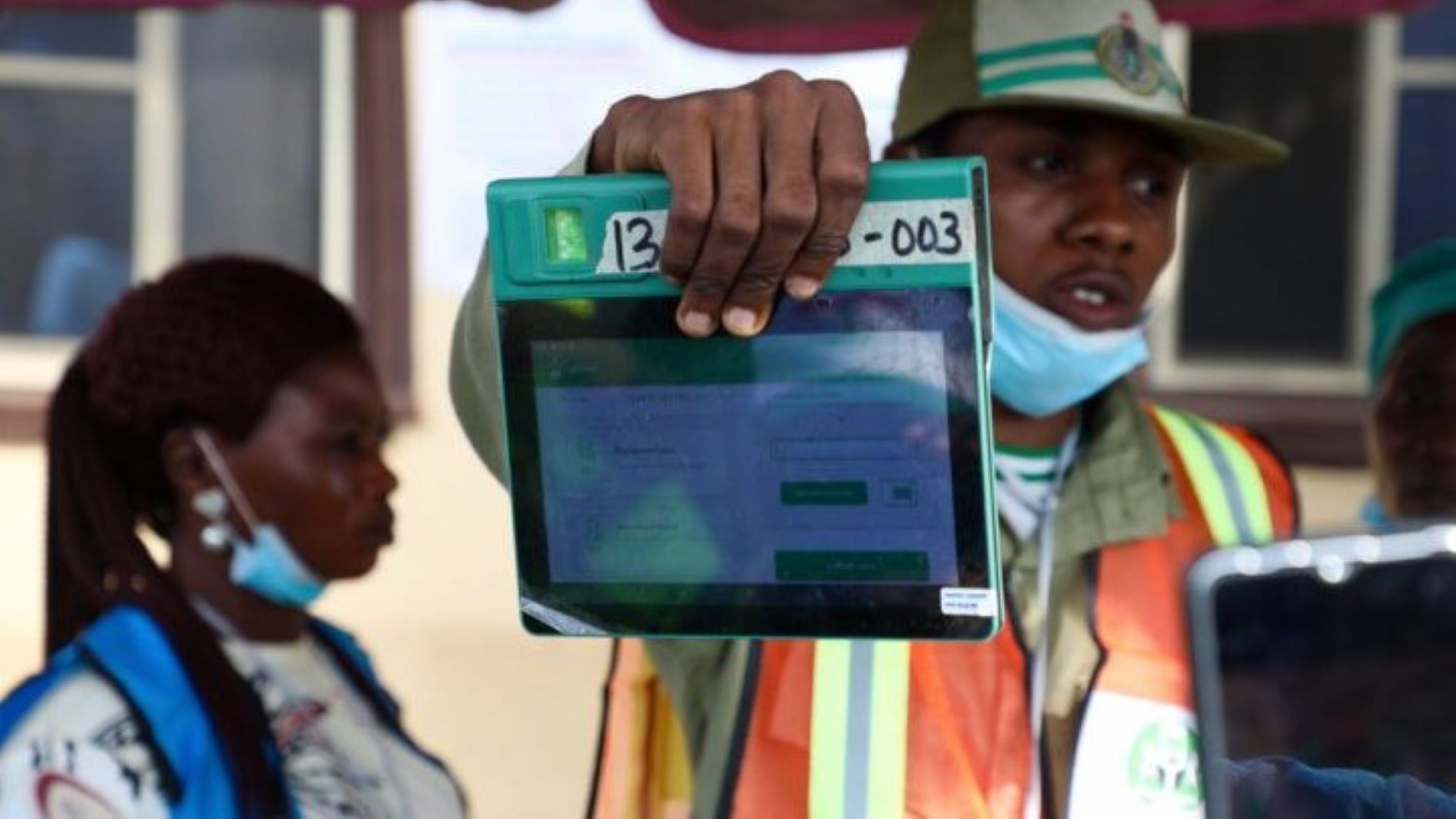
Barely three weeks after a mock accreditation exercise exposed weaknesses in Osun State’s voting technology, the Bimodal Voter Accreditation System developed fresh glitches at polling units across the state on Saturday as voters queued to choose a new governor, prompting Afrobeats star Davido to publicly recommend a workaround on the machine’s cameras.
Nigerian singer David Adeleke, known globally as Davido, posted on his X handle as voting continued in the Osun State governorship election, advising election officials and voters to switch to the front camera of the BVAS device wherever the main camera failed to capture a voter’s face or fingerprint. “It is very active and fast,” he wrote of the alternative lens, urging polling officials confronted with a malfunctioning unit to try it rather than turn voters away.
The comment came from a man who is not a neutral observer of the contest. Davido is the nephew of Governor Ademola Adeleke, the Accord Party candidate seeking a second term, and was appointed in April 2026 as head of youth mobilisation for the governor’s re-election campaign council, having earlier served as chairman of the Osun Sports Trust Fund. In the weeks before the poll, he repeatedly used his social media platform to comment on the conduct of the election, including an appeal to United States President Donald Trump and the wider international community, made on August 11, to monitor developments in the state and guard against violence and voter intimidation. It was not immediately possible to independently confirm how widely his front camera suggestion was adopted at affected polling units, or whether the commission had separately issued similar guidance to its officials.
Saturday’s disruptions were not an isolated incident. On August 1, the Independent National Electoral Commission ran a mock accreditation exercise in twelve local government areas to test the BVAS ahead of the governorship poll, but the exercise was interrupted less than an hour after it began when devices in several polling units stopped recognising voters’ fingerprints, facial features and Permanent Voter Cards, according to accounts given to Premium Times by the commission’s Osun State public relations officer, Dayo Olurode, and separately corroborated by civil society observers who monitored the exercise. The setback drew calls from the Accord Party, the APC, the ADC and other parties, as well as from civil society groups such as the Coalition of Concerned Nigerian Citizens, for INEC to explain the cause and fix the machines before election day.
INEC’s national chairman, Professor Joash Amupitan, subsequently told reporters in Osogbo that the initial problem, traced to older Permanent Voter Cards, had been resolved, and expressed confidence that the commission’s technology would perform well on the day. Yet reports from the field on Saturday suggested the difficulties had not been fully eliminated. Voting was delayed at Ward One, Unit Nine in Ede North Local Government Area following a reported BVAS malfunction, while Osun State’s Deputy Governor, Kola Adewusi, told reporters after casting his own ballot in Ife East that the accreditation device was “causing a lot of problems” and slowing the process, and called on INEC to provide backup machines. Separately, voting was suspended for a period at the polling unit of the African Democratic Congress candidate, Najeem Salaam, in Ejigbo, after a violent disruption shortly after he voted forced electoral officials, security personnel and journalists to briefly flee the scene, according to reports from the ground on the day. Voters in parts of Ejigbo also alleged attempts at vote buying, with claims that party agents offered as much as twenty thousand naira for votes, an allegation that had not been independently verified as at the time of filing.
According to INEC, 2,339,233 Osun residents registered to vote in this election, a rise of roughly nineteen and a half per cent from the 1,955,657 registered voters recorded for the 2022 governorship poll. Ahead of Saturday, the commission’s national commissioner for the South West, Mohammed Haruna, said 1,906,390 Permanent Voter Cards, or about 81.5 per cent of the registered figure, had been collected. Voting was conducted across 3,763 polling units in the state’s 30 local government areas, with polls scheduled to open at 8.30am and close at 2.30pm, though voters already on the queue by closing time were expected to be accommodated. INEC reported that all polling units were operational by 9am, with 94.5 per cent already open half an hour earlier. Turnout in the 2022 election stood at 42.16 per cent, a figure electoral analysts are likely to use as a benchmark once collation from Saturday’s poll is complete.
The election itself is an off-cycle contest, one of a handful of Nigerian states that vote for governor outside the national election calendar because of the timing of court-ordered reruns in earlier decades. It was originally scheduled for August 8, 2026, before INEC moved it a week forward to August 15 following the enactment of the Electoral Act 2026 and a revision of the commission’s broader timetable. Civil society groups including the Centre for Journalism Innovation and Development have described the poll as the last major governorship election before the 2027 general elections, and as a test of the credibility of Nigeria’s evolving electoral framework ahead of that larger contest.
Osun’s electoral history helps explain why a technical hitch, however minor it might appear elsewhere, draws such close attention in the state. According to an analysis published by Dataphyte, every governorship election held in Osun since the return to civilian rule in 1999, with the exception of the very first one, has been challenged through an election petition. The most consequential of these came after the 2007 poll, when the Court of Appeal, after almost three years of litigation, nullified the re-election of Olagunsoye Oyinlola of the PDP and installed Rauf Aregbesola of the then Action Congress of Nigeria as governor, one of only a handful of cases nationally in which a sitting governor has been removed by the courts after being sworn in.
The pattern repeated itself in Governor Adeleke’s own political career. In the 2018 governorship election, Adeleke, then of the PDP, led the initial count against the APC’s Gboyega Oyetola by 353 votes, but INEC declared the contest inconclusive after cancelling 3,498 votes across Ife North, Ife South and Orolu local government areas, a margin larger than his lead. In the resulting rerun, Oyetola overturned the deficit to win by 482 votes. Adeleke rejected the outcome and pursued the matter through the tribunal, which briefly declared him the winner in March 2019, before the Supreme Court affirmed Oyetola’s victory in July of that year.
Adeleke returned in the 2022 election and defeated the then incumbent Oyetola more comfortably, polling 403,371 votes to Oyetola’s 375,027, a margin of about 3.5 per cent, or roughly 28,000 votes, according to figures reported at the time and reflected in the state government’s own records. He was sworn in on November 27, 2022, but the APC challenged the result at the tribunal, which in January 2023 annulled his victory over allegations of over voting. The Court of Appeal reversed that decision and restored Adeleke, and the Supreme Court closed the matter in March 2023 by upholding his mandate. Adeleke went on to defect from the PDP to the Accord Party in late 2025 ahead of this year’s contest.
Three candidates dominated campaign coverage ahead of Saturday’s poll, even though a longer list of names appeared on the ballot. Governor Adeleke, 65, sought a second term on the Accord platform, campaigning heavily on infrastructure projects undertaken during his first term, including road and flyover construction. His closest challenger on paper was Bola Oyebamiji of the APC, a career banker turned public administrator who has served as Osun’s Commissioner for Finance under both Aregbesola and Oyetola, and who has been Managing Director and Chief Executive Officer of the National Inland Waterways Authority since October 2023. The African Democratic Congress fielded Najeem Salaam, a former two term Speaker of the Osun State House of Assembly and political science academic closely associated with Aregbesola, who has since aligned his political fortunes with the ADC.
The Peoples Democratic Party’s participation added a further complication. Governor Adeleke’s earlier departure from the party left it without a candidate of its own for much of the campaign, until a Court of Appeal judgment on August 13 upheld the nomination of Adebayo Olugbenga Adedamola by a faction of the party and ordered INEC to place the PDP’s logo on the ballot. A day later, however, that same faction’s interim leadership announced it was backing Adeleke rather than its own candidate, citing what it called insufficient time for Adedamola to campaign following the late court ruling, while a rival PDP faction maintained that the party had no valid candidate at all. Separately, two other candidates, of the All Progressives Grand Alliance and the Allied Peoples Movement, withdrew from the race in its final days, one endorsing Oyebamiji and the other backing Adeleke, though both names remained on the ballot owing to the timing of their withdrawal.
The technical concerns around BVAS sat alongside a more serious worry in the weeks before the poll: political violence. Figures on the resulting death toll varied by source. The Nigeria Police Force was reported to have documented about 30 politically motivated killings in the build up to the election, while the Nigerian Bar Association’s president put the figure at 29 deaths across 73 violent incidents recorded between May and July, and the election monitoring group YIAGA Africa said it had counted more than 35 fatalities. A separate conflict tracker maintained by the Centre for Journalism Innovation and Development recorded 18 deaths across 34 incidents in its most recent count before the election. The two leading parties traded accusations over the killings, with the Accord Party alleging that at least eight of its members were killed in areas including Oriade, Ijebu-Jesha, Ilobu and Ikire, and the APC campaign council saying ten of its supporters had died in Ilesa, Iwo, Osogbo and Ijebu-Jesa, allegations that were not independently verified by press time. President Bola Tinubu had, ahead of the poll, charged INEC and security agencies to protect voters, and the police announced additional air and drone support along with restrictions on vehicular movement across the state on election day.
It was against that backdrop of tension that Davido made his appeal to Trump and the international community earlier in the week, arguing that Osun voters deserved to exercise their franchise “freely, peacefully, and without fear.” Accredited local and international observers were, in turn, cautioned on the eve of the poll against spreading unverified information capable of undermining confidence in the process, a reminder of how contested the information environment around the election had become even before votes were cast.