
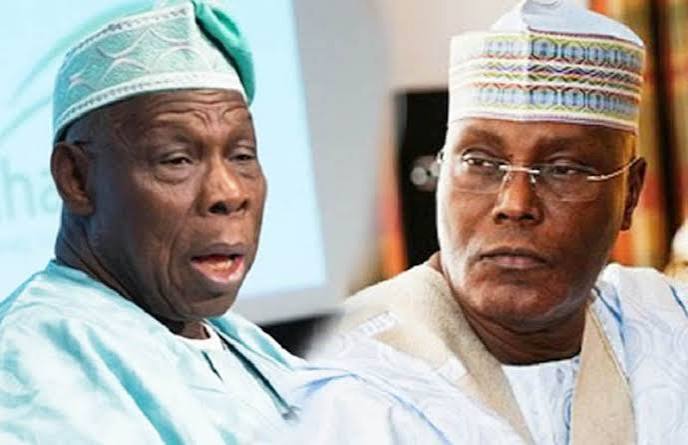
A private warning that Ibrahim Babangida allegedly gave Olusegun Obasanjo about Atiku Abubakar more than two decades ago has resurfaced at a striking moment, just as Atiku mounts his seventh attempt at Nigeria’s presidency and his first under the African Democratic Congress ahead of the 2027 election.
The account comes from a new book by Seun Oloketuyi, How to Win Elections in Nigeria, in which former Cross River governor Donald Duke, himself the Peoples Redemption Party presidential candidate for 2027, recounts an informal meeting at the Presidential Villa involving Babangida, fellow former military head of state Abdulsalami Abubakar, Obasanjo and his deputy, Atiku, during the tensions that preceded the 2003 election.
According to Duke, the relationship between Obasanjo and Atiku had frayed as the president prepared to seek a second term, with Atiku’s political moves raising doubts about whether he would back the re-election bid. Duke said the dispute grew so serious that ten governors, himself included, met the party leadership, including Solomon Lar, to weigh alternatives for the vice-presidential slot.
Duke said Obasanjo telephoned him late one night to complain of betrayal, and that Atiku later arranged for the two former military rulers to meet the president. During that meeting, Babangida reportedly reminded Obasanjo of understandings reached after his release from prison and warned that winning over northern leaders for a second term would be difficult.
The decisive moment, Duke claimed, came afterwards. He said Babangida drew Obasanjo aside to his study on the pretext of retrieving forgotten keys and told him, “I warned you not to trust that your deputy.” Returning to the group, Babangida allegedly glanced at Atiku and remarked, “This one cannot rule Nigeria.” Duke summed up the episode with a line he said politics had taught him: “Betrayal is a very crazy thing in politics.”
The claims remain Duke’s personal recollection. Babangida has not publicly confirmed the private exchange, and neither Obasanjo nor Atiku has responded directly to the book’s account.
The rupture Duke describes helped shape the Fourth Republic. Obasanjo and Atiku served together from 1999 to 2007 before their alliance collapsed, partly over Obasanjo’s failed third-term effort to amend the constitution. Atiku broke away to contest the 2007 election on the Action Congress platform, finishing third behind the PDP’s Umaru Yar’Adua and Muhammadu Buhari of the ANPP.
That was the first of his appearances on a presidential ballot. Atiku has sought the presidency six times since 1993, contesting the general election proper in 2007, 2019 and 2023. He polled 11,262,978 votes as the PDP candidate against Buhari in 2019 and 6,984,520 votes against Bola Tinubu in 2023. His emergence as ADC flagbearer, after defeating Rotimi Amaechi and Mohammed Hayatu-Deen in the party’s May 2026 primary, makes 2027 his fourth outing on a presidential ballot and his seventh attempt overall.
The old wounds have reopened in recent weeks. In July, Obasanjo alleged that Atiku gave the late former House Speaker, Ghali Na’Abba, five million naira to push impeachment proceedings against him during his first term. On 1 August, Obasanjo again criticised his choice of Atiku as running mate during a fireside conversation in Lagos with the activist Charles Oputa, known as Charly Boy. Atiku rejected the allegations and accused Obasanjo of fabricating claims to advance the interests of a kinsman ahead of 2027.
The timing gives the book unusual weight. INEC has published the particulars of 19 presidential candidates for the 2027 general election, and campaigning opened on 19 August. Atiku, who turns 80 in November, leads the ADC ticket with Amaechi as his running mate, against President Tinubu and Vice President Kashim Shettima of the APC, and Peter Obi, who is running on the Nigeria Democratic Congress platform with former Kano governor Rabiu Kwankwaso.
For a politician whose career has been defined as much by endurance as by disappointment, Babangida’s alleged verdict from more than twenty years ago now reads less like settled history than like a live question. Whether Atiku can finally convert experience and name recognition into victory, or whether the doubts recorded in Duke’s book prove prophetic, will be answered at the polls.