
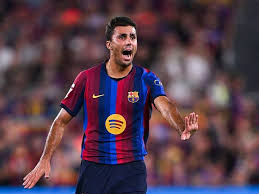
Barcelona midfielder Rodri has publicly apologised to Valencia and their captain José Gayà after television cameras appeared to catch him describing the club as “very weak” from the substitutes’ bench during a La Liga fixture at Mestalla.
The apology came on Wednesday night at the Spotify Camp Nou, minutes after Barcelona opened their Champions League campaign with a 5-1 win over Feyenoord. Rodri asked to speak before questions began, a decision that turned a three day social media storm in Spain into a formal statement of regret from one of the most decorated midfielders in world football.
What makes the episode notable is not the insult itself but the way it surfaced. There is no audio on the footage. What exists is a silent camera shot of Rodri in conversation with teammate Pau Cubarsí after being substituted, broadcast by Movistar and its long running match programme El Día Después. The words attributed to him, that Valencia were “really weak” and had not passed the halfway line, came from lip readers consulted by the broadcaster, not from a recording. That distinction has been largely lost in the reaction, but it matters: the quotation remains an interpretation of silent images rather than a verified utterance.
Rodri did not dispute the substance. “I apologised to my friend and colleague Jose Gaya and to the entire squad as well,” he said, referring to the Spain defender who wears the Valencia armband. He described the remark as an expression of surprise rather than mockery. “At no point did I intend to mock anyone or take a difficult moment for a team out of context. Quite the opposite, we all want Valencia to return to where it belongs in the league, it is one of the best clubs in the competition.”
He also pushed back on how the moment reached the public. “I would also add that it was a private conversation; I think we should all learn a bit more from this, as things really do get taken out of context sometimes. But at no point did I mean any disrespect. My apologies to Valencia.” In remarks carried by Marca, he broadened the apology to include supporters, saying that when a person makes a mistake he must come out and apologise.
The context on the pitch helps explain both the comment and the sensitivity around it. Barcelona won 5-0 at Mestalla on Sunday, 6 September, in the fourth round of the 2026/27 La Liga season. That scoreline is, jointly with their 5-0 win at Elche on 23 August, the biggest away win recorded in the league so far this season. It also continued a pattern. In September 2025, Barcelona beat Valencia 6-0 at home, the heaviest home win of the entire 2025/26 campaign, a season Barcelona finished with 94 points, 31 wins and their 29th league title.
Valencia’s current position is stark by any measure. After four matches they sit twentieth and bottom of La Liga with a single point, one goal scored and nine conceded, a goal difference of minus eight. Their run of three straight defeats is the longest losing sequence in the division at this stage. Elche, nineteenth, are the only other side yet to win, with one point and a marginally better goal difference of minus seven. For a club that has won six Spanish league titles and reached two Champions League finals, the numbers represent an early and public crisis.
Barcelona, by contrast, have the only perfect record in the competition: four wins from four, twelve points, seventeen goals scored and two conceded. They are chasing a third consecutive league title, a feat the club has not managed since the 1990s. The Feyenoord result added to that momentum, with Raphinha scoring twice and Karim Adeyemi, Lamine Yamal and Gabriel Jesus, the last on his debut, completing the rout. Raphinha is also the league’s leading scorer with six goals, and his brace came days after he was left off the thirty name Ballon d’Or shortlist.
Rodri’s own profile is central to why the story travelled. The 30 year old, born Rodrigo Hernández Cascante, completed a move to Barcelona from Manchester City on 18 August 2026 in a deal the club and City confirmed as worth about 76.5 million euros, roughly 65.4 million pounds, structured as an initial fee near 60 million euros plus add ons. He signed a four year contract running to 30 June 2030 and took the number 16 shirt. Barcelona’s bids of about 40 million and 55 million pounds were rejected before the third offer was accepted, with Rodri entering the final year of his City deal.
He arrived with a rare résumé. Rodri joined City from Atlético Madrid in 2019, made close to 300 appearances, won four Premier League titles and the Champions League, and took the 2024 Ballon d’Or. This summer he captained Spain to their second World Cup, beating Argentina in a final settled in extra time by his new Barcelona teammate Ferran Torres, and was named the tournament’s best player with the Golden Ball. He was substituted again on 83 minutes against Feyenoord, replaced by Gavi.
The Gayà connection adds an awkward layer. The two are international teammates, and the Valencia captain was among the Spain squad that won in the summer. That relationship is why Rodri’s first call, by his own account, was to Gayà rather than to the club’s press office.
Valencia have not issued a formal complaint over the footage. Neither club has indicated that any disciplinary or league process is involved, and no La Liga sanction applies to private conversations picked up by broadcast cameras. What remains is a smaller question with wider implications for modern football coverage: how far broadcasters should go in decoding silent images of players who believe themselves off the record, and whether a lip read phrase should be treated with the same weight as a spoken quotation.
For Rodri, the immediate matter appears settled. For Valencia, the harder problem is the table.