
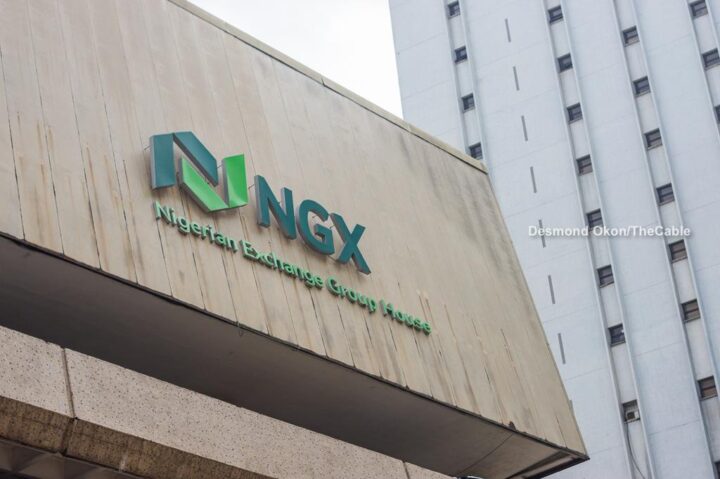
The Nigerian Exchange closed the week ended Friday, 12 September 2026, deep in the red, with widespread selling wiping about N1.97 trillion off the value of listed equities as investors trimmed positions after months of record gains and began raising cash ahead of the Dangote Refinery public offer.
The benchmark All-Share Index fell 1.60 per cent to 243,052.74 points, down from 246,992.44 points at the start of the week. Market capitalisation contracted by 1.24 per cent to N157.587 trillion from N159.558 trillion. The gap between the two percentages reflects new shares added to the official list during the week, which cushioned the fall in overall market value even as prices dropped.
Despite the pullback, the market remains one of the strongest performers globally this year. The index opened 2026 at 155,613.03 points, so its close on Friday represents a year-to-date return of about 56 per cent, in line with the level analysts had cited through the third quarter.
Market breadth was firmly negative. According to figures published by the exchange, 80 equities lost ground during the week against just nine that appreciated, while 58 closed flat. That ratio points to a broad retreat rather than pressure confined to a few counters.
Trading activity also thinned. Investors exchanged 3.647 billion shares worth N130.151 billion in 244,777 deals, down from 4.360 billion shares valued at N210.331 billion in the preceding week. The fall in value, roughly 38 per cent, was steeper than the drop in volume, indicating that much of the week’s turnover came from lower-priced, high-volume stocks rather than the large-capitalisation names that usually drive value.
That pattern was clearest in the Financial Services industry, which again dominated the floor. The sector accounted for 2.909 billion shares worth N56.668 billion in 106,662 deals, contributing close to 80 per cent of total volume but about 43.5 per cent of value. The Services industry followed with 153.122 million shares worth N2.331 billion, while Consumer Goods placed third at 116.656 million shares valued at N11.035 billion.
Three insurance and financial holding stocks led turnover by volume: Fortis Global Insurance Plc, Mutual Benefits Assurance Plc and Sterling Financial Holdings Company Plc. Together they traded 1.544 billion shares worth N4.067 billion in 3,017 deals, about 42 per cent of all shares exchanged but only around three per cent of total value, confirming the low-price character of the week’s heaviest trading.
Sector indices moved almost uniformly lower. The Insurance Index recorded the sharpest fall at 5.52 per cent, followed by the Banking Index at 4.07 per cent, Industrial Goods at 3.36 per cent and Consumer Goods at 2.55 per cent. A handful of specialised indices bucked the trend. The Oil and Gas Index rose 2.83 per cent and the Commodity Index gained 2.19 per cent, with smaller advances in the value, dividend yield and sovereign bond indices.
Among individual stocks, Nigerian Exchange Group Plc, the operator of the market itself, was the biggest gainer, rising 13.85 per cent to N148.00 from N130.00. Ellah Lakes Plc added 13.33 per cent to N10.20, while Seplat Energy Plc gained 10.00 per cent to N14,907.80. On the downside, Fortis Global Insurance Plc fell 27.50 per cent to N1.45, the steepest loss of the week, and Critical Minerals Financing Corp Plc dropped 24.24 per cent to N2.00.
Two explanations for the sell-off have been advanced. Market operators point to portfolio rebalancing after an extended bull run, with profit-taking encouraged by lingering inflationary pressure and attractive yields in the fixed-income market, which draw money away from equities. A second factor is the pending initial public offering by Dangote Refinery, which has prompted some investors to free up cash in anticipation of the listing. Heavy activity in the primary market, including rights issues, commercial paper and bond sales, has also diverted liquidity from secondary trading.
Even in a losing week, the primary market was active. Two tranches of Federal Government of Nigeria Savings Bonds issued in August were listed on 9 September: a two-year instrument carrying 13.963 per cent and maturing in August 2028, with an issued value of N1.318 billion, and a three-year bond at 14.963 per cent maturing in August 2029, valued at N4.545 billion. Dangote Sugar Refinery Plc admitted more than 8.097 billion ordinary shares following its rights issue at N60.00 per share, lifting its issued capital above 20.244 billion shares from 12.146 billion, one of the factors that supported market capitalisation against the price decline. Chapel Hill Denham Nigeria Infrastructure Debt Fund listed a further 350,531 units from a second-quarter scrip distribution.
In the alternative segments, Exchange Traded Products recorded 2.259 million units worth N451.246 million in 5,627 deals, up from the previous week. Fixed-income turnover on the equities board fell to 115,145 bond units valued at N123.330 million in 50 deals, from 295,465 units worth N293.761 million.
The week’s decline should be read against how far the market has travelled. Capitalisation crossed N100 trillion on 5 January, the index broke 200,000 points for the first time on 16 March and passed 250,000 in May before easing back. Much of that surge followed the completion of the banking recapitalisation exercise on 31 March, which the Securities and Exchange Commission has described as a structural reset, and renewed foreign portfolio interest.
Whether the current profit-taking marks a pause or a deeper correction will depend partly on how the Dangote Refinery offer is received and on the direction of inflation and interest rates in the coming weeks. For now, the market has surrendered part of its recent gains while holding on to a substantial lead for the year.