
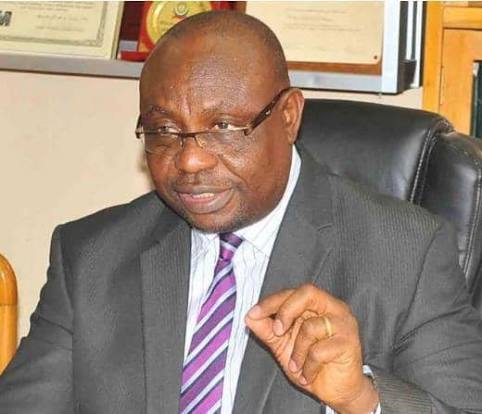
More than three years after the failure of the portal meant to show Nigerians their votes in real time, a former senior official of the Independent National Electoral Commission has offered a fresh account of what went wrong, saying the commission’s digital systems came under sustained cyberattacks during the 2023 presidential election even as he stopped short of blaming those attacks for the breakdown.
Festus Okoye, who served as National Commissioner and Chairman of the Information and Voter Education Committee and was the public face of INEC throughout the 2023 polls, made the disclosure in an interview on Deep Insights, a podcast hosted by Austin Agbonsuremi. He said the commission’s platforms were targeted repeatedly during the election period. “I know that there were all sorts of cyberattacks on our platforms during that particular period,” he said, according to the recorded interview. He added that he could not establish whether those attacks caused the problems that later engulfed the Result Viewing Portal, known as IReV. “Whether those cyberattacks influenced what happened at the end of the day, I’m not in a position to say,” he said.
The significance of his account lies in what it revisits. Ahead of the February 2023 election, INEC assured Nigerians that polling unit results would be scanned and uploaded to IReV, a public facing platform that lets voters, parties, candidates and observers view images of the original result sheets recorded on Form EC8A. On election day, results of the National Assembly polls, held simultaneously, were uploaded, but the presidential results largely failed to appear on the portal for hours and, in many cases, days. The delay triggered protests from opposition parties and cast a long shadow over the credibility of the outcome.
Okoye’s latest remarks partly reframe how the commission has explained that failure. In his account, officials initially believed the fault would be fixed within minutes, and a dispute arose internally over how to describe it to the public. He said he objected to the technical language proposed at the time. “And that was how the issue of glitch came into the equation,” he said. That word, glitch, became one of the most contested terms of the post election period.
The official record tells a more specific story. In its 526 page report on the 2023 general election, released in February 2024 to mark the first anniversary of the poll, INEC attributed the failure to a configuration problem within its result management system. The commission said that because the presidential election was not mapped to any state on the database in the way the legislative elections were, attempts to upload presidential result sheets returned an internal server error, described as an HTTP error, while the National Assembly uploads succeeded. According to the report, the problem was first reported around 4pm on election day, was partially resolved within about four hours, and the first presidential result was uploaded at 8.55pm on 25 February 2023. The commission maintained that the difficulty did not affect the credibility of the election.
That explanation stood in some tension with an earlier assurance. On election day itself, Okoye, then still in office, told Nigerians that the challenge was a technical hitch linked to scaling up IReV from a system used for off season state elections to one handling a nationwide general election, and stressed that the problem was not due to any intrusion or sabotage and that IReV remained secure. His current reference to cyberattacks introduces a dimension the commission did not emphasise in its public statements at the time, though he has been careful not to draw a causal line between the two.
The courts examined the technology question closely and settled it against the petitioners. The Presidential Election Petition Court, led by Justice Haruna Tsammani, held in September 2023 that the Electoral Act 2022 did not make electronic transmission of results mandatory and that IReV was not a collation system. Witnesses called by Atiku Abubakar of the Peoples Democratic Party, including presiding officers from Yobe, Bauchi and Katsina, testified that they were able to transmit National Assembly results but could not upload presidential results. The Supreme Court affirmed President Bola Tinubu’s victory in October 2023, with Justice John Okoro holding that the unavailability of IReV could not be a ground for nullifying the election and that the failure to transmit results to the portal did not affect the outcome. The court also held, consistent with its earlier decision in the Oyetola case on Osun State, that allegations such as over voting could not be proved by reference to IReV or INEC’s server, but only through the BVAS, the voter register and Form EC8A.
Analyses conducted after the results were eventually posted found discrepancies in at least one state. In Rivers, several media and civil society reviews concluded that the figures on IReV differed from the announced tally, with Tinubu credited with 231,591 votes and Peter Obi of the Labour Party with 175,071 in the official results, while the portal images suggested a stronger showing for Obi. The gap was not large enough to alter the national outcome, which Tinubu won by a margin of more than two million votes over Atiku, who came second. INEC has consistently rejected accusations of bias and insisted the declared results reflected the votes cast.
Okoye no longer sits on the commission. His five year tenure as National Commissioner, which began on 25 July 2018 as the South East representative, ended on 24 July 2023, months after the election, and was not renewed. He was succeeded as information chief by Sam Olumekun. The commission itself now has different leadership. Professor Mahmood Yakubu, who chaired INEC through the 2023 election, left office in October 2025, and Professor Joash Amupitan, a law professor from Kogi State, was sworn in as chairman on 23 October 2025 after Senate confirmation, pledging to rebuild public trust in the electoral process.
The renewed attention to what happened in 2023 carries weight because the same tools are due to be used again. INEC has indicated it is considering a full audit of its result management systems ahead of the 2027 general election to avoid a repeat of the IReV failure, and the commission is under a separate obligation, arising from litigation, to maintain a permanent database of polling unit results. Whether the technology performs differently next time will depend partly on how candidly the commission and its former officials account for what went wrong, and cyberattacks, if they occurred as Okoye describes, would point to a category of risk distinct from the configuration bug the commission has officially blamed.
For now, what is confirmed is limited but consequential. The presidential results did not upload in real time. The commission has attributed that to a system configuration error. The courts ruled that electronic transmission was not legally required and upheld the result. What Okoye has added, from the vantage of a central participant, is an assertion that the commission’s platforms were also under attack during the same window, alongside his own admission that he cannot say whether those attacks made any difference. That uncertainty, rather than any settled conclusion, is what his account leaves on the table.