
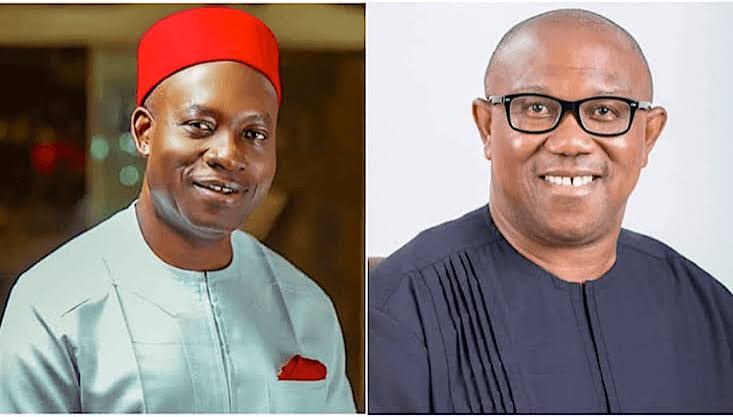
Peter Obi has rejected a fresh claim by the Anambra State Government that it is still servicing loans contracted during his time as governor, reopening a long running argument over the state of the finances he left behind in 2014 and injecting a familiar credibility question into the early stages of his 2027 presidential campaign.
The former governor, now the presidential candidate of the Nigeria Democratic Congress, responded through a video from the Voice of Ndi Anambra Podcast circulated on Monday, 15 September 2026. He said his administration cleared every obligation that had been properly processed before he handed over. “As at the day I left office, I was not owing any salary, pension, or gratuity that Anambra State Government is supposed to pay,” Obi said. “I was not owing any supplier or contractor that had executed his job and his documents processed, not one.”
His reply followed comments by the state Commissioner for Finance, Izuchukwu Okafor, on a Ndi Anambra podcast published by the state’s New Media team on Monday, 14 September. Okafor said the administration of Governor Charles Soludo had not taken a commercial bank loan since assuming office in 2022, but was still meeting obligations inherited from earlier governments. “Every month during our FAAC meetings, and when you see the schedule of FAC, you will notice there were substantial, significant deductions from our own FAC because of loans previously borrowed by previous administrations,” he said, attributing some of the debts to the tenures of Obi and his successor, Willie Obiano. Okafor also said the Soludo government had cut the state’s overall debt burden by more than 83 per cent and brought domestic debt to near zero.
The two accounts are not as far apart as the exchange suggests, because they describe different things. Obi’s denial is specific to processed liabilities: salaries, pensions, gratuities and contractor payments for completed and documented work. The commissioner’s statement refers to formal loans still being deducted at source through the Federation Account Allocation Committee. A government can owe scheduled long term loan repayments while owing no salary or contractor arrears at handover, and both positions can hold at once.
Official records support that reading. Data from the Debt Management Office, the agency that centrally verifies subnational debt, put Anambra’s external debt at about 30.3 million dollars and its domestic debt at roughly 3 billion naira as of December 2013, less than three months before Obi left office on 17 March 2014. Those were among the lowest debt figures of any state at the time. External facilities of that kind are typically multilateral, carry long tenors and are serviced through automatic FAAC deductions over many years, which is consistent with the commissioner’s description of continuing monthly deductions more than a decade later.
The DMO figures also qualify Obi’s broader framing. In earlier interviews he has said he left office owing “nobody”, and a June 2025 fact check by The Guardian rated that sweeping claim misleading, noting that while he may have cleared salaries and contractor fees, the state still carried both domestic and external debt on the official books when he departed. The more precise version, that he left no unpaid processed obligations, sits comfortably with the records. The absolute version does not.
Obi added a further detail on Monday, saying he left an ecological fund of about 2.1 billion naira in a First Bank account at the Nnamdi Azikiwe University branch, released by the Federal Government roughly three months before his exit for a specific erosion control project. He said he resisted pressure from within his administration to spend it. “Government is a continuity and I want the person coming after me to succeed,” he said, challenging anyone in doubt to inspect the account records and pledging to stop campaigning if the balance was found to differ.
That figure has not been independently confirmed, and it should be treated as his account rather than an established fact. It is separate from the disputed claims, repeated over the years, that he handed Obiano large cash reserves and a foreign currency fund. Independent checks by DUBAWA and other outlets have found no publicly available document that conclusively establishes the sums, variously quoted between 72 billion naira and 156 million dollars, that have circulated in that argument. The amounts have shifted across different tellings, including Obi’s own.
The timing matters more than the accounting. The dispute has surfaced as Obi, who governed Anambra from March 2006 to March 2014, mounts a second presidential run. He finished third in the 2023 election with 6.1 million votes as the Labour Party candidate, behind Bola Tinubu and Atiku Abubakar. After leaving the Labour Party, he joined the African Democratic Congress in December 2025, then moved again to the Nigeria Democratic Congress, which unveiled him as its presidential candidate at a convention in Abuja on 30 May 2026. His public identity rests heavily on a reputation for frugal, debt averse governance, which makes any challenge to his Anambra record politically consequential rather than merely historical.
Obi used the same appearance to address the wave of gubernatorial support lining up behind the President. He said governors, including Soludo, were entitled to back any candidate. “It’s about over 30 governors today supporting the president. And it is politics and their rights to support whoever they want,” he said, adding that his appeal was to voters and to the conduct of the election rather than to office holders. “I’m not urging them to support me. I am only urging them to allow free, fair and credible elections.”
For voters in Anambra, the underlying question is verifiable in principle. The Debt Management Office publishes state debt stocks, and FAAC deduction schedules exist in the state’s own monthly records. Neither the commissioner nor the former governor has released the specific loan agreements, disbursement dates or repayment schedules that would settle which facilities are still being serviced and which administration contracted them. Until those documents are made public, the exchange remains a contest of characterisations rather than a matter of proven figures, with the official debt records offering the only firm ground between the two positions.