
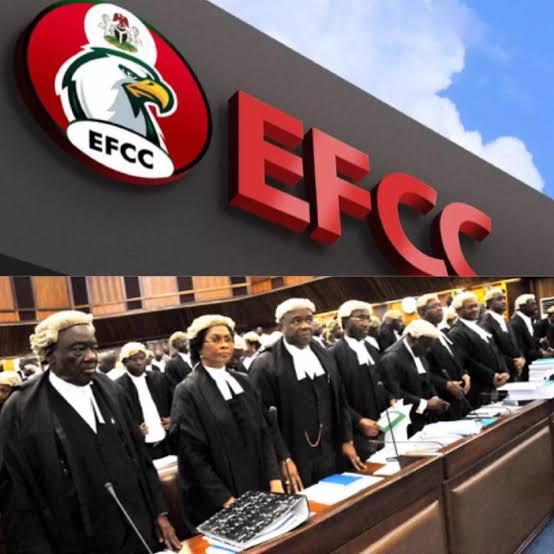
The Economic and Financial Crimes Commission has drawn a sharp response from lawyers over its threat to prosecute practitioners who bill clients in foreign currencies, with several branches of the Nigerian Bar Association arguing the agency has stepped outside its legal remit.
The commission set out its position on Friday, 11 September 2026, when its Acting Zonal Director for Lagos Zonal Directorate 2, Ikoyi, Bawa Usman Kaltungo, received a delegation from the NBA Lagos Task Force on Illegal Practice of Law. In a statement issued by EFCC spokesman Dele Oyewale, Kaltungo said the agency was handling two cases involving lawyers accused of charging fees in dollars.
“We have two cases of lawyers who were found to have charged fees in dollars. This is unethical and illegal, as the naira is the country’s legal tender,” Kaltungo said. He added that any lawyer found culpable would be prosecuted, while stressing that practitioners remained free to set their own fees.
Kaltungo also warned lawyers against invoking the commission’s name to justify high charges. “Lawyers should stop name-dropping the EFCC to overcharge their clients,” he said, noting that some had allegedly told clients part of the foreign currency demanded was meant for the agency.
The warning fits a wider campaign. The commission has for months pressed shops, schools and hotels to stop pricing goods and services in dollars, and its latest move extends that anti-dollarisation drive into the legal profession.
The pushback came quickly. The Chairman of the Gwagwalada branch of the NBA, Nurudeen Abdulsalam, argued the EFCC has no statutory power to regulate professional fees. He said that authority rests with the Legal Practitioners Remuneration Committee established under Section 15 of the Legal Practitioners Act, which he said had already acted through the Legal Practitioners Remuneration Order 2023.
Abdulsalam anchored his objection in the Constitution. He cited Section 36(12) of the 1999 Constitution, as amended, which bars conviction for any offence not defined, with its penalty prescribed, in a written law. In his words, “No criminal offence can be created by a press statement.”
A similar view came from the Chairman of the Anaocha branch in Anambra State, Uzoma Dioha, who said the commission must separate its mandate over economic and financial crimes from the regulation of lawyers’ pay. He argued that receiving fees in foreign currency is not, by itself, a crime absent a specific statutory prohibition.
Dioha pointed to the Foreign Exchange (Monitoring and Miscellaneous Provisions) Act, which he said recognises professional fees and other invisible earnings as a legitimate source of foreign currency for sale in the market. He also noted the case of Osun State Government v. Dalami Nigeria Ltd (2007), in which claims and awards were expressed in United States dollars or their naira equivalent.
He acknowledged the naira’s status as legal tender. Section 20 of the Central Bank of Nigeria Act 2007 establishes CBN-issued currency as legal tender, and Section 20(5) makes refusal to accept the naira an offence, subject to the CBN’s power to prescribe conditions for using other currencies. Dioha argued that this is narrower than any claim that every foreign-currency fee arrangement is criminal, adding that the National Industrial Court has itself considered Section 20(5) in disputes over dollar-denominated salaries.
Not all lawyers rejected the commission’s reasoning outright. An Abuja-based practitioner, Vivian Igbor, said the directive had two sides, crediting it with protecting local content and adding value to the naira, but questioning its practicality. “You cannot say a lawyer should not charge in dollars if the banks are also allowing the opening of domiciliary accounts,” she said, pointing to the difficulty of billing a foreign client in naira.
A senior member of the Bar, Chief Chukwuma Nwachukwu, said the agency had “overstretched it a bit.” He argued there can be no offence unless it is defined in a written law with a prescribed punishment, and noted that the NNPC and its affiliates routinely make oil and gas procurement payments partly in dollars. What could amount to an offence, he said, is refusing payment in naira for services rendered in Nigeria.
The dispute turns on a distinction the two sides frame differently. The commission presents foreign-currency billing as a breach of the naira’s legal-tender status; the lawyers present fee currency as a matter of contract and professional regulation, governed by the Legal Practitioners Act rather than the criminal code.
For now the disagreement remains at the level of statements and legal argument. The two cases the commission says it is handling have not been tested in court, no charges have been made public, and the newly inaugurated national leadership of the NBA had yet to issue a formal response. Any prosecution would ultimately require a court to decide whether existing law criminalises the practice, or whether, as the objecting lawyers contend, the question belongs to the profession’s own regulators.