
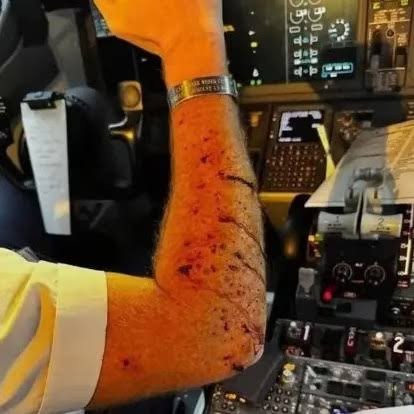
A Flydubai flight bound for Israel made an emergency landing in Saudi Arabia after the co-pilot allegedly stabbed the captain midair, prompting a passenger to intervene and avert disaster.
What began as a routine morning commute across Middle Eastern skies turned into a harrowing struggle for survival at thirty thousand feet. A commercial airliner packed with passengers suddenly lost stability, sending terror through the cabin as screams echoed and blood spilt across the entrance to the flight deck.
Flight FZ1073, operated by Flydubai, was traversing its regular route from Dubai International Airport toward Israel when violent chaos erupted inside the cockpit. Ground controllers in Saudi Arabia received an urgent distress signal at 8:44 a.m. local time requesting an immediate emergency landing at Prince Sultan bin Abdulaziz International Airport in Tabuk.
The midair crisis triggered a swift, high-alert emergency response on the ground as airport authorities scrambled emergency crews. Just over an hour after broadcasting the distress call, the aircraft landed safely in Tabuk, where medical teams immediately evacuated both the captain and co-pilot to a local hospital with physical injuries.
Blood on the Flight Deck
Eyewitness accounts from inside the cabin paint a chilling picture of the moments preceding the emergency descent. Passengers described how sudden turmoil broke out behind the secured cockpit partition, followed by an abrupt loss of smooth control as the airliner manoeuvred erratically.
“We just heard screams, and then the cockpit door opened, and we saw a huge amount of blood,” recounted a passenger identified as Miriam during an interview with Israel’s i24 news channel. She recalled the overwhelming dread that swept through the cabin during the flight’s most unstable moments. “There were moments when all of us here were certain we weren’t going to make it out alive.”
Initial information gathered by international security authorities points to an extraordinary betrayal inside the cockpit. According to two Israeli officials and a source familiar with the preliminary findings, the aircraft co-pilot launched an unprovoked stabbing attack against the captain while in flight.
During the physical struggle, an Israeli passenger reportedly intervened, entering the forward area to assist in physically subduing and restraining the aggressive co-pilot, effectively preventing a catastrophic crash.
High-Level Security Alarm and Diplomatic Fallout
The unprecedented nature of an alleged cockpit attack involving commercial aircrew triggered immediate security manoeuvres across the region. Israeli Prime Minister Benjamin Netanyahu abruptly cancelled his scheduled calendar to convene emergency strategy sessions with top national intelligence and security leadership.
Israeli authorities are treating the incident as a suspected attempt at airborne terrorism. While Saudi aviation operator Cluster2 confirmed that airport staff treated passengers inside the Tabuk terminal while organising a replacement aircraft, international intelligence agencies have launched forensic inquiries into the background and motivations of the flight crew.
The incident highlights severe new security considerations for one of the region’s newest and busiest travel corridors. Commercial aviation between the United Arab Emirates and Israel expanded rapidly following the 2020 Abraham Accords, which normalised diplomatic relations between the two nations.
What was once a non-existent air route quickly transformed into a bustling commercial pipeline, with flight tracking records showing approximately 70 direct flights operating weekly between Dubai and Tel Aviv. In 2025 alone, data from Ben Gurion Airport recorded more than 1.1 million Israeli passengers travelling along the Dubai corridor.
Questions Hover Over Aviation Safety Protocols
The Tabuk emergency has exposed grave questions regarding aircrew screening, psychological evaluation, and internal cockpit security mechanisms. Modern aviation regulations, heavily fortified following historical hijacking events, were built primarily to keep external threats out of the flight deck, rather than managing a violent assault initiated from within the control cabin itself.
As Saudi, Emirati, and international investigators gather evidence from the grounded aircraft and conduct forensic interviews in Tabuk, the global aviation community faces a disturbing reality. The bravery of a civilian passenger and the resilience of an injured captain averted a mass tragedy, but the vulnerability exposed in midair will force an immediate reassessment of flight deck protocols worldwide.