
Ghana’s Cyber Security Authority has publicly rejected suggestions that the United States Federal Bureau of Investigation independently led a recent operation against suspected cybercrime centres in the country, insisting that the exercise was planned, coordinated and executed by Ghanaian authorities with international partners playing a supporting intelligence role.
The dispute, which erupted on Friday, October 9, 2026, followed a post on X by FBI Director Kashyap Pramod Patel announcing the dismantling of what he described as a major fraud compound in Ghana under the bureau’s global “Operation Blackout” initiative. Patel said the operation had identified nearly US$10 million in losses affecting 89 victims, with more than 130 individuals arrested or detained, including victims of trafficking who would be repatriated to their home countries, and over 300 electronic devices seized.
The CSA, in a statement issued on its X handle and subsequently detailed in a press release dated October 8, rejected any portrayal of the operation as “independently conceived, commanded or executed by the FBI”. The Authority said the operation, which it refers to as “Operation Cyber Hunt,” was led and coordinated by Ghanaian institutions with support from Ghana’s National Security Council, the Criminal Investigations Department of the Ghana Police Service, the Ghana Immigration Service, and the Office of the Attorney-General.
International partners included the United Kingdom’s National Crime Agency, the FBI, Nigeria’s Economic and Financial Crimes Commission, and the Joint Case Team on Cybercrime. While acknowledging the “valuable intelligence contributions” of the FBI and the NCA, the CSA said public accounts of the operation must accurately reflect the roles of all participating institutions and called on the FBI to clarify its account and acknowledge Ghanaian contributions.
The Authority stressed that Ghana’s status as a sovereign republic meant foreign law enforcement agencies could not independently exercise police powers or conduct arrests within the country, and that their involvement must be based on lawful cooperation and the authorisation of relevant Ghanaian authorities.
Ghana’s Minister for Communication, Digital Technology and Innovations, Samuel Nartey George, reinforced the CSA’s position in a separate post on X. He said Ghanaian law enforcement and intelligence agencies led the Cyber Hunt operations with primary support from the UK’s NCA and the FBI, and warned that presenting the exercise as solely an FBI operation could undermine future cooperation between the two countries. “To suggest the @FBI acted solely to execute this operation in your tweet undermines the potential for future collaboration,” George said.
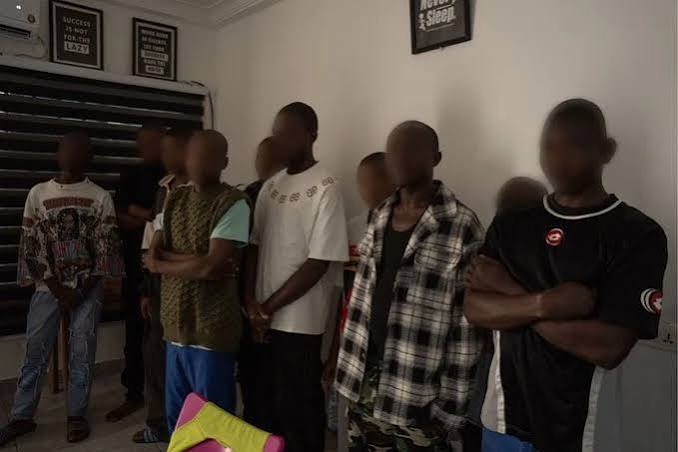
According to the CSA, the operation followed intelligence received on August 26, 2026, indicating that apartments at Ubuntu Haven Estate in Kpone Katamanso, Franko Estate in Ga North, and other locations in Ga West were being used as bases for organised cybercrime, including romance scams. The swoop led to the arrest of eight suspects and the rescue of 120 people suspected of being trafficked and exploited for online fraud.
Items recovered included 136 mobile phones, 130 laptops, internet connection devices, four motor vehicles, and other digital equipment. One of the vehicles was reported to have been stolen from Canada. Investigators also recovered jewellery and 10 Nigerian passports. The CSA said most of the rescued victims were Nigerians and that arrangements were being made for their repatriation while investigations into the suspects and seized devices continued.
The figures released by the CSA distinguish between eight suspects arrested and 120 people rescued, many of whom authorities suspect were victims of trafficking and exploitation. The FBI’s account, by contrast, stated that more than 130 people had been arrested or detained, including victims who would be repatriated. The discrepancy in figures reflects differing legal categorisations of the individuals involved, with Ghanaian authorities emphasising the distinction between suspects and victims, while the FBI’s public statement did not draw that line as clearly.
Patel described the wider Operation Blackout initiative as a global effort targeting scam compounds responsible for online fraud, particularly schemes affecting Americans. He said the operation had so far seized approximately US$17 billion worldwide, arrested hundreds of alleged scammers, freed thousands of trafficked workers, and warned more than 10,000 Americans at risk of being scammed. He described scam compounds as large, fortified facilities where trafficked workers are allegedly forced to conduct fraud against victims abroad, and said criminal networks are increasingly moving their operations towards Africa as law enforcement pressure increases in Southeast Asia and other regions.
The dispute over operational credit comes amid growing cooperation between Ghanaian and United States authorities over transnational financial and cybercrime. In July 2026, Ghanaian national Frederick Kumi, popularly known as Abu Trica, was extradited to the United States to face charges over his alleged involvement in a romance-fraud network. The United States Department of Justice said Kumi, 31, was accused of being part of a network that targeted more than 80 elderly victims in the United States and allegedly defrauded them of more than US$8 million. He was arrested in Ghana in December 2025 and extradited on July 9, 2026, facing charges of conspiracy to commit wire fraud and money laundering conspiracy. United States authorities acknowledged the cooperation of several Ghanaian institutions in securing his arrest and extradition, including the Attorney-General’s Office, the Economic and Organised Crime Office, and the Ghana Police Service.
The presence of 10 Nigerian passports among the recovered items and the identification of most rescued victims as Nigerians underscores the transnational dimension of the case and its direct implications for Nigeria. The Economic and Financial Crimes Commission’s participation in the operation reflects the commission’s growing role in cross-border cybercrime investigations, particularly as Nigerian nationals feature prominently among both perpetrators and victims of online fraud networks operating across West Africa. In February 2026, Interpol announced that police in 16 African countries had arrested 651 people in an eight-week operation targeting investment scams, mobile money fraud, and fraudulent mobile loan applications.
Ghana’s Public Relations Officer for the Ministry of Communications, Digital Technology and Innovations, Kwame Appiah, did not respond to requests for comment on whether the rescued Nigerians would be repatriated through official channels or handed over to Nigerian authorities. The EFCC has not issued a public statement on its role in the operation or on the status of the rescued Nigerians.
The CSA said Ghana remained committed to dismantling cybercrime networks, protecting the public from online fraud, and strengthening intelligence-led investigations, inter-agency coordination, digital forensics, and international cooperation. It added that victim protection, evidence preservation, due process, and prosecution of offenders remained central to its efforts.
The clash over who led the operation reflects a broader tension in international law enforcement cooperation: the need for partner agencies to claim credit for successes in their domestic political environments, versus the sovereign prerogative of host nations to control and characterise operations conducted on their territory. The CSA’s public call for the FBI to clarify its account signals that Ghana is unwilling to allow its institutional role to be diminished, even as it acknowledges the value of the intelligence support it received. Whether the FBI adjusts its public narrative, and whether the dispute affects future collaboration, remains to be seen.