
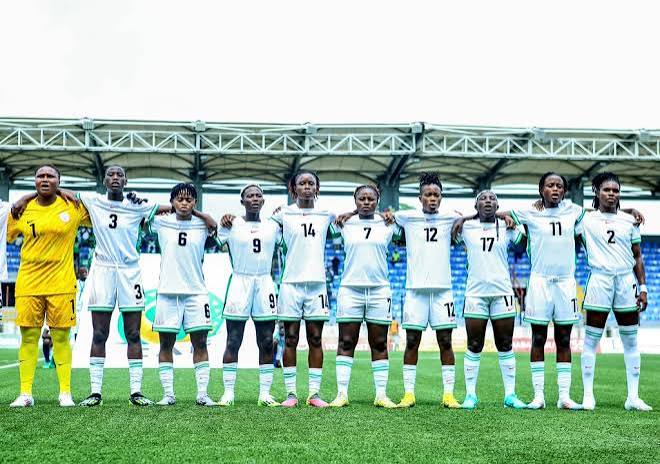
Nigeria’s Super Falcons have dropped seven places to 43rd in the FIFA Women’s World Ranking released on Tuesday, October 20, their lowest position in years and the clearest statistical measure yet of a troubled 2026. The team, ranked 36th in the June update, shed 83.54 ranking points, the largest loss recorded by any country in this edition. Despite the fall, Nigeria remain the highest ranked women’s team in Africa, ahead of South Africa, Morocco, Ghana and Zambia.
The slide is the team’s steepest since August 2022, when the Falcons, then under American coach Randy Waldrum, also dropped seven places from 39th to 46th after losing 69.33 points. This time the damage is greater in points terms, and it comes barely a year after the side were crowned African champions for a record 10th time. Their best ever position remains 23rd, a mark they reached on three occasions.
FIFA’s latest table was compiled after 183 international matches played during the most recent window, which included the 2026 Women’s Africa Cup of Nations, Olympic qualifiers, World Cup qualifiers and friendlies. Because the women’s ranking is based on an Elo rating system that weighs recent results heavily, defeats to lower rated opponents tend to cost teams more points. That detail goes some way to explaining why Nigeria’s August results proved so expensive.
The trouble began on the opening day of the tournament in Morocco. Nigeria arrived as defending champions but lost 3-2 to Malawi, a side playing at the continental championship for the first time. The Falcons steadied themselves with a 1-0 win over Zambia and a 6-2 thrashing of Egypt to reach the quarter-finals, where Cameroon beat them 1-0.
That defeat carried consequences well beyond the tournament. In a competition expanded to 16 teams, only the four semi-finalists qualified directly for the 2027 FIFA Women’s World Cup in Brazil. It was also the first time Nigeria had been knocked out at the quarter-final stage of the African championship.
The Falcons still had one route left through a play-off, but South Africa won 2-1 in Casablanca on August 13. Thembi Kgatlana and Refiloe Jane scored for Banyana Banyana before substitute Christy Ucheibe converted a stoppage time penalty for Nigeria. The result means Nigeria will be absent from the Women’s World Cup for the first time since the competition began in 1991, ending a run of nine consecutive appearances.
The tournament itself produced a surprise champion. Cameroon won their first continental title after beating Malawi 3-0 in the final in Rabat, completing a campaign in which they also eliminated hosts Morocco in the semi-finals. Malawi, the debutants who beat Nigeria on the opening day, went on to defeat Egypt, Ghana and Algeria on their way to the final.
The Nigeria Football Federation responded within days. On August 17, its Executive Committee asked head coach Justine Madugu and his entire technical crew to step down with immediate effect, in a brief statement on its official X account. Madugu, first drafted into the Falcons’ technical set up in November 2021, had led the team to the 10th continental title in 2025.
The federation did not give detailed reasons for the decision, which came shortly after it set up a six-member fact-finding committee to examine the team’s decline. The sacking drew mixed reactions, with some stakeholders calling on NFF President Ibrahim Gusau and the federation’s board to take responsibility as well. As of the latest update, the NFF had not publicly named a permanent replacement for Madugu.
The Falcons’ difficulties have unfolded alongside wider strain in Nigerian football. The Super Eagles failed to qualify automatically for the 2026 men’s World Cup in the United States, Canada and Mexico. The National Sports Commission has also moved against the federation’s planned electoral congress, adding to uncertainty at the top of the game.
There has been some recovery on the pitch since August. The Falcons beat Comoros in both legs of their qualifying tie for the 2028 Olympic Games in Los Angeles. Those wins, however, were not enough to offset the heavier penalties incurred during the African championship and the World Cup play-off.
At the top of the global table, Spain remain first, followed by the United States, Germany, England and Japan, with the top five unchanged. FIFA’s next women’s ranking is scheduled for release on December 7, 2026. How far the Falcons recover by then will depend largely on the fixtures arranged before that date and the technical direction the NFF settles on in the coming weeks.