
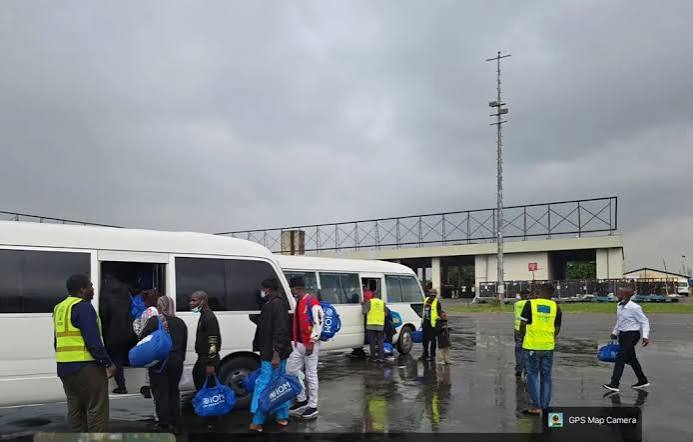
Another 180 Nigerians who had been stranded in Libya landed in Lagos on Tuesday, the National Emergency Management Agency (NEMA) has said, adding to a steady stream of returns that has now passed 71,000 since 2017. The returnees flew in from Sebha, a desert city in southern Libya long known as a transit point for migrants heading north. According to NEMA, they arrived at the Cargo Terminal of the Murtala Muhammed International Airport, Ikeja, at about 4:20pm aboard an Air Buraq Airlines flight with registration number 5A-BAE.
The agency said the group was made up of 143 adults, 26 children and 11 infants. The adults included 75 men and 68 women, while the children comprised 12 boys and 14 girls. Eight of the 11 infants were girls. The return was carried out under the Assisted Voluntary Return Programme, coordinated by the International Organisation for Migration (IOM) with the Federal Government.
NEMA said its Lagos Operations Office received the returnees alongside the National Commission for Refugees, Migrants and Internally Displaced Persons. Officers of the Nigeria Immigration Service took their biometric details on arrival to confirm their identities and keep records for reintegration. “Reintegration support was also provided to facilitate their return to their respective communities,” the agency stated. NEMA added that the returnees received food, water, medical screening and counselling, with ambulances on standby for those who needed urgent care.
The Sebha flight stands out for where it came from. Most of the return flights from Libya this year left from the coastal cities of Benghazi and Tripoli. On March 31, NEMA received 145 returnees from Benghazi, followed by 181 from Tripoli on April 27 and 170 from Tripoli on May 11. Another 182 arrived from Benghazi on June 1, while 180 came in from the same city on September 7.
The make-up of each group has shifted from flight to flight. Of the 163 adults who arrived on May 11, NEMA said 129 were men and only 34 were women. The June 1 flight went the other way, with IOM putting the adult figure at 108 women and 45 men, and two children travelling without their parents. Tuesday’s group was more evenly split, but the presence of 37 children and infants again shows that whole families are among those caught up in the journey.
IOM figures put the scale of the problem in clearer focus. The agency said 14,787 Nigerians returned home with its support in 2025 alone. By June 1 this year, 7,825 had already returned in 2026, and the programme’s total since 2017 stood at more than 65,700. Speaking in Abuja earlier this month, IOM Nigeria’s Chief of Mission, Sharon Dimanche, said the figure had passed 71,000 as of October 14. That suggests more than 5,000 Nigerians returned between June and mid-October, keeping 2026 on a pace close to last year’s.
These figures cover returns from several countries along the migration routes through West, Central and North Africa, not Libya alone. Libya, however, remains the most dangerous stop on the journey for many. The voluntary return programme was scaled up in 2017, the same year footage of migrants being sold at auction in Libya drew global outrage and pushed the Federal Government to step up evacuations. IOM’s Lagos office said in June that charter flights from Libya were arriving almost every week, alongside commercial arrivals in Abuja and Kano.
The pool of people who could still need help remains large. IOM’s Displacement Tracking Matrix counted 943,748 migrants across Libya between March and April 2026, up slightly from 939,638 at the end of 2025. Nigerians were among the five largest nationalities in the country, after Sudanese, Nigeriens, Egyptians and Chadians. About 11 per cent of all migrants in Libya were in the south, where Sebha is located.
Not everyone who returns gets the support they need to start again. IOM says eligible returnees can receive vocational training, help with small businesses, education and referrals to other services, but Dimanche has also warned that global funding for migration work is shrinking. With flights from Libya continuing and thousands more Nigerians still in the country, NEMA and its partners are likely to be back at the cargo terminal in Ikeja before long.