
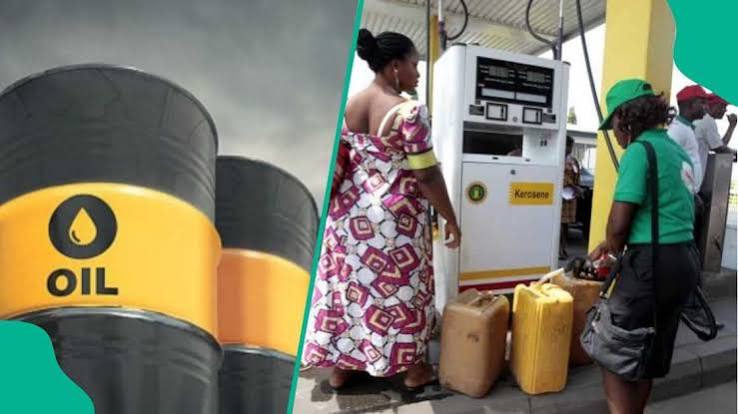
Petrol prices in Nigeria could ease for the first time in months, after a sharp fall in international crude oil prices lifted hopes that the energy costs squeezing households and businesses may finally retreat. Brent crude, the global benchmark, dropped to about $92 a barrel this week, extending a weekly decline of roughly 16 per cent, one of its steepest in recent memory.
The slide follows fresh efforts to end the conflict between the United States and Iran, which has choked shipping through the Strait of Hormuz since late February. Qatar’s prime minister was travelling to the White House with an Iranian proposal for an interim deal, under which Tehran would reopen the waterway and stop attacks on Gulf tankers, while Washington would lift its naval blockade and release about $8 billion in frozen Iranian funds.
Neither government has confirmed the terms, and the road to an agreement remains uncertain. President Donald Trump said fresh American strikes were unlikely if talks produced a strong deal, but Secretary of State Marco Rubio insisted the two sides were still far apart. Iran’s foreign minister, Abbas Araghchi, said Tehran could reopen the strait within two days once the war ended on all fronts, even as attacks on vessels near the waterway continued over the weekend.
The stakes for Nigeria are considerable. The Strait of Hormuz carries about one-fifth of the world’s seaborne oil, and its disruption since 28 February pushed Brent up by more than 60 per cent this year, to four-year highs above $110 a barrel at one stage. Although the Dangote refinery now supplies most of the petrol consumed locally, pump prices still track the cost of crude and imported products, so swings in the global market reach Nigerian motorists within weeks.
That link shows clearly in the numbers. The average pump price stood at N1,214.17 per litre in November 2024, according to the National Bureau of Statistics, and eased to N1,061.35 a year later. The relief proved brief. As crude climbed through 2026, petrol returned to between N1,350 and N1,450 per litre by August, and energy inflation jumped to 10.85 per cent year on year in September, from 4.69 per cent a month earlier.
The government has moved to blunt the impact. The Nigerian National Petroleum Company applied a N66 per litre discount on Independence Day, and on 8 October the Finance Minister, Taiwo Oyedele, announced a 30-day petrol discount tied to the company, which he said was meant to curb volatility rather than restore a blanket subsidy. Some relief has already reached the pump. On 4 November the NNPC cut its price in Abuja to N1,325 and in Lagos to N1,355, following a downward review of Dangote’s gantry price.
The wider economy remains under pressure. Headline inflation has slowed from above 24 per cent in mid-2025 to 15.43 per cent in July 2026, helped by a firmer naira and easing food prices, though the Central Bank’s projection of a 12.94 per cent average for the year now looks ambitious. Fuel sits at the heart of the problem, feeding into transport fares, food prices and the cost of the generators that power millions of homes and small businesses.
The price of petrol has also become one of the earliest flashpoints of the race to 2027. Atiku Abubakar, the African Democratic Congress candidate, has pressed President Bola Tinubu to bring prices down, arguing through his aide Phrank Shaibu that cheaper energy would ripple across the economy. His Economic Recovery Plan proposes a targeted, capped and independently audited subsidy for fuel refined at home, not for imports.
Tinubu and his aides have rejected the idea. The President dismissed calls for a return to subsidy as a sign of “serious ignorance” of the economy, while his spokesman, Bayo Onanuga, asked who would bear the cost and argued that inflation is not driven by petrol alone. The administration credits the removal of subsidy in 2023 with rescuing public finances.
Running beside the economic quarrel is a legal one. Atiku and the ADC have asked the Federal High Court in Abuja to disqualify Tinubu from the 2027 race over an alleged discrepancy in a National Youth Service Corps certificate, in a suit the electoral commission has described as an abuse of court process and which the President and his party have urged the court to dismiss. The court is due to rule on 20 November on an application to amend the case.
For now, motorists will watch the oil market closely. Whether this week’s slide in crude reaches the pump will depend on how long prices stay down, how fast marketers pass on the savings, and whether the fragile moves towards peace in the Gulf hold as Yuletide demand builds.