
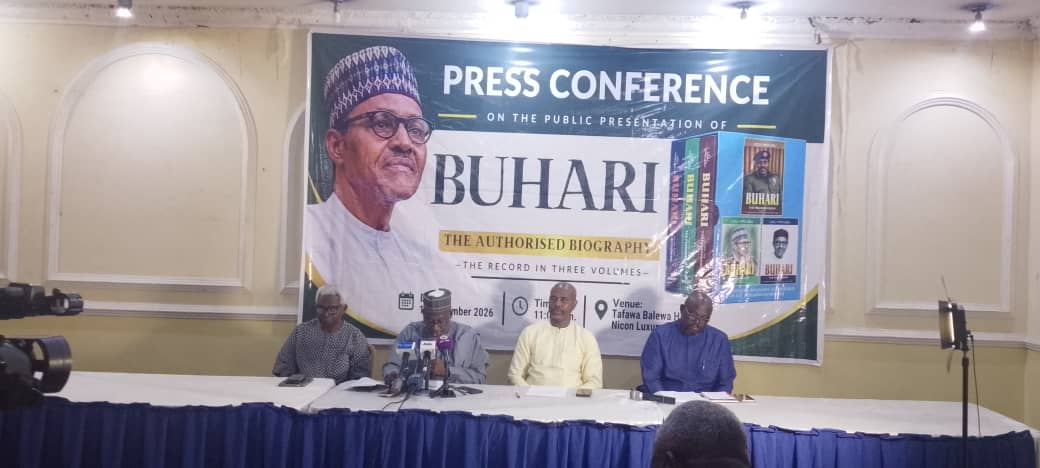
The late President Muhammadu Buhari sat for interviews and gave his blessing to a full account of his life before he died, the firm behind the project, May Publishing Limited, said at a press conference in Abuja on Wednesday. The announcement opened the way for the public presentation of *Muhammadu Buhari: The Authorised Biography*, a three-volume work the publisher describes as one of the most extensive yet devoted to a Nigerian political leader.
The author and chief biographer, Dr Udu Yakubu, told the gathering at the Tafawa Balewa Hall of the NICON Luxury Hotel that the volumes grew out of more than two years of research, interviewing, writing and revision. He was careful to separate access from control, saying the authorisation opened doors to people and records but did not mean surrendering judgement, and that his task was to recover the life and let evidence and consequence do their work rather than to canonise or condemn.
Buhari died on 13 July 2025 at a clinic in London, at the age of 82, after a prolonged illness. Yakubu has said he began the independent project in April 2024, that Buhari was personally involved and granted interviews before his passing, and that the work was neither commissioned nor funded by the former president. That distinction matters for a figure whose record still divides opinion, and the biographer presented the three volumes as an attempt to place a reliable account before the next generation.
Few Nigerian public figures moved through as many roles. Born on 17 December 1942 in Daura, Katsina State, Buhari rose through the army to become military Head of State from January 1984 until August 1985, then served as a democratically elected president from 2015 to 2023. His 2015 victory made him the first Nigerian opposition candidate to remove a sitting president through the ballot box. He won a second term in 2019. The three volumes carry the titles *The Phenomenon*, *The Presidency* and *The Reckoning*, tracing his path from Daura through military rule, detention, long years in opposition and eventual return to power.
Selected excerpts released at the event offered a sense of the book’s method. One, from the first volume, revisits the coup of August 1985 that ended his military government, recounting how two soldiers entered his bedroom to tell him he was under arrest and his single-word reply, “OK,” which the biographer frames not as resignation but as the quick judgement of a general who knew the position was lost. Another, from the second volume, draws on the recollections of former junior petroleum minister Ibe Kachikwu, who described Buhari’s early instinct to meet the Niger Delta Avengers with force and his reluctance to approve talks with the militants, before he was persuaded to let a peace process proceed.
The chairman of the planning committee, Engr. Suleiman Adamu, said the presentation was conceived as a serious national occasion built around history, memory and leadership, not as a tribute. He said the organisers were deliberately widening the event beyond Buhari’s political associates to draw in academia, the military community, the diplomatic corps, civil society and the wider reading public, and that the volumes should reach universities, libraries, research institutions and diplomatic missions so that students and researchers can interrogate them.
The work enters an already crowded field. The same publisher earlier produced a five-volume study, *Muhammadu Buhari: The Nigerian Legacy (2015 to 2023)*, also edited by Yakubu, while other memoirs and biographies have appeared since his death. Buhari’s legacy remains contested, with supporters pointing to infrastructure, an anti-corruption posture and personal discipline, and critics citing insecurity, economic hardship and human rights concerns across his eight years in office.
Organisers said the formal public presentation would follow, with the programme and participants to be announced as arrangements are concluded. For now, the biographer’s invitation to readers was plain: return to the events, weigh intention against consequence, and arrive at their own judgement.