
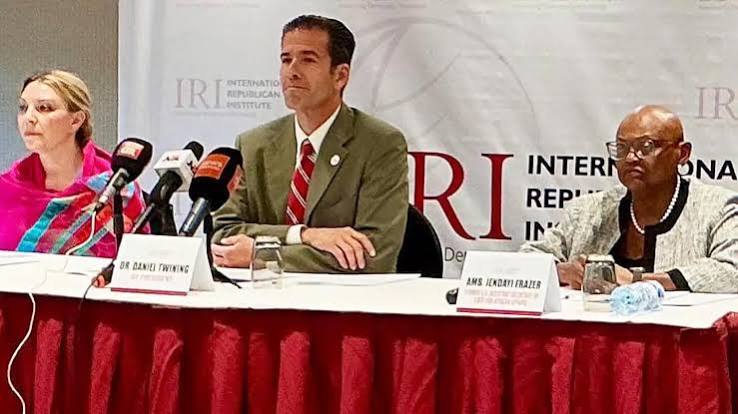
Senior United States officials have pledged to watch Nigeria’s presidential election closely, singling out the January poll as a possible flashpoint for violence in a country already fighting insecurity on several fronts.
The warning came from the US Assistant Secretary of State for African Affairs, Frank Garcia, in testimony before the House of Representatives Subcommittee on Africa during a hearing on violence in Nigeria. Garcia listed the coming election among the pressures complicating efforts to curb insecurity, saying it could spur violence. He also pointed to an overstretched security architecture, limited judicial reach into the Middle Belt and thin resources as the main constraints facing the government. “Nigeria will hold presidential elections in January, which could spur violence,” he told the lawmakers.
Other voices at the hearing pushed for even sharper attention. Congressman Riley Moore said the United States should watch the vote “like a hawk,” urging colleagues to track developments around the exercise. The Assistant Secretary of State for Democracy, Human Rights and Labour, Riley Barnes, said his bureau was already following the election through a dedicated team that monitors high-priority polls across the world, describing Nigeria’s as one such contest.
The scrutiny lands on an election whose timing has already stirred debate at home. The Independent National Electoral Commission moved the presidential and National Assembly vote to 16 January 2027, bringing it forward from 20 February, after lawmakers passed the Electoral Act 2026. INEC, under its chairman Joash Amupitan, said the adjustment was needed to align the calendar with the new law. The earlier February date had drawn protests from some Muslim groups because it fell within Ramadan.
Washington’s interest in the poll is tied to a wider standoff over security and religious freedom. On 31 October 2025, US President Donald Trump designated Nigeria a Country of Particular Concern over the killing of Christians, and warned in follow-up messages of possible aid cuts and even military action if the attacks continued. Nigeria had carried the same designation during Trump’s first term before it was lifted under President Joe Biden in 2021.
The scale of the violence is contested, but the broad picture is grim. Figures compiled by the Armed Conflict Location and Event Data Project put the number of attacks on civilians in Nigeria at close to 12,000 between January 2020 and September 2025, with more than 20,000 deaths recorded across religious lines. Nigerian authorities reject the framing of the crisis as state-backed religious persecution, arguing that the bloodshed stems from terrorism, banditry and long-running conflicts between herders and farmers. Some US lawmakers, among them Congresswoman Sara Jacobs, have also cautioned that reducing the crisis to a purely religious conflict risks missing its real drivers.
Behind the public pressure, the two governments have opened a formal channel. A US-Nigeria Joint Working Group set up after the designation has focused on heavier security deployments, faster responses to early warnings, accountability for attackers and closer military cooperation. Garcia, who visited Abuja in July, has since credited Nigeria with stepping up its efforts, while Washington keeps pressing for measurable results.
For now, the message from Washington is that the January vote will be read as a test of both Nigeria’s democracy and its ability to keep the peace. With campaigns already under way and security agencies promising to protect voters and materials, the coming weeks will show whether the election steadies the country or deepens the strain. What remains unresolved is how far American concern will translate into concrete action, and whether the government can show the progress its partners want before polling day.