
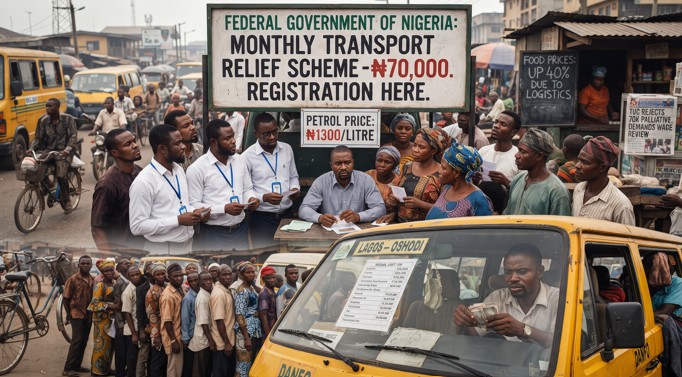
The Trade Union Congress recently rejected the Federal Government’s proposed ₦70,000 monthly transport relief scheme, pointing to persistent inflationary pressure and demanding systemic wage adjustments instead. This rejection highlights the immediate limits of emergency palliatives in the wake of full fuel subsidy removal and exchange rate unification. While the administration framed the proposed stipend as a direct cushion for low-income wage earners, organised labour viewed it as a temporary plaster on a deep structural wound. The disagreement is not merely a tactical dispute over wage figures; it marks a fundamental clash between short-term liquidity management and long-term economic stabilisation.
The core of this policy impasse lies in a recurring misdiagnosis within Nigerian macroeconomic management: treating structural supply shocks with short-term demand-side cash injections. When fuel subsidies were removed, transport costs doubled overnight, immediately raising the floor for freight, food distribution, and daily commuter tariffs. A fixed monthly transport allowance attempts to subsidise the end consumer without altering the underlying cost of fuel, vehicle maintenance, spare parts, or transit route inefficiencies. By injecting liquidity directly into a market where public transit supply remains severely constrained, the state risks generating secondary inflationary ripples while doing nothing to bring down the baseline cost of moving goods and people across the country.
Short-term cash palliatives fail to offset logistics and pass-through costs because transit inflation is cumulative, not static. When a commercial driver pays higher prices at the pump, that expenditure cascades through every tier of the local economy. The cost of transporting farm produce from rural agrarian hubs to urban consumer markets rises instantly, driving up food prices before the produce even reaches the retail shelf. A fixed monthly cash transfer to formal sector workers covers only a fraction of their immediate transit bill, while there is no relief to the informal food vendors, agricultural hauliers, and small-scale distributors who dictate everyday consumer prices. Because the cash disbursement does not alter the unit cost of diesel or premium motor spirit, transport operators continue to pass their operational overhead onto commuters and merchants, rendering the cash stipend ineffective within weeks of implementation.
To break this cycle, state intervention must pivot from consumer-side cash transfers to supply-side structural investments in mass urban transit infrastructure. Rather than distributing liquid capital that rapidly depreciates under high inflation, public funds ought to be redirected toward expanding high-capacity, low-emission transit networks. Establishing dedicated Bus Rapid Transit corridors, completing suburban rail linkages, and deploying compressed natural gas or electric bus fleets directly reduces the operational expense per passenger-kilometre. When the government invests in the physical capital of mass transit—owning or leasing heavy vehicles and leasing them to managed private operators under regulated fares—it establishes a stable, low-cost baseline for public movement. This structural approach lowers living expenses across the entire urban populace, regardless of whether an individual works in the formal or informal sector.
From a fiscal standpoint, recurring cash relief programmes present a far heavier and less sustainable burden on public budgets than targeted energy subsidies or credit guarantees for public transport operators. Cash transfers require massive, recurring budget allocations that leave behind no permanent state assets or productive capacity. They also require complex administrative machinery to manage disbursements, introducing overhead expenses and verification leakage. In contrast, target-driven interventions, such as granting tax breaks on transit fleet imports, subsidising conversion kits for commercial vehicles switching to compressed natural gas, or offering bulk fuel discounts to verified public transport unions, directly suppress the main cost driver of passenger transit. The fiscal outlay for targeted operator subsidies bears a persistent anti-inflationary return by holding down transit tariffs, whereas cash disbursements drain state reserves while leaving urban mobility as vulnerable to price shocks as before.
Organised labour’s refusal to accept a temporary transport allowance underscores the need for systemic economic solutions over quick political fixes. Sustained economic stability cannot be achieved through perpetual liquid relief in a market suffering from severe infrastructure deficits. A lasting resolution requires policymakers to move beyond emergency distribution frameworks and commit funds to building durable public transport systems that can insulate Nigerian households from future energy price volatility.