
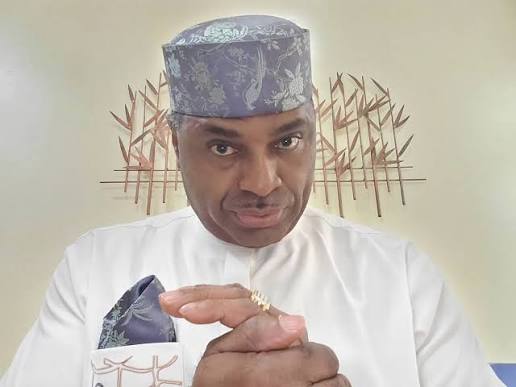
Kenneth Okonkwo, a chieftain of the African Democratic Congress and a supporter of former Vice President Atiku Abubakar, has seized on President Bola Tinubu’s admission that water supply failed at the Presidential Villa to argue that the administration cannot deliver basic services to ordinary Nigerians.
The lawyer and former actor made the claim in a post on his X handle on Monday, reacting to Tinubu’s disclosure at a family prayer session in Lagos on Sunday that the water went off while he was shaving at the Villa during the week. Okonkwo described the confession as the clearest evidence yet of a failing government.
He argued that if the President could not guarantee steady water and power at the seat of government almost four years into his tenure, he could hardly be expected to provide those services for the wider population. Linking the two utilities, Okonkwo said there could be no industrialisation without electricity and no life without water, and urged Nigerians to vote for Atiku in 2027 for “light and life”.
Tinubu did not hide the problem. He told the gathering that the Villa itself was not spared, acknowledged that the country still struggled with power and water, and pledged to correct it, insisting the work had only just begun and that his government would deliver for Nigeria.
Beyond the political sparring, the episode points to a wide gap between official promises and daily reality, one the numbers lay bare. Nigeria’s electricity grid has a nominal capacity of about 12,000 megawatts but typically delivers only 4,000 to 5,000 megawatts to a population of more than 200 million. The system has also proved fragile, collapsing on 29 December 2025, again on 23 January 2026, when generation crashed from nearly 4,000 megawatts to about 20 megawatts within an hour, and a third time on 27 January, barely five days later.
Access tells the same story. More than 90 million Nigerians still live without any connection to electricity, among the highest totals of any country in the world. Analysts put the country’s real need at well above 30,000 megawatts to power its homes and industries, several times what it currently generates. South Africa, with roughly a third of Nigeria’s population, produces many times more.
Water supply is no better. In Lagos, where Tinubu spoke, the state water corporation acknowledged in October that its network reached only about 1.03 per cent of the roughly 20 million residents, serving some 34,424 registered households, with actual production at a small fraction of installed capacity. The city needs well over 700 million gallons a day but produces less than 200 million, forcing most households to depend on boreholes, wells and sachet water.
These shortfalls carry real costs. Unreliable power pushes homes and businesses onto expensive petrol and diesel generators, raising production costs and the prices consumers pay, while poor water access has been tied repeatedly to outbreaks of cholera and other waterborne diseases.
The politics are unmistakable. Okonkwo belongs to the ADC, the opposition platform on which Atiku is expected to challenge Tinubu in 2027, and his intervention fits a wider opposition effort to turn everyday infrastructure failures into a campaign message. The governing All Progressives Congress has consistently argued that the administration inherited decades of underinvestment and that its reforms need time to bear fruit.
What is not in dispute is the scale of the task. Tinubu’s own account of a dry tap at the Villa has, if anything, underlined how far the country remains from reliable electricity and water, and how central those basics are likely to be when voters make their choice in 2027.