
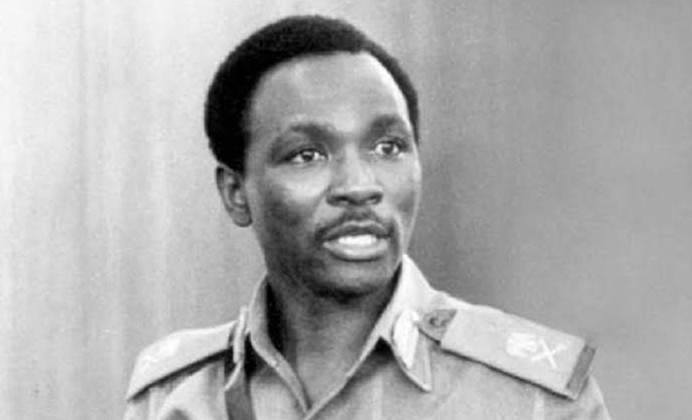
For decades, orthodox Cold War historiography has caricatured Nigeria’s 1967 pivot toward the Soviet Union as an opportunistic ideological flirtation, or a reckless departure from post-independence non-alignment. That narrative collapses under historical scrutiny. Far from an ideological conversion in Lagos, the entry of Soviet fighter jets and Kalashnikov rifles into the Nigerian Civil War was the direct, predictable consequence of Western diplomatic abandonment – a calculated strangulation of a sovereign state by its presumed traditional allies at the hour of its existential peril. When Washington slammed its armoury doors shut, and London rationed support with paternalistic condescension, General Yakubu Gowon did not embrace communism; he embraced survival.
In the volatile aftermath of the July 1966 counter-coup and the collapse of the Aburi talks, the thirty-one-year-old Head of State approached the secessionist crisis not as a warlord spoiling for annihilation, but as a reluctant custodian of a fractured federation. Even after Lieutenant Colonel Chukwuemeka Odumegwu Ojukwu proclaimed the independence of the Republic of Biafra on 30 May 1967, Gowon initially conceived the federal response as a calibrated “police action” designed to arrest national disintegration without plunging the country into total war. Yet the state machinery at his disposal was catastrophically under-equipped for an internal conflict of that magnitude. The Nigerian Navy could muster only a single frigate, six patrol boats, and an obsolete Second World War landing craft; the Air Force possessed virtually no effective striking power; and the Army relied on basic light weapons and ageing FN FAL rifles entirely unsuited to protracted, multi-front warfare.
What Lagos desperately required in those opening months of full-scale combat – which erupted on 6 July 1967 – was reliable resupply from the Western powers whose political and economic architecture Nigeria had inherited. Instead, the Federal Military Government encountered a wall of geopolitical hypocrisy. While France, acting through its West African satellites and Gabon, funnelled clandestine assistance to Biafra, and mercenaries poured in from South Africa and elsewhere to bolster the secessionist enclave, Nigeria’s traditional Western partners chose diplomatic attrition. The United States imposed a total arms embargo, ensuring that Lagos could not procure a single bullet from American sources. Britain, Nigeria’s former colonial power and regular defence supplier, adopted a minimalist supply policy – dripping out what Gowon rightly dismissed as the bare minimum of peacetime maintenance rather than the logistics required to prosecute a major internal war.
The consequences on the battlefield were immediate and perilous. Despite capturing the Biafran capital of Enugu by 3 October 1967 – a milestone that under conventional military doctrine ought to have signalled the collapse of organised resistance – federal forces found themselves trapped in a grinding war of attrition. Armed with a formidable propaganda apparatus spearheaded by Radio Biafra and the persuasive voice of broadcaster Okoko Ndem, Ojukwu’s administration successfully framed the conflict abroad as a defensive struggle against genocide. Western media outlets – including the BBC, Voice of America, and Radio France – amplified this narrative, treating federal communiqués as mere “claims” while reporting Biafran assertions with unquestioned authority. Shielded by this global theatre of pity and sustained by foreign supply lines, Biafran forces pressed deep into the Mid-West and threatened the South-West, exploiting federal logistical paralysis.
Behind the lines, Nigeria’s military predicament had deteriorated from precarious to existential. Gowon had originally projected that the rebellion would be contained by the close of 1967 or early 1968, yet his commanders at the front were starved of the basic tools of combat. As young officers like Muhammadu Buhari later attested, frontline units were repeatedly forced to halt advances or endure avoidable casualties because ammunition was scarce and orders to push forward never arrived from Lagos. Gowon had imposed a strict operational restraint upon his commanders, refusing to authorise fresh offensives without adequate stockpiles in hand. By early 1968, that restraint had become a desperate necessity: Nigeria’s reserve for the entire Army had plummeted to roughly half a million rounds of ammunition. Half a million rounds for a national army fighting across multiple fronts is not a war chest; it is an invitation to collapse. Had that meagre reserve been exhausted and the frontline reversed, every territorial gain secured since July 1967 would have evaporated overnight. Forced to scavenge through private arms markets in Europe – notably in Belgium – Lagos discovered that Western diplomatic neutrality was, in practice, an instrument of institutional suffocation.
The decisive breaking point arrived not in the trenches of the East, but in the skies over Nigeria’s heartland. Having witnessed the indiscriminate devastation of aerial bombardment during the Second World War and in Vietnam, Gowon had deliberately resisted introducing air warfare into the Nigerian conflict. That restraint evaporated when Ojukwu threatened to unleash B-26 bombers against major Nigerian cities – specifically targeting Lagos, Ibadan, Benin, Kano, and Lokoja. Faced with the imminent aerial terrorization of civilian populations and critical economic centres, Gowon approached London and Washington with a modest, defensive request. He did not ask for advanced strategic bombers or offensive escalation; he requested merely a limited aircraft capability sufficient to deter Ojukwu’s B-26s and shield Nigerian cities from bombardment.
The response from the Western capitals laid bare the cold calculus of Cold War paternalism. Washington offered nothing. London responded with evasive diplomatic formulations and vague possibilities that never materialised into a single aircraft on a Nigerian tarmac. In effect, Britain and the United States demanded that the legitimate government of Africa’s most populous nation sit passively while its cities were bombed into submission, all to preserve Western domestic sensibilities and geopolitical convenience.
At that moment, Gowon demonstrated the quiet resolve that separates statecraft from servility. Summoning the British and American representatives in Lagos, he informed them with measured clarity that while he respected their sovereign right to withhold assistance, he bore a higher constitutional and moral duty to defend his country – protecting Nigerians and foreign nationals alike. Since London and Washington refused to honour their obligations as partners, Nigeria would go wherever necessary to secure the means of its own survival.
The diplomatic pivot was swift, unsentimental, and devastating to Western complacency. The moment the British and American envoys departed, Gowon summoned the Soviet ambassador. Unlike the tortuous bureaucratic evasions of Whitehall and the State Department, Moscow’s response was instantaneous. The Soviet envoy noted Nigeria’s urgent requirements, cabled Moscow for instructions, and returned the next morning with an affirmative commitment. Overnight, the balance of the air war shifted: Lagos secured MiG-15 fighter jets for pilot training and MiG-17s for combat operations – hardware immediately sufficient to neutralise Ojukwu’s B-26 threat. Alongside those aircraft came heavy artillery, ordnance, and Soviet Kalashnikov rifles, which frontline federal troops swiftly preferred over their older, jam-prone FN FALs.
What Western policymakers failed to grasp in 1967 and 1968 is a fundamental axiom of international relations: sovereignty does not negotiate its own extinction. By weaponising arms embargoes and rationing ammunition to a beleaguered state fighting to preserve its territorial integrity – and to protect the roughly 67 per cent of its petroleum resources concentrated in the East – Washington and London engineered the very outcome they feared most. They handed the Soviet Union its most consequential diplomatic foothold in West Africa without Moscow firing a single ideological shot. Gowon’s turn to the Kremlin was neither an embrace of Soviet dogma nor a betrayal of Western friendship; it was an act of national self-defence forced upon Lagos by allies who mistook Nigerian dependence for permanent submission.