
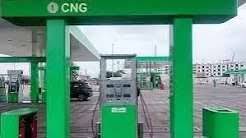
The Federal Government is expanding Nigeria’s compressed natural gas (CNG) infrastructure through the Midstream and Downstream Gas Infrastructure Fund (MDGIF), as part of efforts to reduce dependence on petrol and ease transportation costs for households and businesses.
The Minister of State for Petroleum Resources (Gas), Senator Ekperikpe Ekpo, said President Bola Tinubu had directed the establishment of an additional 500 CNG refuelling stations towards a national target of 1,000 facilities.
The directive comes amid concerns over inadequate refuelling infrastructure, vehicle conversion costs and the impact of petrol subsidy removal on transportation and commercial activities across the country.
Figures released by the Nigerian Upstream Petroleum Regulatory Commission (NUPRC) show that Nigeria’s natural gas reserves increased from 210.54 trillion cubic feet in January 2025 to 215.19 trillion cubic feet in January 2026, representing an increase of 2.21 per cent. Despite this abundance, inadequate processing, distribution and storage facilities have continued to restrict domestic gas consumption.
The government’s latest intervention includes five CNG stations inaugurated on November 11 in Lagos through a partnership between the MDGIF and the state owned Ibile Oil and Gas Corporation (IOGC). The facilities are located in Idimu, Abule Egba, Ogolonto, Ajah and Oko Oba.
The Executive Director of MDGIF, Oluwole Adama, said the five stations could collectively serve approximately 8,400 vehicles daily when operating at full capacity. Each facility has a daily compression capacity of 24,000 standard cubic metres, bringing their combined processing capacity to 120,000 standard cubic metres.
The inauguration increased the number of stations delivered under the Lagos programme from four to nine, representing 60 per cent of the state’s target of 15 facilities. The remaining six are expected to be completed by the first quarter of 2027.
Established under the Petroleum Industry Act of 2021, the MDGIF operates under the Nigerian Midstream and Downstream Petroleum Regulatory Authority (NMDPRA). Its mandate covers investment in infrastructure required to process, transport, store and distribute natural gas for domestic consumption.
According to Adama, the fund has supported the delivery of more than 25 operational CNG stations within two years, while its wider investment portfolio comprises 31 projects covering 205 infrastructure assets nationwide.
The expansion has also extended to tertiary institutions under the Special Palliative Relief on University Transportation initiative, known as Project SPROUT. Four facilities were recently inaugurated at the University of Lagos, University of Ibadan, Federal University of Technology, Akure, and Federal University Oye Ekiti.
The Minister of Education, Dr Tunji Alausa, said the programme was designed to ease transportation expenses for students and university workers. Government figures put the number of participating universities with CNG stations at 11, representing 55 per cent of the initial target of 20 institutions.
Nigeria’s renewed interest in gas powered transportation followed the removal of petrol subsidy in May 2023, which significantly increased fuel expenditure for commercial transport operators. The Presidential CNG Initiative was subsequently introduced to encourage the use of alternative fuels and reduce the economy’s exposure to rising petrol costs.
Although industry operators estimate that CNG could reduce fuel expenditure by up to 70 per cent, actual savings depend on retail gas prices, vehicle efficiency, conversion expenses and access to refuelling stations. Vehicle conversion costs, which can approach N1m, also remain a financial barrier for motorists unable to meet the initial expenditure.
For commuters, however, cheaper fuel does not necessarily guarantee lower transport fares. There is insufficient publicly available data to establish the extent to which savings recorded by commercial operators using CNG have been passed on to passengers.
Beyond transportation, increased domestic gas utilisation could benefit manufacturers, agricultural businesses and logistics companies whose operating expenses are heavily influenced by energy costs. Realising those benefits would require reliable gas distribution, sustained private investment and effective regulatory oversight.
Adama identified regular maintenance, reliable supply and compliance with safety standards as critical to the sustainability of the new facilities. Ekpo also maintained that the success of the programme should be assessed by its economic impact rather than the number of stations inaugurated.
With Nigeria’s gas reserves now exceeding 215 trillion cubic feet, the government’s challenge remains converting that resource advantage into affordable energy. Whether the expansion delivers meaningful relief will depend largely on accessibility, affordability and measurable reductions in transportation costs.