
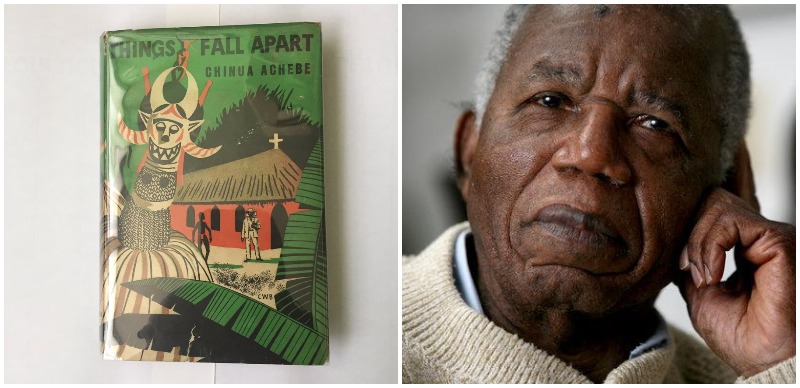
Before Things Fall Apart became one of the most widely read novels in African literature, its handwritten manuscript nearly disappeared at a typing agency in London. The experience, which Chinua Achebe later recounted, remains a remarkable chapter in the history of a book that challenged Western representations of Africa and introduced generations of readers to Igbo society from an African perspective.
Achebe, who was born on November 16, 1930, in Ogidi, present day Anambra State, would have turned 96 this November. His account of the missing manuscript offers an insight into the difficulties African writers faced in securing international publishing opportunities during the colonial era.
The incident dates back to 1957, when Achebe travelled to Britain on a scholarship to undertake professional training at the British Broadcasting Corporation (BBC). He was working for the Nigerian Broadcasting Service and had already prepared an early draft of his first novel.
While attending the training programme, Achebe showed the manuscript to Gilbert Phelps, a novelist and BBC instructor. Impressed by the work, Phelps offered to introduce Achebe to his publishers, but the young Nigerian decided to return home and revise the novel before submitting it.
After completing the revisions in Lagos, Achebe sent his only handwritten copy to a London typing agency that had advertised its services in a British magazine.
According to Achebe’s 1994 interview with The Paris Review, the agency acknowledged receipt of the manuscript and requested £32 to produce two typed copies. He forwarded the payment through a British postal order, but subsequent letters seeking information about the manuscript went unanswered for months.
Achebe recalled losing considerable weight during the period as uncertainty grew over the whereabouts of his work. With no duplicate manuscript in his possession, the prospect of losing the novel threatened the progress he had made towards becoming a published author.
Relief came through Angela Beattie, his British supervisor at the Nigerian Broadcasting Service, who was travelling to London on annual leave. After learning about his predicament, Beattie obtained the agency’s address and visited its office.
The company claimed that British customs authorities had returned the manuscript after an attempted dispatch. However, when Beattie requested its dispatch records, the agency could not produce them.
Following her intervention, Achebe received one typed copy instead of the two for which he had paid, without any explanation for the lengthy delay.
His eventual publisher, Alan Hill, believed the manuscript might simply have been neglected at the agency. Achebe, however, suspected that the treatment he received was connected to his being an African customer, although the company’s actual intentions were never independently established.
Recovering the manuscript was only the first hurdle. Heinemann, the British publishing company to which Achebe submitted the novel, was initially uncertain about the commercial prospects of publishing fiction by an African author.
The manuscript received a favourable assessment from Donald MacRae, an academic at the London School of Economics, helping to persuade the company to proceed with publication.
Things Fall Apart was published on June 17, 1958, two years before Nigeria gained independence from Britain. Its initial print run was just 2,000 copies, reflecting the publisher’s uncertainty about the potential market for the novel.
Centred on Okonkwo and the fictional Igbo community of Umuofia, the novel explored the social, religious and political structures of African society and the upheaval associated with European colonial expansion.
Its success subsequently contributed to the establishment of the African Writers Series in 1962, with Achebe serving as its founding editorial adviser. The series provided an international publishing platform for African authors at a time when many countries on the continent were gaining independence.
The novel has since sold millions of copies and been translated into more than 50 languages, becoming a major text in schools and universities across the world.
Its influence also extended to Nigerian television. The Nigerian Television Authority adapted the novel in the 1980s, with veteran actor Pete Edochie portraying Okonkwo, a performance that introduced another generation of Nigerians to Achebe’s work.
Achebe went on to publish other notable books, including No Longer at Ease in 1960, Arrow of God in 1964, A Man of the People in 1966 and Anthills of the Savannah in 1987. He received the Man Booker International Prize in 2007 in recognition of his contribution to literature and died on March 21, 2013, aged 82.
Nearly seven decades after its publication, Things Fall Apart remains central to discussions about colonialism, African identity and the representation of indigenous societies in world literature. Its unlikely journey to publication also illustrates the institutional barriers African writers had to navigate to bring their stories to an international audience.