
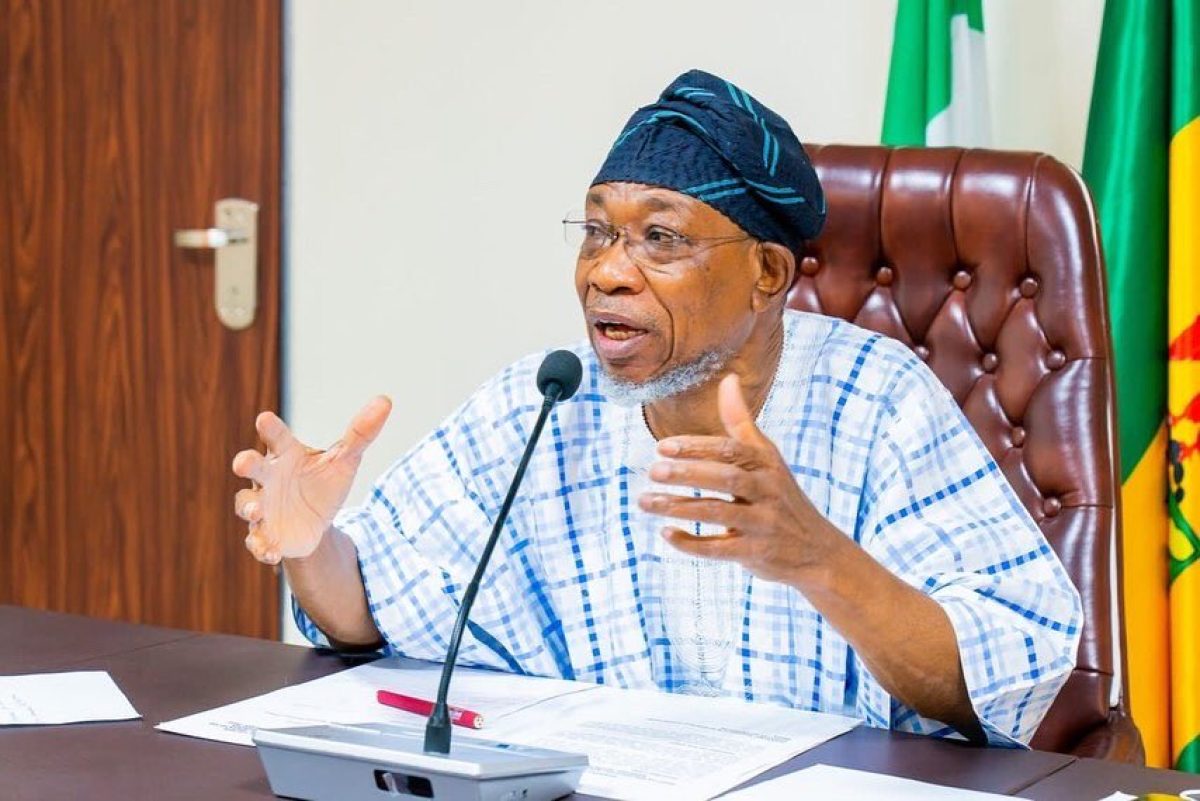
Three weeks before Osun State votes for a governor, a claim by former Governor Rauf Aregbesola that he completed eight years in office without owning a house of his own has pushed the question of personal probity to the centre of an already crowded campaign, and revived scrutiny of an administration whose fiscal record remains one of the most contested in the state’s recent history.
Aregbesola, now National Secretary of the African Democratic Congress, ADC, made the assertion while addressing supporters in a video that circulated online on Thursday, July 23, 2026. He said he lived in a friend’s house in the Amuta area of Ilesa for the duration of his tenure and invited anyone who disputes him to produce evidence.
“I’m the first governor in Nigeria to govern a state for eight years without owning a house of my own. I stayed in my friend’s house for eight years as governor in my fatherland. Whoever says what I’m saying is not true should come out and show me the house I own,” he said.
The former governor, who administered Osun from November 2010 to November 2018 before serving as Minister of Interior under the late President Muhammadu Buhari, framed the remark within a broader account of his years in office, saying his government focused on poverty reduction, education and public peace.
Nigerian law places asset disclosure obligations on every governor, but it does not place those disclosures in the public domain. Section 185(1) of the 1999 Constitution, as amended, requires a governor and deputy governor to declare assets and liabilities before assuming office. Paragraph 11 of Part 1 of the Fifth Schedule further requires public officers to submit written declarations of all properties, assets and liabilities to the Code of Conduct Bureau on assumption of office, at the end of every four years, and at the end of their term.
The Bureau retains those records and makes them available for inspection only on terms prescribed by the National Assembly. Because the filings are not routinely published, a claim of this nature cannot be verified or falsified from any open register, a structural gap that anti corruption commentators have raised repeatedly. As of the time of filing, no institution, political party or state agency had formally contradicted the statement with documentary evidence, and none had confirmed it.
The claim lands on ground that has been fought over for years. Aregbesola’s second term coincided with the collapse in crude prices, and from July 2015 his government adopted what it called a modulated salary regime. Under the arrangement, as set out in official statements at the time, workers on grade levels one to seven received full pay, those on levels eight to ten or twelve received 75 per cent, and those on level twelve and above, along with political appointees, received 50 per cent.
Aregbesola told a Civil Service Week gathering in Osogbo in December 2017 that only 28 per cent of the workforce was affected, and gave figures for the strain. Income from all sources between July 2015 and November 2017, including federation account allocations, internally generated revenue and two tranches of Paris Club refunds, stood at N121.6 billion, he said, while full personnel costs of N3.6 billion monthly would have amounted to N104.4 billion over the same period, or 85.8 per cent of total revenue.
In September 2018, weeks before the governorship poll of that year, the state announced the disbursement of N19,801,328,271.22 for salary arrears, pensions and leave bonuses. The announcement was made by the then Commissioner for Finance, Bola Oyebamiji, who is now the All Progressives Congress candidate in the August election. Government statements at the time noted that monthly salaries and pensions had risen from N1.6 billion at the start of the administration to N3.6 billion after minimum wage adjustments. Labour figures and opposition politicians have maintained that arrears from the period were never fully cleared.
Governor Ademola Adeleke’s camp has drawn on that history repeatedly. In a statement issued in Osogbo in July 2025 through his spokesperson, Olawale Rasheed, the governor described his predecessor as “a man who left a legacy of huge state debt, half salary, scam learning tablets (Opon Imo) and several fanciful, inflated, uncompleted projects”, calling the tenure “the worst in Osun history”. Aregbesola’s supporters have countered that the salary policy was a burden sharing measure agreed with labour representatives to avoid retrenchment.
On debt, figures published by the Debt Management Office and cited by the state government put Osun’s domestic debt at N148.37 billion in December 2022, falling to N83.32 billion by the first quarter of 2025, a reduction of about 43.8 per cent. External debt over the same period moved from 91.78 million dollars to 75.14 million dollars. The administration attributes the decline to repayment without fresh borrowing for infrastructure.
The statement comes days after Aregbesola led the ADC governorship campaign council to Ile-Ife on Tuesday, July 21, where the party flagged off its statewide campaign at Enuwa following a courtesy visit to the palace of the Ooni of Ife, Oba Adeyeye Enitan Ogunwusi. He was accompanied by the party’s candidate, Najeem Salaam, a two term former Speaker of the Osun State House of Assembly who served during Aregbesola’s tenure. The Ooni used the occasion to appeal to parties and residents to keep the contest peaceful.
Speaking at the palace, Aregbesola said the choice of Ile-Ife was deliberate. “Ile-Ife remains our source. It has been about eight years since we last came here for this purpose,” he said, adding that his tradition had always been to open campaigns in the city. A statement by the Osun ADC Publicity Secretary, Abosede Oluwaseun, listed further rallies for Iwo on July 28 and Osogbo on August 8.
The Independent National Electoral Commission fixed the poll for August 15, 2026, having earlier scheduled it for August 8. Its final list of candidates, conveyed in a letter signed by the Commission Secretary, Dr Rose Oriaran Anthony, on March 4, 2026, cleared 14 parties, with campaigns formally opening on March 11. The Peoples Democratic Party, on whose platform Adeleke won in 2022, and the Labour Party did not field candidates. Adeleke is seeking re election on the Accord platform with Kola Adewusi as running mate, while Oyebamiji is paired with Benjamin Adereti.
A document titled Analysis of Register of Voters, signed by the Osun INEC Director of Voter Registry, Olatunde Olalere, and released to political parties on July 9, 2026, puts the eligible electorate at 2,339,233.
The margins in Osun have been historically thin. In July 2022, Adeleke polled 403,371 votes to Oyetola’s 375,027, a gap of 28,344 across 17 local government areas to 13. The 2018 contest was declared inconclusive after the September 22 poll, went to a rerun on September 27, and was litigated until the Supreme Court affirmed Oyetola on July 5, 2019.
Security agencies have signalled concern about the temperature of the race. The state Commissioner of Police, Ibrahim Gotan, convened a stakeholders’ meeting urging political actors to discourage thuggery, following reported clashes in Osogbo, Ede and Ife.
With three parties commanding the visible structures, incumbency under Adeleke, federal weight behind Oyebamiji and Aregbesola’s Omoluabi bloc behind Salaam, character arguments are likely to carry as much campaign traffic as policy. Whether a claim about property ownership can be tested against anything more than assertion remains, for now, a limitation of Nigeria’s disclosure architecture rather than a question the ballot can answer.