
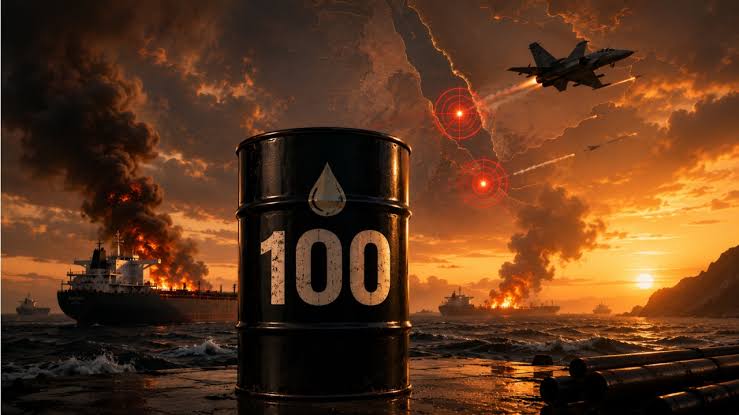
Brent crude closed above $100 a barrel on Thursday for the first time since late May, after Iran aligned Houthi fighters struck Saudi oil tankers in the Red Sea and opened a second maritime front in a conflict that has already crippled traffic through the Strait of Hormuz.
The international benchmark settled 7 percent higher at $100.69 a barrel after touching an intraday peak of about $102, its strongest level in eight weeks. West Texas Intermediate rose 6.2 percent to $92.19, its best close since June 4 and its first move above $90 since June 11. Both contracts advanced for a fifth consecutive session. Brent has now gained close to 40 percent in July alone.
The trigger was an assault on two Saudi vessels, identified in reports as the Encelia and the Layla, days after the Houthi movement declared a naval blockade on Saudi shipping. The Saudi Press Agency confirmed that one of the tankers caught fire and described the attacks as a breach of international conventions protecting commercial vessels and their crews. Five Saudi tankers reversed course in the corridor, and Saudi loadings through the passage were reported to have fallen by about 36 percent.
United States President Donald Trump threatened the group with what he called “major military punishment,” while Iran vowed to keep striking targets across the Gulf region for as long as it remains under American attack.
The current crisis dates to February 28, 2026, when the United States and Israel launched joint strikes on Iranian nuclear sites, Revolutionary Guard bases and missile infrastructure. Tehran responded by declaring the Strait of Hormuz closed to commercial traffic without its permission. About a fifth of the world’s oil supply normally moves through that waterway.
Prices reacted violently. Brent climbed from roughly $75 to above $100 within days of the closure, and by late March it was trading above $115, the highest since July 2022. The International Energy Agency coordinated a record release of 400 million barrels from strategic reserves in an attempt to steady the market. Reports over the course of the conflict indicate the benchmark touched as high as $120 at one stage.
A memorandum of understanding signed in June extended a ceasefire by 60 days and required Washington to lift its naval blockade in exchange for safe passage of commercial ships. That arrangement unravelled after Iranian attacks on three vessels on July 6 and 7. Trump declared the truce over, and by Thursday American forces had completed a twelfth consecutive night of strikes on Iranian missile stores, drone facilities and coastal surveillance sites.
The Red Sea escalation matters because Saudi Arabia had been rerouting millions of barrels through that corridor precisely to avoid Hormuz. According to the United States Energy Information Administration, roughly 8 percent of global oil passes through the Bab el Mandeb chokepoint at the southern end of the Red Sea.
“If Saudi Arabia is unable to move the additional quantities of crude oil that they redirected already from the Persian Gulf, it means that supply disruption is that much worse for the rest of the world at a time that we continue to draw down our commercial inventories,” Andy Lipow of Lipow Oil Associates said.
Tim Snyder, chief economist at Matador Economics, said in a market note that the attack had pushed prices “into a higher gear as the ramifications of yet another chokepoint for crude oil trade originating from the Middle East is constricting trade.”
Wall Street closed lower. The Dow Jones Industrial Average fell 1.0 percent to 51,711.65, the S&P 500 dropped 1.2 percent to 7,408.30 and the Nasdaq Composite shed 2.2 percent to 25,137.69. In Europe, London’s FTSE 100 lost 0.7 percent to 10,639.17, the CAC 40 in Paris fell 1.6 percent to 8,299.09 and Frankfurt’s DAX declined 1.6 percent to 24,763.12. Asian markets, which closed before the worst of the news, ended higher.
Investor anxiety was compounded by earnings. Alphabet finished down 6.9 percent and Tesla sank 14.5 percent as markets questioned their heavy capital spending programmes. Energy and defence stocks bucked the trend, with RTX gaining 7.3 percent and Lockheed Martin surging 10.5 percent on the back of expanded Pentagon outlays tied to the war.
“The calendar is not great,” said Art Hogan of B. Riley Wealth Management, adding that “the tensions with Iran are getting worse, not better.”
European Central Bank President Christine Lagarde described the reports as “alarming” but said they arrived too late to influence Thursday’s decision to hold interest rates steady. She added that the situation “is clearly going to have an impact and is having an impact,” noting that the effect could be seen “on the price of Brent as it evolves almost by the hour.”
Forecasts have turned sharply bullish. Goldman Sachs sees Brent above $120 by the fourth quarter if disruptions persist. Helima Croft, head of global commodity strategy at RBC Capital Markets, has said prices “could potentially take out the Russia Ukraine oil price highs of $128 per barrel in 2022 or even the 2008 peak of $146 per barrel, especially in the worst case scenario of a full regional war.”
For Africa’s largest crude exporter, the rally is a double edged instrument. The 2026 budget, presented by President Bola Tinubu on December 19, 2025 and later expanded by the National Assembly to N68.32 trillion, rests on a benchmark of $64.85 per barrel, output of 1.84 million barrels per day and an exchange rate of N1,400 to the dollar. Brent at $100 sits more than 54 percent above that benchmark, and Nigerian grades such as Bonny Light are priced off it.
The constraint remains volume. Data from the Nigerian Upstream Petroleum Regulatory Commission put average crude and condensate output at 1.63 million barrels per day between January and June, producing about 295.18 million barrels worth an estimated $28.08 billion, or roughly N41.74 trillion. Between January and May the country fell about 35.3 million barrels short of its budget assumption, an underperformance of some 12.7 per cent, and an estimated $839.22 million in revenue was lost in the first four months through failure to meet the OPEC quota of 1.5 million barrels per day. June output of 1,735,398 barrels per day marked a fourth straight monthly gain and exceeded that quota for the first time in more than six years.
Some of the benefit is already visible. The Federation Account Allocation Committee shared a record N2.6 trillion in June, with the Federal Government receiving N923.44 billion, states N838.21 billion, local governments N591.39 billion and oil producing states N197.61 billion under the 13 per cent derivation principle. External reserves rose to $52.52 billion as at July 17, about 11 months of import cover and the highest in roughly 17 years, up from $45.56 billion at the start of the year.
The sting arrives at the pump. Dangote Petroleum Refinery briefly shifted to dollar pricing on July 13, quoting petrol at $0.779 per litre, before resuming naira sales on July 22 at a gantry price of N1,215 per litre, an increase of N140 or 13.02 per cent from N1,075. Retail prices in Abuja and its environs now range between N1,270 and N1,350 per litre, while stations in Lagos and Ogun have moved to about N1,300 from roughly N1,220 earlier in the week.
That pass through arrives at a delicate moment for prices. Headline inflation eased marginally to 15.91 per cent in June from 15.93 per cent in May, according to the National Bureau of Statistics, but food inflation quickened to 17.52 per cent. At its 306th meeting on July 20 and 21, the Monetary Policy Committee held the Monetary Policy Rate at 26.5 per cent, with Governor Olayemi Cardoso citing renewed geopolitical tension in the Middle East, persistent food inflation and the need to protect price stability. The naira closed the previous week at about N1,380 to the dollar officially and N1,413 in the parallel market, while real gross domestic product expanded 3.89 per cent in the first quarter, driven mainly by activity outside the oil sector.
The direction of prices from here depends on whether the Red Sea corridor stabilises or joins Hormuz as a second closed artery. Sovereign bond yields rose on Thursday, tightening fiscal space for governments globally. For Nigeria, the arithmetic is straightforward but uncomfortable. Higher crude lifts revenue only to the extent that barrels actually leave the terminals, while the cost of imported refined products and the logistics chain that carries food to market rises immediately, and without waiting for policy.